
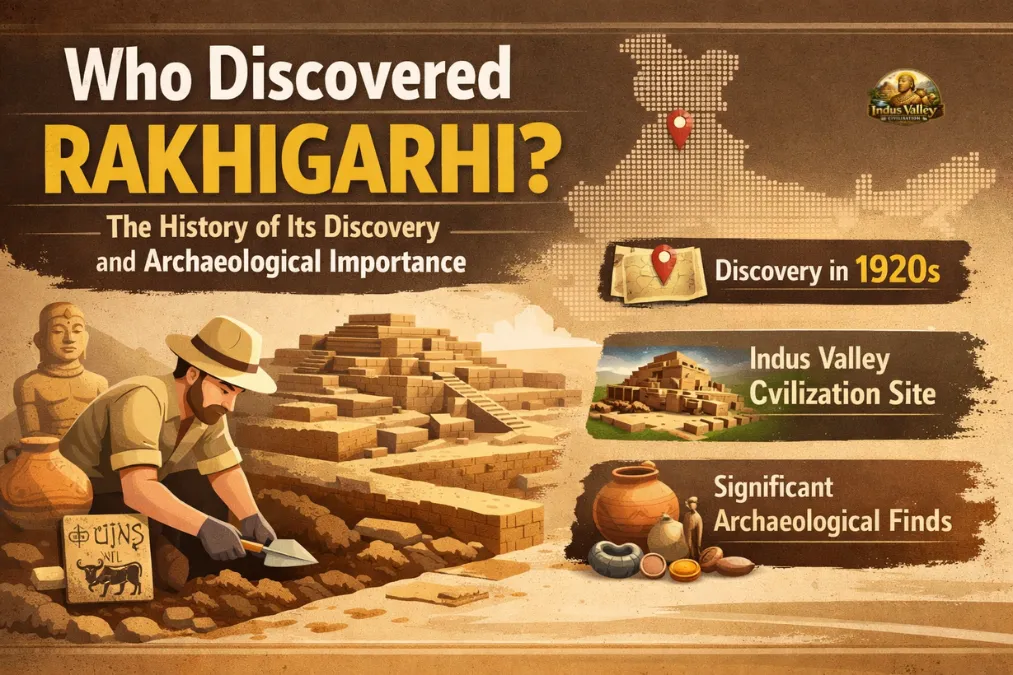
Who discovered Rakhigarhi is a question that often comes to mind when learning about the largest known site of the Indus Valley Civilization. Rakhigarhi is one of India’s most important archaeological discoveries, and its excavation has changed how historians understand ancient urban life in South Asia. Located in the Hisar district of Haryana, this ancient city offers valuable information about the Harappan civilization, its culture, town planning, economy, and people.
This article explains in simple and clear language who discovered Rakhigarhi, how it was found, who excavated it, and why the site is considered extremely important in world history.
Introduction to Rakhigarhi
Rakhigarhi is an ancient archaeological site belonging to the Indus Valley Civilization, also known as the Harappan Civilization. It dates back nearly 5,000 years, to around 2600 BCE. Today, it is recognized as the largest Harappan site ever discovered, even larger than Mohenjo-daro and Harappa.
The site lies near the dried-up Saraswati–Drishadvati river system, which played a major role in the development of early settlements in northwest India.
Understanding who discovered Rakhigarhi helps us trace the beginning of its archaeological journey and the efforts that brought this lost city back into history.
Who Discovered Rakhigarhi
The answer to who discovered Rakhigarhi leads us to the Archaeological Survey of India. Rakhigarhi was first discovered in 1963 by archaeologist Suraj Bhan, who worked under the Archaeological Survey of India.
During a village-level archaeological survey in Haryana, Suraj Bhan noticed ancient mounds near the modern village of Rakhigarhi. These mounds contained pottery fragments, bricks, and structural remains that clearly belonged to the Harappan period.
His discovery marked the first official identification of Rakhigarhi as an Indus Valley Civilization site.
Discovery of Rakhigarhi in 1963
In the early 1960s, the Archaeological Survey of India was conducting systematic surveys across Haryana and Punjab to locate ancient settlements. At that time, many believed that the Indus Valley Civilization was limited mainly to present-day Pakistan.
When Suraj Bhan surveyed the area around Rakhigarhi village in Hisar district, he found seven large mounds spread across a wide area. The size of these mounds immediately suggested that this was not a small settlement.
Initial surface findings included:
- Typical Harappan red pottery
- Mud bricks and baked bricks
- Terracotta objects
- Structural remains
These early signs confirmed that Rakhigarhi was a mature Harappan city.
Early Archaeological Work After Discovery
After the discovery, limited excavations were conducted in the late 1960s. However, due to lack of funds and focus on major sites like Harappa and Mohenjo-daro, Rakhigarhi did not receive immediate large-scale attention.
For several decades, the site remained partially explored, although scholars recognized its importance. Researchers understood that Rakhigarhi had the potential to reveal new information about Harappan settlements located within modern Indian borders.
Renewed Excavations at Rakhigarhi
Large-scale excavations resumed in the 1990s and continued in different phases during the 2000s and 2010s. These excavations were carried out by teams from the Archaeological Survey of India and Indian universities.
Under archaeologists such as Amarendra Nath and later Vasant Shinde, the site was systematically studied using modern scientific methods.
These excavations confirmed that Rakhigarhi was not only a Harappan city but possibly the largest urban center of the entire Indus Valley Civilization.
Why the Discovery of Rakhigarhi Is So Important
The discovery of Rakhigarhi transformed the understanding of ancient Indian history. Before this site was explored, most large Harappan cities were known mainly from Pakistan.
Rakhigarhi proved that:
- Major Harappan urban centers existed deep inside India
- The civilization was far more widespread than earlier believed
- Haryana was a core region of Harappan culture
The site covers more than 350 hectares, making it larger than Mohenjo-daro.
Layout and Size of Rakhigarhi
Rakhigarhi consists of multiple mounds labeled RGR 1 to RGR 7. These mounds include:
- Residential areas
- Industrial zones
- Storage facilities
- Drainage systems
- Public structures
The city was carefully planned with wide roads, standardized bricks, and an advanced drainage system, showing strong urban management.
Archaeological Findings at Rakhigarhi
Excavations after the discovery revealed a wide variety of artifacts that give insight into daily Harappan life.
Pottery and Tools
Large quantities of pottery were found, including:
- Painted red ware
- Storage jars
- Bowls and dishes
Tools made of copper, bronze, stone, and shell were also recovered.
Seals and Ornaments
Harappan seals with animal motifs and undeciphered script were discovered. Ornaments made of gold, semi-precious stones, shell, and terracotta show advanced craftsmanship.
Houses and Streets
Homes were built with standardized baked bricks. Many houses had:
- Bathrooms
- Covered drains
- Courtyards
This reflects a high level of hygiene and civic planning.
Burial Sites and Human Skeletons
One of the most significant discoveries at Rakhigarhi was a large cemetery area. Several well-preserved skeletons were found, providing rare biological evidence of Harappan people.
These burials included:
- Extended burials
- Pottery offerings
- Personal ornaments
The cemetery helped scientists understand Harappan burial customs and social beliefs.
DNA Study and Global Attention
Rakhigarhi gained international attention after ancient DNA samples were successfully extracted from human remains.
The DNA study revealed that:
- Harappans were indigenous to the region
- They had no direct genetic link to Steppe pastoralists
- Their ancestry contributed significantly to modern South Asian populations
This research reshaped debates on ancient migration and population history in the Indian subcontinent.
Economic Life of Rakhigarhi
Findings show that Rakhigarhi had a strong economy supported by:
- Agriculture
- Animal domestication
- Craft production
- Long-distance trade
Evidence of barley, wheat, pulses, and animal bones indicates a stable food system.
Trade links existed with:
- Gujarat
- Rajasthan
- Afghanistan
- Mesopotamia
Beads and seals found at the site support these connections.
Religious and Cultural Practices
Although no temples were found, figurines and symbols suggest religious beliefs related to:
- Nature worship
- Fertility symbols
- Animal reverence
Terracotta figurines resembling mother goddesses were commonly discovered.
Comparison With Other Harappan Sites
Rakhigarhi stands out among Harappan cities for several reasons.
- Larger in size than Harappa and Mohenjo-daro
- Located in the Saraswati river region
- Contains continuous occupation layers
- Provides strong Indian archaeological evidence
Its discovery shifted academic focus from western to eastern Harappan regions.
Preservation Challenges
Despite its importance, Rakhigarhi faces serious challenges.
- Modern village expansion
- Farming activities
- Weather erosion
- Limited funding
Some ancient mounds lie beneath modern houses, making excavation difficult.
Government Efforts and Site Development
The Indian government has taken steps to protect and develop Rakhigarhi as a heritage site.
These include:
- Land acquisition
- Site fencing
- Museum development
- Tourism infrastructure
Plans are underway to make Rakhigarhi a major center for heritage tourism and education.
Rakhigarhi Museum
A site museum near Rakhigarhi is being developed to display:
- Excavated artifacts
- Models of Harappan houses
- Educational panels
- Interactive exhibits
This museum aims to bring ancient history closer to the public.
Role of Rakhigarhi in Indian History
Rakhigarhi has become a symbol of India’s ancient urban heritage. Its discovery proved that advanced city life flourished in India thousands of years before modern times.
It highlights:
- Scientific town planning
- Social organization
- Environmental adaptation
- Peaceful urban living
The site shows that ancient Indians possessed remarkable engineering and administrative skills.
Importance for Students and Researchers
For students of history and archaeology, Rakhigarhi is extremely valuable because:
- It provides primary archaeological evidence
- It helps understand Harappan culture in India
- It supports interdisciplinary research
- It connects archaeology with genetics and climate studies
Many universities now include Rakhigarhi in their academic curriculum.
Read also: Where Is Rakhigarhi Located? Complete Guide to India’s Largest Harappan Site
Conclusion
Understanding who discovered Rakhigarhi allows us to appreciate the efforts behind one of the most important archaeological finds in Indian history. Discovered in 1963 by Suraj Bhan, Rakhigarhi has grown from an unnoticed group of mounds into a world-famous heritage site.
Its excavation has revealed a highly advanced civilization with planned cities, strong trade systems, skilled craftsmanship, and complex social life. Today, Rakhigarhi stands as a powerful reminder that India was home to one of the world’s earliest and greatest urban civilizations.
As research continues, Rakhigarhi will undoubtedly provide even more answers about our ancient past and deepen our understanding of human history.
FAQ
Who discovered Rakhigarhi?
Rakhigarhi was discovered in 1963 by archaeologist Suraj Bhan of the Archaeological Survey of India.
When was Rakhigarhi excavated?
Initial excavations began in the 1960s, with major excavation phases occurring from the 1990s onward.
Why is Rakhigarhi important?
It is the largest known Indus Valley Civilization site and provides crucial evidence about Harappan life in India.
Is Rakhigarhi older than Mohenjo-daro?
Some layers at Rakhigarhi may be equally old or slightly earlier, dating back to the early Harappan phase.