
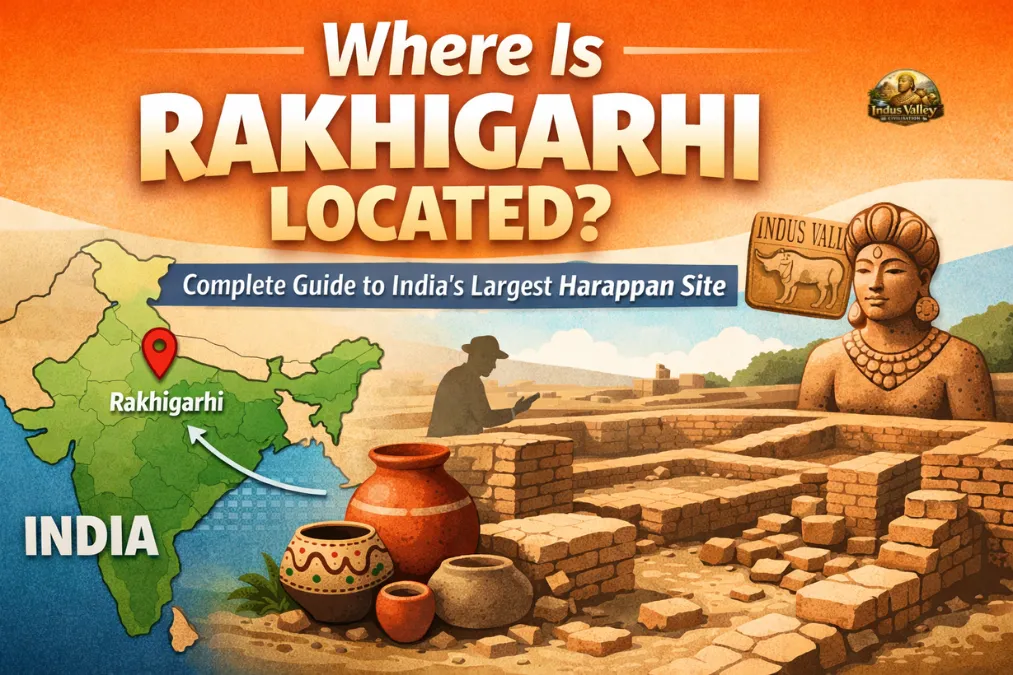
Where Is Rakhigarhi Located: Where is rakhigarhi is a common question asked by people who want to learn about the ancient Indus Valley Civilization and its most important archaeological sites. Rakhigarhi is a historic village located in the Hisar district of the Indian state of Haryana, and it is known as the largest Harappan site ever discovered in the Indian subcontinent.
This ancient site has changed the way historians understand early urban life in South Asia. Its size, age, and discoveries have made Rakhigarhi one of the most significant archaeological locations in India.
Where Is Rakhigarhi Located in India
Rakhigarhi is situated in northern India, within the Hisar district of Haryana. The site lies in the northwestern part of the state, close to the Ghaggar River basin, which is believed by many scholars to be associated with the ancient Saraswati River mentioned in early Indian texts.
Geographically, Rakhigarhi is positioned around 150 kilometers northwest of Delhi. It is about 45 kilometers from Hisar city, making it accessible by road from major cities of Haryana and neighboring states.
The village of Rakhigarhi falls under the Narnaund subdivision of Hisar district. The archaeological remains are spread across a wide area covering several mounds located in and around the modern village.
Where Is Rakhigarhi on the Map of Haryana
To understand where is rakhigarhi on the map, it helps to look at Haryana’s central-western region. Haryana is bordered by Punjab in the north, Rajasthan in the west and south, and Uttar Pradesh in the east.
Rakhigarhi lies between the ancient trade routes that once connected the Indus Valley region with the Gangetic plains. Its location made it ideal for agriculture, trade, and settlement during ancient times.
The site is surrounded by fertile alluvial plains, which supported large-scale farming thousands of years ago. This natural advantage explains why Rakhigarhi grew into such a massive urban center.
Historical Importance of Rakhigarhi
Rakhigarhi dates back to around 2600 BCE to 1900 BCE, placing it firmly within the Mature Harappan phase of the Indus Valley Civilization. Some findings even suggest earlier habitation during the pre-Harappan period.
What makes Rakhigarhi exceptional is its size. Archaeologists estimate that it covered more than 350 hectares, which is larger than well-known Harappan cities such as Mohenjo-daro and Harappa.
Because of this, when people ask where is rakhigarhi, historians often describe it as the heart of the Indus Valley Civilization in India.
Discovery and Excavation History
Rakhigarhi was first identified as an ancient site in 1963 by the Archaeological Survey of India. However, large-scale excavations began much later, mainly in the 1990s and again after 2011.
During these excavations, researchers uncovered residential areas, drainage systems, streets, industrial zones, and burial sites. These discoveries confirmed that Rakhigarhi was a fully planned urban city with advanced infrastructure.
The excavations also revealed that the city had multiple phases of occupation, showing long-term development and continuity.
Why Rakhigarhi’s Location Is So Important
The answer to where is rakhigarhi becomes even more meaningful when its strategic location is understood. The site lies near seasonal rivers and ancient water channels, which were crucial for agriculture and daily life.
Its position between the Indus region and the eastern plains allowed it to act as a cultural and commercial link. This helped spread Harappan culture across a wide geographical area.
The surrounding plains offered fertile soil, while nearby routes enabled trade with distant settlements.
Archaeological Features Found at Rakhigarhi
Rakhigarhi has provided a wealth of archaeological material that helps explain Harappan life in detail.
Urban Planning
The city followed a grid-based layout with straight roads and well-organized neighborhoods. Houses were built using standardized baked bricks, showing strong administrative control.
Drainage System
A sophisticated drainage system ran beneath the streets. Covered drains connected homes to main channels, proving that sanitation was a priority even 4,500 years ago.
Residential Structures
Large houses with courtyards suggest the presence of wealthy families, while smaller homes indicate social diversity within the city.
Industrial Areas
Evidence of bead-making, pottery production, and metalwork has been found. These workshops show that Rakhigarhi was a major manufacturing center.
Burial Sites
Cemeteries discovered at Rakhigarhi provide insight into Harappan burial practices, beliefs, and social customs.
Rakhigarhi and the Indus Valley Civilization
Understanding where is rakhigarhi helps historians see how widespread the Indus Valley Civilization actually was. Earlier, it was believed that major Harappan cities were mostly in present-day Pakistan.
Rakhigarhi proved that large and advanced cities also existed deep inside modern India. This discovery shifted the geographical understanding of the civilization eastward.
Today, Rakhigarhi is considered one of the five largest Harappan sites, along with Harappa, Mohenjo-daro, Dholavira, and Ganeriwala.
Scientific Discoveries at Rakhigarhi
One of the most important findings at Rakhigarhi came from ancient DNA studies. Scientists successfully extracted DNA from human remains found at the site.
The results showed a strong genetic connection between Harappans and present-day populations of South Asia. This discovery provided valuable information about human migration, ancestry, and continuity in the region.
Such scientific research has made Rakhigarhi internationally famous.
Where Is Rakhigarhi Compared to Other Harappan Sites
When comparing where is rakhigarhi with other Indus Valley sites, several differences stand out.
Mohenjo-daro lies in the lower Indus region near the Indus River. Harappa is located in Punjab, Pakistan. Dholavira is in the arid region of Gujarat’s Rann of Kutch.
Rakhigarhi, however, is located in the fertile plains of Haryana, showing that Harappan settlements adapted to various environments. Its size suggests it may have been a political or economic center of great importance.
How to Reach Rakhigarhi
Rakhigarhi is well connected by road and can be reached easily from major cities.
From Delhi, the distance is around 150 kilometers. The journey takes about four hours by car.
Hisar is the nearest major city with railway connectivity. From Hisar, Rakhigarhi can be reached by taxi or local transport.
The nearest airport is in Delhi, making air travel convenient for visitors coming from other states or countries.
Present Condition of the Site
Today, Rakhigarhi is protected by the Archaeological Survey of India. Excavation work continues in phases, and large areas remain unexcavated.
Some ancient mounds are still part of farmland, while others are preserved for research. Efforts are ongoing to develop the site into a heritage tourism destination.
The Haryana government has also proposed a site museum to display artifacts and explain the history of the region.
Cultural Significance of Rakhigarhi
Rakhigarhi is not just an archaeological site but a symbol of India’s deep-rooted civilization. It shows that urban planning, trade systems, and social organization existed in the region thousands of years before modern times.
The site highlights the scientific knowledge, craftsmanship, and peaceful lifestyle of the Harappan people.
For students, researchers, and history lovers, Rakhigarhi offers a direct connection to one of the world’s earliest civilizations.
Why People Search “Where Is Rakhigarhi”
Many people search where is rakhigarhi because it is frequently mentioned in textbooks, documentaries, and research studies related to ancient India.
Its recognition as the largest Harappan site in India has increased public curiosity. School curricula, competitive exams, and academic discussions often include questions about its location and importance.
As awareness grows, Rakhigarhi continues to attract attention from both national and international scholars.
Future Research and Tourism Potential
Large portions of Rakhigarhi are yet to be excavated. Archaeologists believe that many more discoveries lie buried beneath the soil.
Future research may reveal new information about Harappan governance, economy, and daily life. With proper conservation and tourism planning, Rakhigarhi has the potential to become one of India’s major heritage destinations.
Educational tourism could help people better understand India’s ancient past while supporting local development.
Read also: Rakhigarhi Museum: A Complete Guide to India’s Largest Harappan Heritage Center
Conclusion
Where is rakhigarhi is not just a question about geography but a gateway to understanding one of the greatest civilizations of the ancient world. Located in the Hisar district of Haryana, Rakhigarhi stands as the largest and one of the most important sites of the Indus Valley Civilization.
Its strategic location, advanced urban planning, scientific discoveries, and cultural importance make it a priceless heritage site. As research continues, Rakhigarhi will keep revealing new chapters of human history and strengthen India’s connection to its ancient roots.
For anyone interested in archaeology, history, or early human civilization, knowing where Rakhigarhi is marks the beginning of a fascinating journey into the past.