
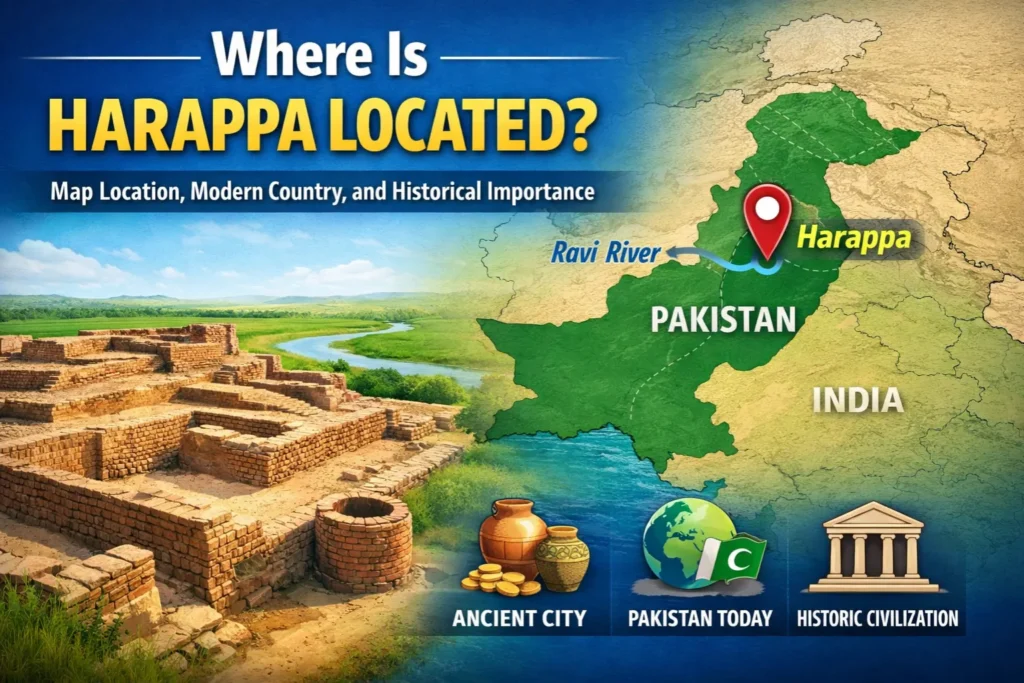
Where is Harappa located is one of the most common questions asked by students, history lovers, and researchers who want to understand the roots of the ancient Indus Valley Civilization. Harappa is located in present-day Pakistan, in the Punjab province, near the banks of the Ravi River. This ancient city is one of the earliest known urban centers in human history and played a major role in shaping early civilization in South Asia.
Harappa is not just an archaeological site; it represents a powerful civilization that existed more than 4,500 years ago. Its location helped it grow into a center of trade, culture, technology, and urban planning. Understanding where Harappa is located also helps us understand why the Indus Valley Civilization became so advanced for its time.
Where Is Harappa Located Geographically
Exact Location of Harappa
Harappa is located in the Sahiwal District of Punjab province in Pakistan. It lies approximately 35 kilometers southwest of the city of Sahiwal and about 200 kilometers south of Lahore. The archaeological site is close to the modern village of Harappa, from which it gets its name.
Geographically, Harappa is situated near the Ravi River, one of the five major rivers of the Punjab region. Although the river has changed its course over thousands of years, its presence was crucial for the settlement’s survival and growth.
Coordinates and Physical Setting
Harappa is located at approximately 30.63 degrees north latitude and 72.87 degrees east longitude. The land around Harappa is mostly flat and fertile, ideal for agriculture. This region experiences hot summers, mild winters, and seasonal rainfall, conditions that supported farming activities in ancient times.
The natural environment around Harappa provided clay for bricks, water for daily use, fertile soil for crops, and easy transportation routes through rivers and land paths.
Why the Location of Harappa Was Important
The answer to where is Harappa located becomes more meaningful when we understand why this location was chosen.
Access to Water Resources
The Ravi River was the lifeline of Harappa. Water was essential for drinking, farming, sanitation, and trade. The river also made it easier to transport goods and connect with other settlements.
Seasonal flooding enriched the soil, making agriculture productive. Crops such as wheat, barley, and peas were grown in large quantities, supporting a growing population.
Fertile Agricultural Land
Harappa was located in the fertile Indus plains. The alluvial soil deposited by rivers made the land highly suitable for farming. This allowed the city to produce surplus food, which supported artisans, traders, and administrators.
This agricultural advantage was one of the main reasons Harappa developed into a major urban center.
Strategic Trade Position
Harappa’s location connected it to important trade routes. It linked northern regions like Afghanistan with southern areas of the Indus Valley. Goods could move easily between settlements such as Mohenjo-daro, Dholavira, Lothal, and Kalibangan.
Because of this, Harappa became an important trade hub for metals, beads, pottery, cotton textiles, and semi-precious stones.
Historical Background of Harappa
Discovery of Harappa
Harappa was first discovered in 1921 by Indian archaeologist Daya Ram Sahni under the supervision of Sir John Marshall. At first, no one realized the importance of the ruins. Later excavations revealed that Harappa belonged to a civilization far older than previously imagined.
This discovery changed the understanding of ancient Indian history and pushed its timeline back by thousands of years.
Age of the Harappan Civilization
The Harappan Civilization, also known as the Indus Valley Civilization, flourished between approximately 2600 BCE and 1900 BCE. Harappa was one of its two main cities, along with Mohenjo-daro.
At its peak, the civilization covered a vast area of more than 1.2 million square kilometers, making it one of the largest ancient civilizations in the world.
Where Is Harappa Located in Relation to Other Sites
Connection with Mohenjo-daro
Mohenjo-daro is located about 600 kilometers southwest of Harappa, in Sindh province. Together, these two cities formed the core of the civilization.
While Mohenjo-daro is often more famous, Harappa was equally important and possibly even older.
Nearby Archaeological Sites
Harappa was part of a network of hundreds of settlements. Some important nearby sites include:
Kalibangan in Rajasthan
Rakhigarhi in Haryana
Ganeriwala in Pakistan
Dholavira in Gujarat
Lothal near the Arabian Sea
These sites show that the civilization was highly connected and shared common cultural features.
Urban Planning at Harappa
Well-Planned City Layout
One of the most impressive features of Harappa is its advanced city planning. The city was divided into different sectors, often called the citadel and the lower town.
Streets were laid out in a grid pattern, intersecting at right angles. This level of planning was rare in the ancient world.
Drainage and Sanitation System
Harappa had one of the world’s earliest and most efficient drainage systems. Every house was connected to covered drains made of baked bricks.
Wastewater flowed into large street drains, showing that cleanliness and public health were important concerns.
Standardized Bricks and Construction
Harappan buildings were constructed using uniform baked bricks in a fixed ratio. This standardization indicates strong central planning and skilled engineering knowledge.
Public buildings, warehouses, and residential houses were all built with remarkable precision.
Life of People Living in Harappa
Daily Life and Occupations
People in Harappa lived organized lives. Farmers grew crops, artisans made tools and ornaments, traders exchanged goods, and administrators managed the city.
Common occupations included pottery making, bead crafting, metalworking, weaving, and farming.
Clothing and Ornaments
Cotton was widely used for clothing, making Harappa one of the earliest centers of cotton production. People wore simple garments and decorated themselves with beads, bangles, necklaces, and earrings made from gold, silver, shell, and stones.
Food Habits
The people of Harappa ate wheat, barley, rice, lentils, fruits, and vegetables. They also domesticated animals such as cattle, buffalo, sheep, and goats.
Evidence suggests that fish and meat were also part of their diet.
Religious Beliefs and Culture
Worship Practices
Although no large temples have been found, archaeological evidence suggests that Harappans worshipped nature and fertility symbols.
Seals depict animals like bulls, elephants, and unicorn-like figures. Some scholars believe early forms of Shiva worship may have existed.
Art and Craftsmanship
Harappan art was simple but highly skilled. Seals with intricate carvings, terracotta figurines, toys, pottery, and jewelry show artistic excellence.
The famous Harappan seals were also used for trade and identification.
Decline of Harappa
Possible Reasons for Decline
By around 1900 BCE, Harappa began to decline. Several theories explain this fall:
Climate change and reduced rainfall
Drying or shifting of rivers
Floods and environmental damage
Decline in trade
Gradual migration of people
There is no strong evidence of invasion or warfare.
Abandonment of the City
Over time, people slowly left Harappa and moved toward smaller rural settlements. Urban life disappeared, but many cultural traditions continued in later Indian civilizations.
Present Condition of Harappa
Archaeological Excavations Today
Today, Harappa is a protected archaeological site under the Department of Archaeology and Museums of Pakistan. Several excavations have been carried out over the last century.
Museums near the site display tools, seals, pottery, and skeletons discovered during excavations.
Importance for Modern Research
Harappa remains one of the most important sources for understanding early urban life. Archaeologists continue to study the site to learn about ancient technology, trade systems, and social organization.
Educational and Global Significance
Why Harappa Matters Today
Understanding where is Harappa located helps students connect geography with history. Harappa proves that advanced cities existed long before Greece and Rome.
It shows that South Asia was home to one of the world’s earliest civilizations.
Harappa in World History
Harappa stands alongside ancient Egypt and Mesopotamia as one of the three great early civilizations of the world.
Its contributions to urban planning, sanitation, trade, and craftsmanship continue to impress modern scholars.
Read also: What Is Harappa: Complete Guide to the Ancient Indus Valley Civilization
Conclusion
Where is Harappa located is more than a simple geographic question. Harappa is located in present-day Punjab province of Pakistan, near the Ravi River, in a region that once supported one of the world’s greatest ancient civilizations.
Its fertile land, river access, and strategic position made it an ideal place for urban development. Harappa’s advanced planning, skilled craftsmanship, and organized society prove that human civilization reached remarkable heights over 4,500 years ago.
Even today, Harappa remains a powerful symbol of human innovation, cooperation, and cultural achievement. Learning about its location helps us understand not only where Harappa stood on the map, but also its lasting place in world history.