
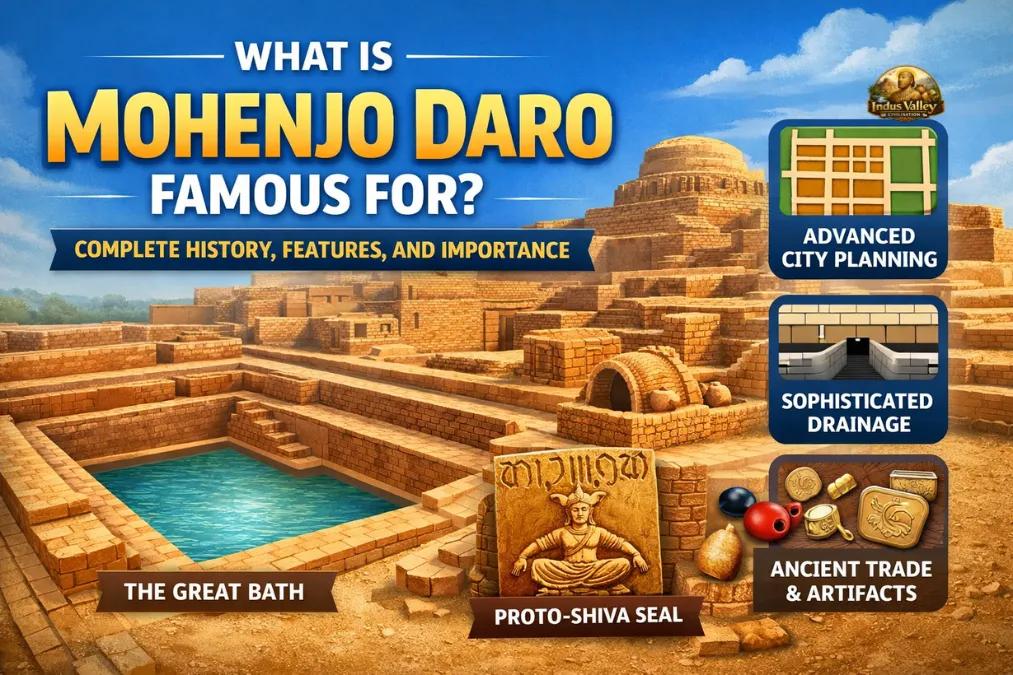
What is Mohenjo Daro famous for is a question that helps us understand one of the greatest ancient civilizations in human history. Mohenjo Daro is famous for its advanced city planning, well-designed drainage system, strong brick architecture, and its role as a major center of the Indus Valley Civilization.
Mohenjo Daro is one of the oldest planned cities in the world. It shows how people lived more than 4,500 years ago with remarkable intelligence, organization, and engineering skills. Even today, historians and archaeologists are amazed by the city’s structure and technology.
Introduction to Mohenjo Daro
Mohenjo Daro is an ancient archaeological site located in present-day Sindh province of Pakistan. The name Mohenjo Daro means “Mound of the Dead.” It was built around 2500 BCE and flourished during the height of the Indus Valley Civilization.
This city was one of the largest settlements of its time. Along with Harappa, it formed the heart of a civilization that extended across modern-day Pakistan and northwest India.
Understanding what is Mohenjo Daro famous for helps us learn how advanced ancient societies were long before modern technology existed.
What Is Mohenjo Daro Famous For in World History
One of the World’s Earliest Planned Cities
Mohenjo Daro is famous for being one of the earliest examples of proper urban planning in world history. The city was built using a grid system, where streets crossed each other at right angles.
The city was divided into two main parts: the Citadel and the Lower Town. This organized layout proves that the city was carefully planned before construction began.
Advanced Drainage System
One of the strongest answers to what is Mohenjo Daro famous for is its highly developed drainage system. Almost every house had access to covered drains made of baked bricks.
Wastewater from homes flowed into main drains along the streets. These drains had inspection holes for cleaning, showing that public hygiene was a major concern for the people.
Even many modern cities struggle to match such advanced sanitation planning.
Strong Brick Architecture
Mohenjo Daro is famous for its standardized baked bricks. All buildings were constructed using bricks of uniform size, showing strict quality control.
Unlike many ancient civilizations that used mud bricks, the Indus people used baked bricks that were strong and durable. This is one reason why the ruins have survived for thousands of years.
The Great Bath
The Great Bath is the most iconic structure found at Mohenjo Daro. It is one of the main reasons people ask what is Mohenjo Daro famous for.
The Great Bath is a large rectangular water tank built with waterproof bricks. It had steps on both sides and a complex drainage system to empty and refill the tank.
Historians believe it was used for ritual bathing, religious ceremonies, or social gatherings.
Highly Organized Residential Areas
Homes in Mohenjo Daro were well designed and varied in size. Some houses had multiple rooms, courtyards, private wells, and bathrooms.
The presence of bathrooms inside houses shows how important cleanliness was in daily life. Many homes were two stories high, built with staircases and strong walls.
Economic and Trade Importance of Mohenjo Daro
Center of Trade and Commerce
Another key answer to what is Mohenjo Daro famous for is its strong trade network. The city was a major trading hub of the Indus Valley Civilization.
Archaeologists have found seals, beads, ornaments, and weights that prove trade with regions such as Mesopotamia, Persia, and Central Asia.
Standard Weights and Measures
Mohenjo Daro used standardized stone weights, which indicates a regulated economic system. These weights followed precise ratios, helping ensure fair trade.
Such accuracy shows that the city had organized administration and economic planning.
Skilled Crafts and Industries
The people of Mohenjo Daro were skilled craftsmen. They produced pottery, jewelry, beads, shell ornaments, and metal tools.
Beads made from carnelian and lapis lazuli were especially famous and exported to distant lands.
Social Life and Daily Living
Advanced Water Management
Mohenjo Daro is famous for having hundreds of wells, more than any other Indus Valley site. Many houses had private wells, while others used public ones.
This ensured clean drinking water for the entire population.
Peaceful Urban Society
One interesting aspect of what is Mohenjo Daro famous for is the absence of large weapons or military structures. This suggests that the society was largely peaceful.
There is little evidence of wars, palaces, or royal tombs, unlike other ancient civilizations.
Equal City Planning
The uniform design of houses indicates social equality. There were no massive palaces or extreme differences between living spaces.
This shows that wealth was distributed more evenly among the people.
Religious and Cultural Significance
Seals and Symbols
Thousands of seals have been discovered at Mohenjo Daro. These seals include animal figures, symbols, and short inscriptions written in the Indus script.
The script has not yet been fully deciphered, making it one of the greatest mysteries of ancient history.
Proto-Shiva Figure
One famous seal shows a horned figure seated in a yogic posture, often called the Proto-Shiva or Pashupati seal.
This has led historians to believe that early forms of Hindu beliefs may have existed during this time.
Importance of Ritual Cleanliness
The Great Bath strongly suggests that ritual purity and cleanliness played an important role in religious life.
Water seems to have held spiritual significance, much like in later Indian traditions.
Scientific and Engineering Achievements
Knowledge of Geometry and Measurement
The city layout shows strong knowledge of geometry. Streets, buildings, and drainage lines were constructed with mathematical precision.
This proves that the Indus people had advanced engineering skills.
Earthquake-Resistant Construction
Many buildings were constructed with thick walls and strong foundations, possibly to protect against floods and earthquakes common in the region.
This is another reason why Mohenjo Daro’s ruins have lasted so long.
Discovery and Excavation of Mohenjo Daro
Discovery in the 20th Century
Mohenjo Daro was discovered in 1922 by archaeologist R. D. Banerji during excavations conducted by the Archaeological Survey of India.
The discovery completely changed the understanding of ancient Indian history.
Before this, it was believed that Indian civilization began around 1500 BCE. Mohenjo Daro pushed the timeline back by nearly a thousand years.
Major Excavations
Large-scale excavations were carried out in the 1920s and 1930s. These revealed streets, houses, public buildings, and artifacts.
Today, only a part of the city has been excavated, as further digging may damage the fragile remains.
Decline of Mohenjo Daro
Possible Reasons for Decline
Historians still debate the exact cause of the city’s decline. Some possible reasons include climate change, river flooding, earthquakes, and environmental degradation.
There is no clear evidence of invasion or warfare.
Gradual Abandonment
The city appears to have been slowly abandoned around 1900 BCE. People likely migrated to other regions as environmental conditions worsened.
Why Mohenjo Daro Is Still Famous Today
UNESCO World Heritage Site
Mohenjo Daro was declared a UNESCO World Heritage Site in 1980. It is protected as one of the most important archaeological sites in the world.
Symbol of Ancient Intelligence
When people ask what is Mohenjo Daro famous for, the strongest answer is human intelligence and planning.
The city proves that advanced urban life existed thousands of years ago without modern machines.
Influence on Modern Urban Planning
Many features of Mohenjo Daro, such as drainage systems, zoning, and water supply, are still used in modern city planning.
Urban planners continue to study the site for inspiration.
Educational and Cultural Importance
A Window into the Indus Valley Civilization
Mohenjo Daro provides valuable information about the lifestyle, beliefs, economy, and governance of the Indus Valley Civilization.
It helps students and researchers understand early human development.
National Heritage
For South Asia, Mohenjo Daro is a source of pride and cultural identity. It represents one of the earliest chapters of civilization in the region.
Read also: What Is Mohenjo Daro: Complete History, Discovery, Civilization, and Importance
Conclusion
What is Mohenjo Daro famous for goes far beyond ancient ruins and broken bricks. It is famous for its advanced city planning, remarkable drainage system, strong architecture, organized society, trade networks, and peaceful way of life.
Mohenjo Daro stands as powerful evidence that human civilization achieved extraordinary progress more than 4,500 years ago. Its streets, wells, and buildings continue to speak silently about a society that valued cleanliness, order, equality, and innovation.
Even today, Mohenjo Daro remains one of the greatest archaeological wonders of the world and a timeless symbol of human achievement.