
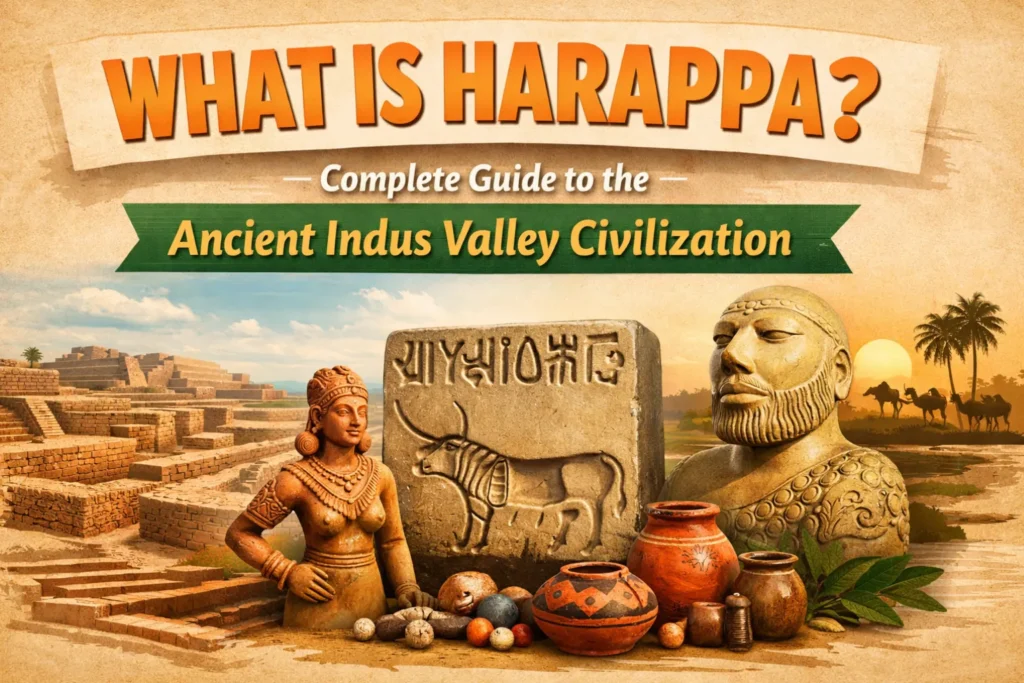
What is Harappa is a common question asked by students, history lovers, and people curious about ancient civilizations. Harappa was one of the most important cities of the Indus Valley Civilization, which existed more than 4,500 years ago in the northwestern part of the Indian subcontinent. This ancient city played a major role in shaping early urban life and is considered one of the world’s earliest advanced civilizations.
Harappa is not just a historical site but a symbol of human intelligence, planning, and social organization in ancient times. Its discoveries have helped historians understand how people lived, traded, and governed thousands of years ago.
What Is Harappa and Why Is It Important
What is Harappa can be explained as an ancient city that belonged to the Indus Valley Civilization, also known as the Harappan Civilization. The city was located near the Ravi River in present-day Punjab, Pakistan.
Harappa is important because it shows that people in ancient times had advanced knowledge of town planning, drainage systems, architecture, and trade. When Harappa was discovered, it changed the way historians understood early human development.
Before its discovery, many believed that advanced civilizations began only in Egypt and Mesopotamia. Harappa proved that South Asia also had a highly developed urban culture during the Bronze Age.
Discovery of Harappa
The ruins of Harappa were first noticed in the 19th century, but serious excavation began in the 1920s. Archaeologists like Daya Ram Sahni and Sir John Marshall played a key role in uncovering the site.
During British railway construction, many ancient bricks from Harappa were unknowingly used for tracks. Later, when experts examined the area, they realized the ruins belonged to a very old civilization.
The discovery of Harappa, along with Mohenjo-daro, revealed a completely unknown chapter of human history.
Location of Harappa
Harappa is located in present-day Pakistan, in the Punjab province. It lies close to the Ravi River, which was one of the major water sources for the civilization.
The location was ideal for settlement because it provided fertile land, water for agriculture, and access to trade routes. Rivers played a crucial role in the growth of Harappa, just as they did in other ancient civilizations around the world.
Time Period of Harappa Civilization
The Harappan Civilization developed around 2600 BCE and declined around 1900 BCE. This period is known as the Bronze Age because people used tools made from bronze.
Historians divide the civilization into three main phases:
Early Harappan Phase from 3300 BCE to 2600 BCE
Mature Harappan Phase from 2600 BCE to 1900 BCE
Late Harappan Phase from 1900 BCE to 1300 BCE
The city of Harappa flourished mainly during the Mature Harappan Phase when urban life reached its peak.
City Planning and Architecture
One of the most impressive features that helps explain what is Harappa is its advanced city planning.
The city was built using baked bricks of uniform size. Streets were laid out in a perfect grid pattern, running north to south and east to west. This level of planning shows strong administrative control.
Harappa was divided into two main areas:
The Citadel, which was built on a raised platform and used for administrative and public buildings
The Lower Town, where common people lived
Houses had multiple rooms, courtyards, and private wells. Many homes had bathrooms connected to covered drains, which was extremely advanced for that time.
Drainage System of Harappa
The drainage system of Harappa is one of its greatest achievements. Almost every house was connected to an underground drainage channel.
These drains were made with carefully fitted bricks and covered with stone slabs. Wastewater flowed out of the city efficiently, keeping the streets clean.
Even today, modern cities struggle with sanitation, which makes Harappa’s system even more remarkable.
Daily Life of Harappan People
Understanding what is Harappa also means understanding how its people lived.
Harappans lived a well-organized life. They wore cotton clothes, which is one of the earliest examples of cotton use in the world. Both men and women used ornaments made of gold, silver, beads, and semi-precious stones.
People lived in peaceful communities, and there is little evidence of war or violence. This suggests that society was stable and well governed.
Food and Agriculture
Agriculture was the main occupation of Harappan people. They grew crops such as wheat, barley, rice, peas, and sesame.
The fertile soil near rivers helped produce good harvests. Farmers used simple tools made of copper and bronze.
They also domesticated animals like cattle, buffalo, sheep, goats, and dogs. Food security played a major role in the growth of large cities like Harappa.
Trade and Economy
Trade was one of the strongest pillars of the Harappan economy.
Harappa traded with nearby cities such as Mohenjo-daro, Dholavira, and Lothal. Evidence also shows trade connections with Mesopotamia, modern-day Iraq.
Harappans exported beads, pottery, jewelry, cotton cloth, and metal goods. In return, they imported raw materials like copper, tin, and precious stones.
Standardized weights and measures were used, proving that trade was well regulated.
Harappan Seals
Seals are one of the most famous discoveries from Harappa.
These seals were usually made of steatite and engraved with animal figures such as bulls, elephants, unicorns, and rhinoceroses. Above the animals, symbols were carved in the Harappan script.
The seals were likely used for trade, identification, and administrative purposes. They also provide valuable information about Harappan culture.
Harappan Script
One of the biggest mysteries related to what is Harappa is its script.
The Harappan script consists of short symbols found on seals, pottery, and tablets. Despite many attempts, the script has not yet been fully deciphered.
Because of this, much about Harappan political and religious life remains unknown. However, the presence of writing shows that the civilization was highly advanced.
Religion and Beliefs
There is no clear evidence of temples or large religious structures in Harappa, but several clues suggest spiritual beliefs.
Archaeologists found figurines believed to represent mother goddesses, indicating fertility worship. Seals depicting a figure similar to Lord Shiva in a yogic posture suggest early forms of Hindu beliefs.
Animals, trees, and nature were possibly worshipped. Religion appears to have been simple and closely connected to daily life.
Art and Craftsmanship
Harappan people were skilled artisans.
They produced beautiful pottery with red and black designs, terracotta figurines, stone sculptures, and metal tools. Bead-making was especially advanced, with beads made from carnelian, agate, and lapis lazuli.
These crafts were not only used locally but also traded with distant regions.
Social Structure
The social structure of Harappa seems to have been equal and organized.
There is no clear evidence of kings, palaces, or large monuments dedicated to rulers. This suggests that society may have been governed by a group of administrators rather than a single monarch.
The uniformity of houses and city planning indicates minimal social inequality compared to other ancient civilizations.
Science and Technology
Harappans had impressive scientific knowledge.
They understood geometry and measurement, which helped in town planning. Their bricks followed a standard ratio, showing mathematical accuracy.
They also had knowledge of metallurgy, using copper, bronze, gold, and silver effectively.
The use of dockyards, wells, and water management systems reflects strong engineering skills.
Decline of Harappa Civilization
Around 1900 BCE, the Harappan Civilization began to decline.
Historians suggest several possible reasons:
Climate change and reduced rainfall
Drying or shifting of rivers
Floods and earthquakes
Decline in trade
Overuse of natural resources
There is no strong evidence of invasion or war. The decline appears to have been gradual rather than sudden.
Life After the Decline
After the decline of Harappa, people slowly moved to smaller villages. Urban life reduced, but many cultural practices continued.
Elements such as pottery styles, farming methods, and religious traditions influenced later Indian civilizations.
Harappa did not disappear completely; its legacy lived on through cultural continuity.
What Is Harappa in Modern Education
Today, what is Harappa is an important topic in school and university history textbooks.
It helps students understand early urban development, human innovation, and the roots of South Asian culture. Harappa also teaches valuable lessons about environmental balance and sustainable living.
Archaeological studies continue to reveal new information about the civilization.
Difference Between Harappa and Mohenjo-daro
Although both cities belonged to the same civilization, they had some differences.
Harappa was larger in area and had more granaries, suggesting it was a major storage and administrative center. Mohenjo-daro had more public baths and advanced civic buildings.
Together, both cities provide a complete picture of Indus Valley life.
Legacy of Harappa
The legacy of Harappa is immense.
It represents one of the earliest examples of planned cities, public sanitation, and organized society. Many modern urban concepts have roots similar to Harappan ideas.
The civilization proves that ancient humans were intelligent, innovative, and capable of creating sustainable communities.
Read also: What Is Mohenjo Daro: Complete History, Discovery, Civilization, and Importance
Conclusion
What is Harappa is not just a question about an ancient city but a journey into one of the greatest civilizations in human history. Harappa stands as a powerful reminder that advanced urban life existed thousands of years ago with remarkable planning, cleanliness, and social harmony.
Through its cities, art, trade systems, and engineering achievements, Harappa continues to inspire historians and learners worldwide. Even after thousands of years, its discoveries still shape our understanding of civilization and human progress.