
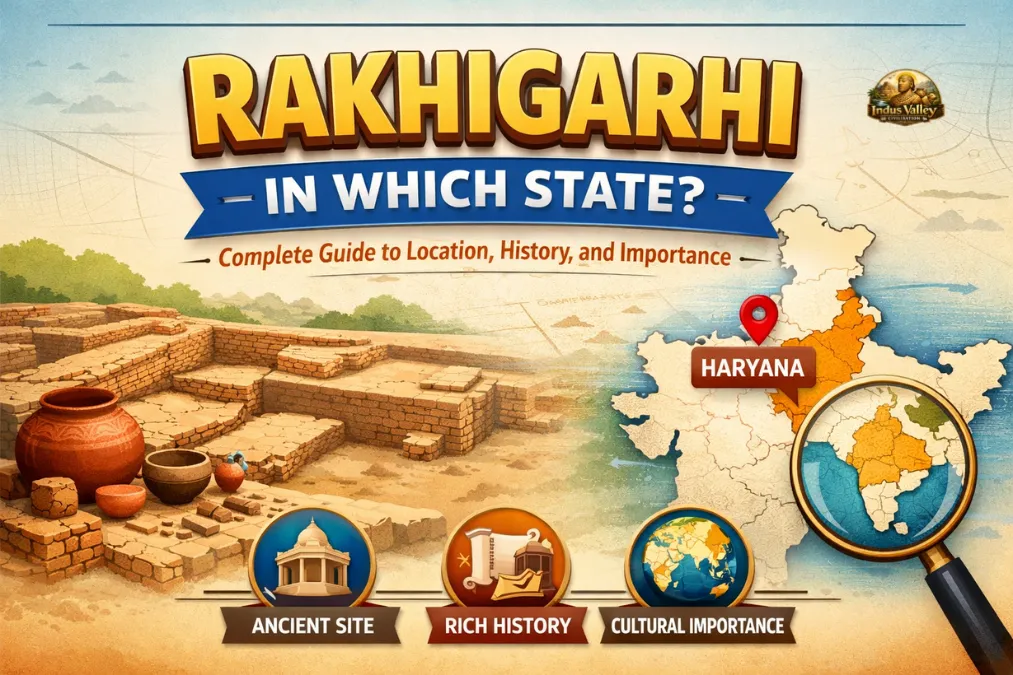
Rakhigarhi in which state is one of the most commonly asked questions by people interested in ancient Indian history and the Indus Valley Civilization. Rakhigarhi is located in the Indian state of Haryana and is considered one of the largest and most important archaeological sites of the Harappan Civilization.
This ancient site has changed our understanding of early urban life in the Indian subcontinent. From its geographical location to its cultural significance, Rakhigarhi offers deep insights into how one of the world’s oldest civilizations lived, developed, and flourished thousands of years ago.
Rakhigarhi in Which State and Where Is It Located
Rakhigarhi in which state can be answered clearly and simply. Rakhigarhi is situated in Haryana, a northern state of India.
The site lies in Hisar district of Haryana, around 150 kilometers northwest of Delhi. It is located near the modern village of Rakhigarhi, close to the Ghaggar River basin, which is often associated with the ancient Saraswati River mentioned in early Indian texts.
Because of this strategic location, Rakhigarhi became a major center of trade, agriculture, and urban development during the Indus Valley Civilization period.
Why Rakhigarhi in Haryana Is So Important
Understanding rakhigarhi in which state helps explain why the site holds such importance. Haryana’s fertile plains and river systems made it an ideal region for early human settlement.
Rakhigarhi is believed to date back to around 2600 BCE to 1900 BCE, the mature phase of the Harappan Civilization. Archaeologists now consider it even larger than Mohenjo-daro, which was earlier thought to be the biggest Harappan city.
Its discovery in Haryana proved that the Indus Valley Civilization was not limited to present-day Pakistan but was widely spread across northwestern India as well.
Discovery of Rakhigarhi
Rakhigarhi was first identified in 1963 by the Archaeological Survey of India. However, large-scale excavations began much later, mainly in the 1990s and after 2011.
As research progressed, archaeologists realized that Rakhigarhi in Haryana covered nearly 350 hectares, making it one of the largest known Harappan settlements.
The discovery completely changed historical understanding and highlighted Haryana as a major heartland of the Indus Valley Civilization.
Rakhigarhi in Which State and Its Connection With the Harappan Civilization
When people ask rakhigarhi in which state, they often want to understand its cultural connection. Being located in Haryana places Rakhigarhi firmly within the Indian subcontinent’s ancient civilization network.
Rakhigarhi was not an isolated town. It was connected to other Harappan cities such as:
Harappa
Mohenjo-daro
Kalibangan
Banawali
Dholavira
Lothal
These cities shared similar town planning, drainage systems, brick sizes, and social organization, showing a highly advanced civilization.
Town Planning at Rakhigarhi
The city planning at Rakhigarhi reflects remarkable urban intelligence.
The city was divided into sectors, often referred to as mounds. Each mound served a specific purpose such as residential areas, industrial zones, and administrative spaces.
Wide roads intersected at right angles, and houses were built using standardized baked bricks. This planned layout confirms that Rakhigarhi in Haryana was part of a centrally organized civilization.
Drainage System and Water Management
One of the strongest proofs of advanced engineering is the drainage system found at Rakhigarhi.
Covered drains ran alongside streets and were connected to individual houses. Wastewater flowed through well-designed channels, showing excellent knowledge of sanitation.
Such systems were far ahead of their time and indicate a strong civic administration.
Houses and Daily Life
Excavations reveal that houses in Rakhigarhi varied in size, suggesting social diversity. Some were small single-room houses, while others were large multi-room structures with courtyards.
Most homes had:
Bathrooms
Wells
Storage areas
Brick floors
These features show that people enjoyed a well-organized urban lifestyle.
Artifacts Found at Rakhigarhi
Many valuable artifacts have been discovered at the site, helping historians understand daily life.
Important findings include:
Pottery with geometric designs
Terracotta toys
Beads made of semi-precious stones
Shell ornaments
Copper tools
Seals with animal motifs
These objects indicate that Rakhigarhi in Haryana was a center of craftsmanship and trade.
Evidence of Trade and Economy
Trade played a major role in the prosperity of Rakhigarhi.
Beads and seals found at the site match materials discovered in distant regions such as Gujarat, Rajasthan, Mesopotamia, and Afghanistan.
This proves that the people of Rakhigarhi were engaged in long-distance trade using both land and river routes.
Agriculture was another economic backbone. Evidence suggests cultivation of wheat, barley, pulses, and possibly rice.
Burial Practices at Rakhigarhi
Burial sites provide important clues about beliefs and social customs.
At Rakhigarhi, archaeologists found:
Extended burials
Pot burials
Grave goods such as pottery and ornaments
These practices suggest belief in life after death and a structured social system.
DNA Evidence and Human Origins
One of the most remarkable discoveries at Rakhigarhi came from ancient DNA studies.
Scientists successfully extracted DNA from human remains found at the site. The results showed that the Harappan people were largely indigenous to the region, with deep roots in South Asia.
This discovery made Rakhigarhi in Haryana internationally significant, as it provided scientific evidence about the origins of Indian civilization.
Rakhigarhi Compared to Other Harappan Sites
When comparing major sites, Rakhigarhi stands out for its size and complexity.
Mohenjo-daro is famous for its Great Bath
Harappa for its granaries
Dholavira for water conservation
Lothal for its dockyard
Rakhigarhi, however, is unique because of its vast area, advanced planning, and continuous occupation over several centuries.
Rakhigarhi in Which State and the Role of the Ghaggar River
The question rakhigarhi in which state is closely connected to river geography.
The Ghaggar River flows near the site and is believed by many scholars to be the ancient Saraswati River. This river system supported agriculture and transportation, helping large cities like Rakhigarhi thrive.
As climate change and river drying occurred, many Harappan cities gradually declined.
Decline of Rakhigarhi
Like other Harappan settlements, Rakhigarhi experienced gradual decline around 1900 BCE.
Possible reasons include:
Climate change
Decrease in monsoon rainfall
Drying of river systems
Shifts in trade routes
Environmental degradation
There is no strong evidence of invasion or war, supporting the theory of environmental causes.
Archaeological Excavations in Modern Times
Major excavations were conducted by the Archaeological Survey of India along with universities and research institutions.
New findings continue to emerge, including residential zones, workshops, and food storage areas.
The Haryana government has also taken steps to preserve the site and promote it as a heritage tourism destination.
Rakhigarhi Museum and Tourism
To educate visitors, a site museum has been planned near Rakhigarhi village.
Tourists can explore:
Ancient mounds
Excavation areas
Information boards
Local exhibits
Rakhigarhi in Haryana is gradually becoming an important destination for students, historians, and travelers interested in ancient India.
Educational Importance of Rakhigarhi
Rakhigarhi is now included in school and university history syllabi across India.
It helps students understand:
Urban development in ancient times
Scientific town planning
Early trade systems
Cultural unity of the Harappan world
Its location in Haryana makes it easily accessible for academic research.
Rakhigarhi in Which State and Its National Importance
Answering rakhigarhi in which state also highlights national heritage.
Being located in Haryana emphasizes that India was home to one of the world’s earliest urban civilizations. The site strengthens India’s cultural identity and showcases the country’s ancient scientific knowledge.
Rakhigarhi is not just a regional monument but a symbol of India’s deep historical roots.
Interesting Facts About Rakhigarhi
Rakhigarhi is larger than Mohenjo-daro in area
It covers seven major mounds
The site dates back more than 4,500 years
DNA evidence was first successfully extracted here
It confirms indigenous development of civilization
These facts make Rakhigarhi one of the most fascinating archaeological discoveries in India.
Future Research and Preservation
Many parts of Rakhigarhi are still unexplored. Archaeologists believe that further excavations may reveal new structures, inscriptions, and scientific data.
Preserving the site is essential for future generations. Controlled tourism, awareness programs, and government support are crucial for protecting this priceless heritage.
Read also: Rakhigarhi: Complete History, Discovery, Civilization, and Archaeological Importance
Conclusion
Rakhigarhi in which state is a simple question with a powerful answer. Rakhigarhi is located in Haryana, India, and stands as one of the most important archaeological sites of the Indus Valley Civilization.
Its massive size, advanced urban planning, rich artifacts, and groundbreaking DNA discoveries have reshaped our understanding of ancient Indian history. Rakhigarhi proves that the roots of civilization in India are deep, scientific, and remarkably advanced.
As research continues, Rakhigarhi in Haryana will remain a key gateway to understanding how one of the world’s earliest civilizations lived, prospered, and influenced human history for thousands of years.