
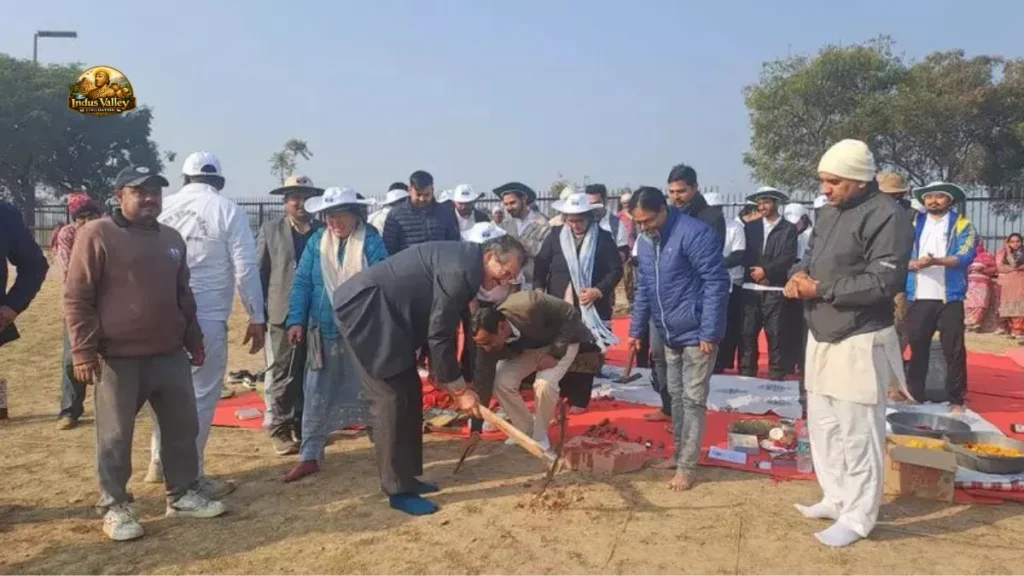
The Rakhigarhi Harappan site, one of the largest and most significant centers of the Indus Valley Civilization, is poised to reveal yet another layer of ancient history. On Thursday, the Archaeological Survey of India (ASI) officially launched the fourth phase of excavations at this historic site, promising insights into urban planning, settlement patterns, and the intricate relationships between its seven mounds.
Dr. Y.S. Rawat, Director-General of the ASI, led the ceremonial commencement at Mound Number One, performing traditional rituals and placing symbolic marks on the excavation tools before personally initiating the dig. Unlike previous excavations, this new phase is planned to last three years and will focus primarily on the lower levels of the mounds, an approach expected to shed light on the foundational layout of the city.
Unlocking the City Beneath the Soil
The Rakhigarhi Harappan site, located in Haryana, India, is a key settlement of the Harappan civilization, which thrived around 4,500 years ago. Despite its historical prominence, much of the site’s structural and cultural evolution remains buried under layers of earth. The fourth excavation phase is particularly significant because archaeologists will examine the lower surfaces of the mounds, an area previously unexplored in depth.
This approach aims to answer critical questions about the city’s development. Were the seven mounds interconnected from the start, or did they evolve separately? Did floods or other natural events fragment the city over time, creating distinct mounds, or were these separations intentional, with specific mounds serving residential, commercial, artisanal, or administrative purposes? Understanding the sequence of construction will illuminate how one of the world’s earliest urban centers grew and organized itself.
Dr. Rawat emphasized, “The lower layers of these mounds hold the key to understanding how the city’s seven sections were interlinked. By studying these foundational layers, we can trace the chronological development of Rakhigarhi and gain insights into its urban planning strategies.”
Historical Importance of Rakhigarhi
Rakhigarhi is not just another Harappan site; it is among the largest known urban centers of the civilization, even larger than Mohenjo-daro and Harappa in some estimates. Its sprawling area and multi-layered mounds indicate a complex societal structure, with distinct zones for living, craftsmanship, trade, and public administration. Discoveries here have the potential to reshape our understanding of early urbanism, social hierarchy, and the spread of civilization in South Asia.
The findings from this excavation are expected to have significance not only for Indian history but also for the broader study of ancient civilizations worldwide. Artifacts, architectural remnants, and environmental data could provide clues about trade, resource management, and daily life during the Harappan period.
Experts on the Ground
Several prominent archaeologists are involved in this latest phase of excavation. From the ASI Chandigarh Circle, experts including Dr. Kubui, Dr. Manoj Saxena, Rakesh Sinha, Sonu Nagar, Bhupinder Phonia, Dr. Appu Saharan, Dinesh Shyoran, and Vineet Bhanwala are supervising the work. Their combined expertise spans urban archaeology, artifact conservation, and ancient civil engineering.
Before initiating the fourth phase, Dr. Rawat also visited the Rakhigarhi Knowledge Center, appreciating the preservation of artifacts and exhibitions documenting previous excavations. This facility not only houses objects recovered from the site but also serves as an educational resource for researchers, students, and visitors eager to understand Harappan civilization.
A Timeline of Excavations at Rakhigarhi
The Rakhigarhi site has been the focus of archaeological attention for over two decades, and each excavation phase has contributed uniquely to our understanding of the city’s history.
- First Excavation (1998–2000): Excavation began at Mound Number Three under the leadership of Dr. Amarendra Nath, then Director of ASI. This initial phase uncovered structural remains, pottery, and tools that provided the first tangible evidence of Rakhigarhi’s significance.
- Second Excavation (2011–2016): Mound Number One was the focus, with Professor Vasant Shinde at the helm. This phase revealed intricate street layouts, residential areas, and workshops, offering a glimpse into the organization and sophistication of Harappan urban life.
- Third Excavation (2023–2025): Led by Dr. Sanjay Manjul, work concentrated on Mound Number Seven. Excavators discovered layers suggesting periodic flooding, changes in settlement patterns, and evidence of community planning and craft specialization. This phase ended in May 2025.
- Fourth Excavation (2026–2029): The current phase focuses on uncovering the lower levels of the mounds, with the aim of understanding their interconnections and the chronological sequence of urban development.
The Significance of Excavating Lower Levels
One of the standout features of this fourth phase is the focus on the mounds’ lower layers. Traditionally, excavations at Harappan sites have concentrated on the more visible upper layers. By exploring beneath, archaeologists hope to reconstruct the earliest stages of the city’s development.
The analysis of these lower levels can provide answers to questions such as:
- Did settlements begin at the base and expand upward over time?
- Were mounds created due to natural events, like flooding, or were they planned for specific societal functions?
- How did residential, commercial, and public areas evolve in relation to each other?
Understanding these patterns is crucial because it offers insight into the technological, social, and environmental strategies employed by one of the world’s earliest urban civilizations.
A Glimpse Into Harappan Urban Planning
Previous excavations have already highlighted the sophistication of Harappan urban design at Rakhigarhi. Streets were laid out in precise grids, drainage systems were advanced, and evidence points to specialized zones for artisans, traders, and administrators.
The fourth excavation phase promises to complement these findings by revealing foundational aspects that shaped the city’s growth. If earlier assumptions hold, Rakhigarhi’s planners had a detailed vision of city organization, possibly including flood management strategies and zoning for economic, residential, and civic purposes.
Implications for Global History
As Rakhigarhi is larger than other well-known Harappan sites, insights from this excavation could have implications beyond Indian history. Scholars believe the city might have been a central hub in the Indus Valley Civilization, connecting distant settlements and facilitating trade across regions.
Discoveries from Rakhigarhi could redefine our understanding of:
- The extent and organization of early urban settlements.
- Socioeconomic structures and trade networks in ancient South Asia.
- Human responses to environmental challenges, such as river course changes and flooding.
Every shard of pottery, fragment of tool, or architectural remnant contributes to piecing together a city that thrived thousands of years ago and shaped the evolution of urban life.
Preserving the Past for Future Generations
The ASI emphasizes not only excavation but also preservation. The artifacts recovered from Rakhigarhi are meticulously documented, conserved, and displayed at local knowledge centers and museums. This ensures that the rich history uncovered remains accessible to researchers and the public alike.
Dr. Rawat noted, “Preserving artifacts is as critical as uncovering them. Each item tells a story of the people who built, lived, and worked here. By safeguarding these objects, we connect modern society with its ancient roots.”
Community and Educational Engagement
Rakhigarhi is not just an archaeological site but also an educational hub. Schools, universities, and international scholars frequently visit the site to study excavation techniques, Harappan culture, and ancient urban planning. Public engagement is key to promoting heritage conservation and fostering a broader appreciation for India’s ancient civilizations.
The site’s exhibitions feature pottery, tools, ornaments, and other artifacts unearthed in earlier excavations. These displays allow visitors to visualize the lives of Harappan inhabitants and understand the complex urban systems they built.
Challenges in Excavation
Excavating a site like Rakhigarhi is not without challenges. Archaeologists contend with factors such as soil erosion, seasonal flooding, and careful removal of sediment layers to avoid damaging fragile structures. Additionally, interpreting findings from such ancient layers requires meticulous analysis and often cross-disciplinary expertise, including archaeology, geology, and environmental studies.
Despite these challenges, the ASI’s systematic approach ensures that every excavation contributes meaningfully to the historical record, gradually revealing the story of a city that flourished over 4,000 years ago.
Also read: Who Discovered Rakhigarhi: The History of Its Discovery and Archaeological Importance
Looking Ahead
The fourth excavation phase at the Rakhigarhi Harappan site is expected to continue until 2029. With advanced excavation techniques, collaborative research, and detailed preservation methods, this project is set to provide some of the most comprehensive insights into the Indus Valley Civilization to date.
As archaeologists peel back the layers of soil and history, each mound may reveal the complex interplay of environment, society, and culture that defined Rakhigarhi. These revelations will not only deepen our understanding of the Harappan civilization but also enhance global appreciation for early urban development.
In the coming years, scholars and history enthusiasts worldwide will be watching Rakhigarhi closely, eager to see what secrets this ancient city will yield next.