
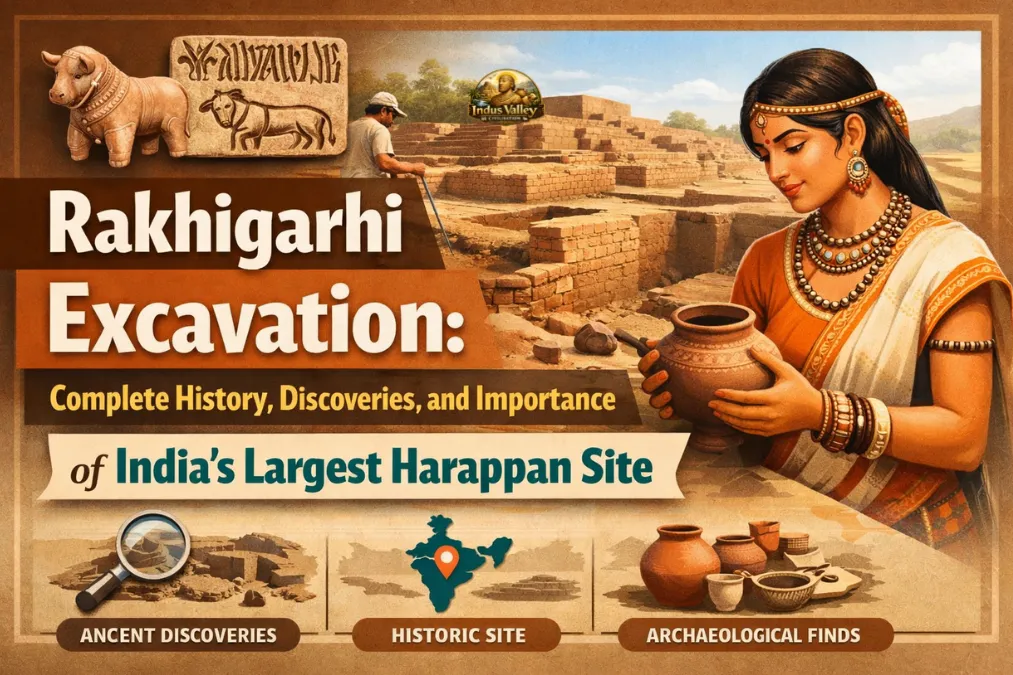
Rakhigarhi excavation has completely changed our understanding of the Indus Valley Civilization and its deep roots in the Indian subcontinent. Located in the Hisar district of Haryana, Rakhigarhi is considered the largest known Harappan site in the world, even bigger than Mohenjo-daro and Harappa. The discoveries made here have helped historians, archaeologists, and researchers learn more about one of the world’s oldest urban civilizations.
This ancient site has provided valuable evidence about early town planning, social life, trade systems, burial practices, and genetic history of the Harappan people. Over several decades, the excavation work at Rakhigarhi has revealed how advanced and well-organized this civilization truly was.
Where Is Rakhigarhi Located
Rakhigarhi is situated in the Hisar district of Haryana, about 150 kilometers northwest of Delhi. The site lies close to the ancient course of the Drishadvati River, which is believed to be linked with the Vedic Saraswati River mentioned in ancient texts.
The village of Rakhigarhi today stands on and around the archaeological mounds. These mounds cover a massive area of nearly 350 hectares, making it the largest Indus Valley settlement discovered so far.
Discovery of Rakhigarhi
The site of Rakhigarhi was first identified in 1963 by archaeologist Suraj Bhan. However, large-scale research and excavation began much later. Initial surveys showed pottery fragments, bricks, and structural remains spread across multiple mounds.
These early findings suggested that Rakhigarhi was not a small settlement but a major urban center of the Harappan Civilization.
History of Rakhigarhi Excavation
Early Excavation Work
The first major Rakhigarhi excavation was conducted by the Archaeological Survey of India (ASI) during the late 1990s. Excavations between 1997 and 2000 confirmed that the site belonged to the Mature Harappan period, dating back to around 2600–1900 BCE.
Archaeologists uncovered well-planned streets, drainage systems, residential buildings, and industrial zones.
Renewed Excavations After 2012
In 2012, excavation work resumed under the leadership of ASI archaeologist Amarendra Nath. These excavations continued in several phases and revealed even deeper layers belonging to the Early Harappan period, dating back to nearly 5000 BCE.
This discovery pushed the timeline of Rakhigarhi much earlier than previously believed.
Rakhigarhi Excavation and Site Layout
The Rakhigarhi site consists of seven major mounds labeled RGR-1 to RGR-7. Each mound served a different purpose in the ancient city.
Residential areas were separated from industrial zones. Public spaces, drainage channels, and storage areas show strong urban planning principles.
The layout reflects a highly organized society with advanced engineering knowledge.
Major Discoveries from Rakhigarhi Excavation
Town Planning and Architecture
One of the most impressive aspects of Rakhigarhi excavation is its urban planning. The city was built using standardized baked bricks, similar to other Harappan cities.
Streets followed a grid pattern and were wide enough to allow movement of carts. Houses were constructed with multiple rooms, courtyards, and proper ventilation.
Drainage systems were covered and connected to main channels, showing advanced sanitation knowledge.
Pottery and Artifacts
Large quantities of pottery were discovered, including:
Red ware with black designs
Storage jars and bowls
Decorated pots with geometric patterns
Other artifacts include beads made of semi-precious stones, shell bangles, terracotta figurines, copper tools, and seals.
These findings indicate skilled craftsmanship and thriving trade networks.
Seals and Script Evidence
Several seals with animal motifs and Harappan script were found during Rakhigarhi excavation. The script remains undeciphered, but its presence confirms administrative and commercial activities.
The seals were likely used for trade, identification, and record-keeping.
Burial Sites and Human Skeletons
One of the most important discoveries was the cemetery area. Several human skeletons were found in well-planned burial pits.
Graves often included pottery, ornaments, and offerings, suggesting belief in life after death.
Some skeletons were buried in north–south orientation, similar to other Harappan burial practices.
DNA and Genetic Findings
Rakhigarhi excavation gained global attention when ancient DNA was successfully extracted from skeletal remains.
Studies revealed that the Harappan population had local South Asian ancestry and showed no direct evidence of large-scale migration from Central Asia during that period.
This discovery reshaped theories about the origin and development of early Indian civilization.
Economic Life Revealed by Rakhigarhi Excavation
The findings indicate that Rakhigarhi was a major economic hub.
Evidence of agriculture includes wheat, barley, and rice remains. Storage facilities suggest surplus production.
Craft production was well developed, with workshops for beads, metal tools, and pottery.
Trade links likely existed with regions of present-day Gujarat, Rajasthan, Afghanistan, and Mesopotamia.
Social Structure of the Harappan People
Rakhigarhi excavation shows a society that valued equality and organization.
There is no clear evidence of large palaces or royal tombs, suggesting that power may not have been concentrated in one ruler.
Uniform housing patterns indicate relatively balanced social conditions compared to later civilizations.
Public infrastructure appears to have been prioritized over monumental architecture.
Religious Beliefs and Cultural Practices
Although no large temples were discovered, several artifacts hint at religious practices.
Terracotta figurines possibly representing mother goddesses were found.
Fire altars and ritual platforms suggest ceremonial activities.
Animal symbols on seals may have held spiritual meaning.
These findings point toward nature worship and fertility beliefs.
Importance of Rakhigarhi Excavation in Indian History
Rakhigarhi excavation is extremely important for understanding India’s ancient past.
It proves that advanced urban culture existed in the Saraswati–Drishadvati river basin.
The site strengthens the idea that the Indus Valley Civilization was largely indigenous.
It provides strong archaeological support to early Indian cultural continuity.
Comparison with Harappa and Mohenjo-daro
Rakhigarhi surpasses Harappa and Mohenjo-daro in size.
While the basic urban features are similar, Rakhigarhi shows longer habitation phases.
Early Harappan, Mature Harappan, and Late Harappan layers are all present.
This continuous occupation makes Rakhigarhi unique among Harappan sites.
Challenges Faced During Excavation
Despite its importance, Rakhigarhi excavation has faced many challenges.
Modern village settlements overlap the ancient mounds.
Agricultural activity has damaged some archaeological layers.
Limited funding and manpower have slowed large-scale excavation.
Conservation of exposed structures remains a major concern.
Government and International Collaboration
The Indian government has supported research at Rakhigarhi through ASI and academic institutions.
Collaborations with international universities helped in DNA analysis and advanced scientific studies.
Plans have been proposed to develop the site as a protected heritage zone and tourist destination.
Rakhigarhi Museum and Tourism Potential
A site museum has been proposed to display artifacts and educate visitors.
Proper development can turn Rakhigarhi into a major heritage tourism center like Dholavira.
This would increase public awareness and help preserve the site for future generations.
What Rakhigarhi Excavation Teaches Us Today
The discoveries show that ancient Indian society valued cleanliness, planning, and sustainability.
Water management, drainage systems, and eco-friendly construction reflect advanced thinking.
The absence of war-related weapons suggests a relatively peaceful society.
These lessons remain relevant even in modern urban planning.
Read also: Rakhigarhi Museum: A Complete Guide to India’s Largest Harappan Heritage Center
Future Scope of Rakhigarhi Excavation
Large parts of the site remain unexplored.
Future excavation may reveal:
Administrative buildings
Educational or ritual centers
More inscriptions and seals
Additional DNA samples
Continued research could provide answers to long-standing historical debates.
Read also: Rakhigarhi Haryana: Complete Guide to India’s Largest Harappan Civilization Site
Conclusion
Rakhigarhi excavation stands as one of the most significant archaeological achievements in India. It has expanded the geographical and cultural understanding of the Indus Valley Civilization and confirmed its deep connection with the Indian subcontinent.
From advanced town planning and skilled craftsmanship to genetic evidence and cultural continuity, Rakhigarhi tells the story of a highly developed ancient society that flourished thousands of years ago.
As research continues, Rakhigarhi will remain central to rewriting early Indian history and understanding the true origins of one of the world’s greatest civilizations.