
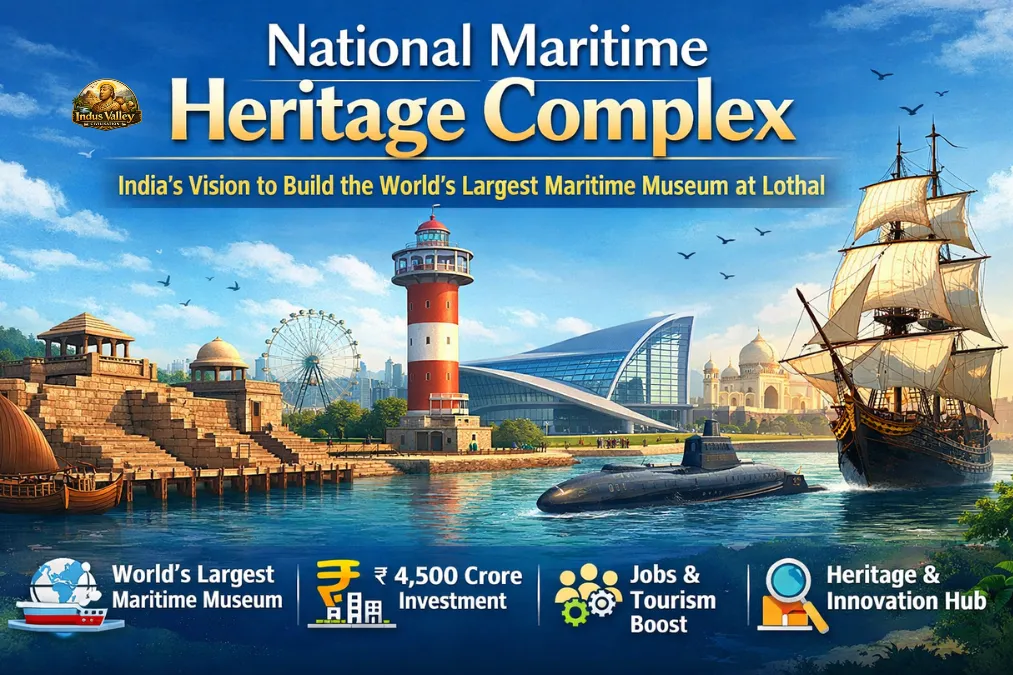
India is preparing to unveil one of its most ambitious cultural and infrastructure projects-the National Maritime Heritage Complex-at Lothal in Gujarat. Designed to become the world’s largest maritime museum, this landmark initiative aims to celebrate India’s deep-rooted seafaring traditions, reconnect the nation with its maritime legacy, and position the country as a global hub for maritime heritage tourism.
Spearheaded by the Government of India under the leadership of the Ministry of Ports, Shipping and Waterways, in collaboration with the Ministry of Culture, the project is a cornerstone of India’s broader vision to integrate heritage with development. With an estimated investment of ₹4,500 crore, the National Maritime Heritage Complex is expected to transform Gujarat into a global cultural destination while preserving over 5,000 years of India’s maritime history.
Lothal: The Historic Foundation of the National Maritime Heritage Complex
Situated around 85 kilometers from Ahmedabad, Lothal is one of the most significant archaeological sites of the ancient Indus Valley Civilization. Dating back to approximately 2400 BCE, this ancient settlement is widely regarded as one of the earliest known dockyard cities in the world.
Why Lothal Matters
Lothal’s historical importance lies in its advanced urban planning and maritime infrastructure. Archaeologists have uncovered evidence of:
- A sophisticated dockyard believed to be the world’s oldest
- Extensive trade networks with regions like Mesopotamia
- Skilled bead-making industries
- Advanced drainage and water management systems
The site’s inclusion in the tentative list of the UNESCO World Heritage highlights its global significance. This rich historical context makes Lothal the perfect location for the National Maritime Heritage Complex, as it allows visitors to experience maritime history at its very origin.
Project Overview: National Maritime Heritage Complex at a Glance
To better understand the scale and ambition of the project, here is a detailed overview:
| Feature | Details |
|---|---|
| Project Name | National Maritime Heritage Complex |
| Location | Lothal, Gujarat, India |
| Distance from Ahmedabad | ~85 km |
| Estimated Cost | ₹4,500 crore |
| Developed By | Government of India |
| Key Ministries | Ports, Shipping & Waterways; Culture |
| Architect | Hafeez Contractor |
| Phases | Phase 1A, 1B, and Phase 2 |
| Key Highlight | World’s Largest Maritime Museum |
| Core Focus | Maritime heritage, tourism, education, research |
Masterplan and Architectural Vision
The National Maritime Heritage Complex has been designed by renowned architect Hafeez Contractor, a Padma Bhushan awardee known for his large-scale urban projects.
Design Philosophy
The masterplan reflects a deep connection to Lothal’s ancient past while embracing modern architectural innovation. The entire complex is structured around a central waterbody, symbolizing the historic dockyard that once served as the heart of maritime activity in the region.
The layout follows a grid-based pattern inspired by Harappan town planning, with the main museum acting as a central “citadel,” much like ancient urban centers.
Development Phases of the National Maritime Heritage Complex
The project is being executed in multiple phases to ensure systematic growth and efficient development.
Phase 1A: Foundation and Core Museum
Phase 1A focuses on establishing the initial infrastructure and the first segment of the National Maritime Museum.
Key highlights include:
- Development of the primary museum galleries
- Basic infrastructure such as roads and utilities
- Recreation of ancient Lothal town
- Exhibits showcasing India’s maritime evolution
This phase aims to demonstrate how maritime activities shaped India’s economy, trade, and culture over centuries.
Phase 1B: Expansion and Landmark Attractions
The second phase of development will significantly expand the complex.
Major features include:
- Second segment of the museum
- A 77-meter-high Lighthouse Museum
- The Bagicha Complex, designed as a cultural and public interaction space
This phase will enhance the visual identity of the National Maritime Heritage Complex and provide immersive visitor experiences.
Phase 2: A Global Cultural and Tourism Hub
Phase 2 will transform the site into a comprehensive heritage and leisure destination.
Planned attractions include:
| Attraction | Description |
|---|---|
| Heritage Theme Park | Recreation of ancient Lothal city and coastal state pavilions |
| Maritime Institute | Research and education in maritime studies |
| Maritime & Naval Park | Displays of naval technology and history |
| Adventure & Amusement Park | Entertainment facilities for visitors |
| Monuments Park | Replicas of iconic monuments |
| Climate Change Theme Park | Awareness and education on environmental issues |
| Hospitality Infrastructure | Hotels, eco-resorts, and themed accommodations |
Immersive Visitor Experience and Technology Integration
The National Maritime Heritage Complex is not just a museum-it is designed as an interactive learning environment.
Cutting-Edge Features
Visitors can expect:
- 5D simulations recreating maritime journeys
- Audio-visual storytelling installations
- Light-and-sound shows narrating historical events
- Interactive digital exhibits
Realistic Reconstructions
The complex will feature:
- Full-scale replicas of ancient and medieval ships
- Archival photographs and rare maritime documents
- Naval artifacts and equipment
- Potential display of a submarine and a warship
These elements will create a multi-sensory experience, blending education with entertainment.
Economic Impact of the National Maritime Heritage Complex
The project is expected to deliver substantial economic benefits, especially for Gujarat.
Job Creation and Investment
- Thousands of jobs during construction and operations
- ₹1,000 crore allocated for hospitality and tourism infrastructure
- Boost to local industries such as handicrafts and cottage businesses
Tourism Growth
The National Maritime Heritage Complex is set to complement existing attractions in Gujarat, including:
- Gir National Park
- Somnath Temple
- Dwarka
This integration will create a comprehensive tourism circuit, attracting both domestic and international visitors.
National Vision: Connecting Heritage with Development
The National Maritime Heritage Complex is part of a larger national strategy to strengthen India’s maritime ecosystem.
During the “Samudra se Samriddhi” initiative, Narendra Modi highlighted the importance of preserving maritime heritage while promoting innovation, research, and skill development.
India’s Maritime Context
- Coastline length: Over 7,500 km
- Historical trade connections: More than 40 countries
- Rich naval and shipbuilding traditions
Despite this legacy, India lacked a dedicated national maritime museum-until now.
Strategic Importance of the Project
The National Maritime Heritage Complex is not just about history; it plays a key role in India’s future development.
Key Objectives
- Preserve and showcase maritime heritage
- Promote tourism and economic growth
- Support maritime research and education
- Enhance global cultural recognition
Integration with Infrastructure Development
The project aligns with other maritime initiatives, including:
- Modern ports
- Cruise terminals
- Ship repair facilities
Together, these efforts aim to position India as a global maritime leader.
Cultural Significance and Global Appeal
The National Maritime Heritage Complex will act as a bridge between India’s ancient past and its modern aspirations.
Cultural Highlights
- Showcasing 5,000 years of maritime history
- Celebrating coastal traditions and communities
- Promoting awareness of India’s global trade legacy
International Attraction
With its scale and innovation, the complex is expected to attract:
- Researchers and historians
- Tourists and students
- Maritime professionals
Sustainability and Future Readiness
The project incorporates sustainable design principles, ensuring minimal environmental impact.
Key Sustainability Features
- Eco-friendly construction methods
- Water conservation systems
- Green spaces and landscaping
- Climate awareness zones
The inclusion of a Climate Change Theme Park further reinforces the project’s commitment to environmental education.
Read also: Lothal City: The Ancient Port of the Indus Valley Civilization
A Landmark for India’s Maritime Future
Once completed, the National Maritime Heritage Complex will stand as a symbol of India’s transformation from an ancient maritime powerhouse to a modern global player.
It will not merely function as a museum but as a living institution that:
- Educates future generations
- Preserves historical knowledge
- Encourages innovation in maritime sectors
Read also: Lothal India: Exploring the Ancient Harappan Port City and Its Remarkable History
Conclusion
The National Maritime Heritage Complex at Lothal represents a bold and visionary step by India to honor its maritime past while shaping its future. By combining cutting-edge technology, historical authenticity, and world-class infrastructure, the project is set to redefine how maritime heritage is experienced.
As the world’s largest maritime museum takes shape in Gujarat, it promises to become a global landmark—celebrating India’s enduring relationship with the seas and inspiring generations to come.