
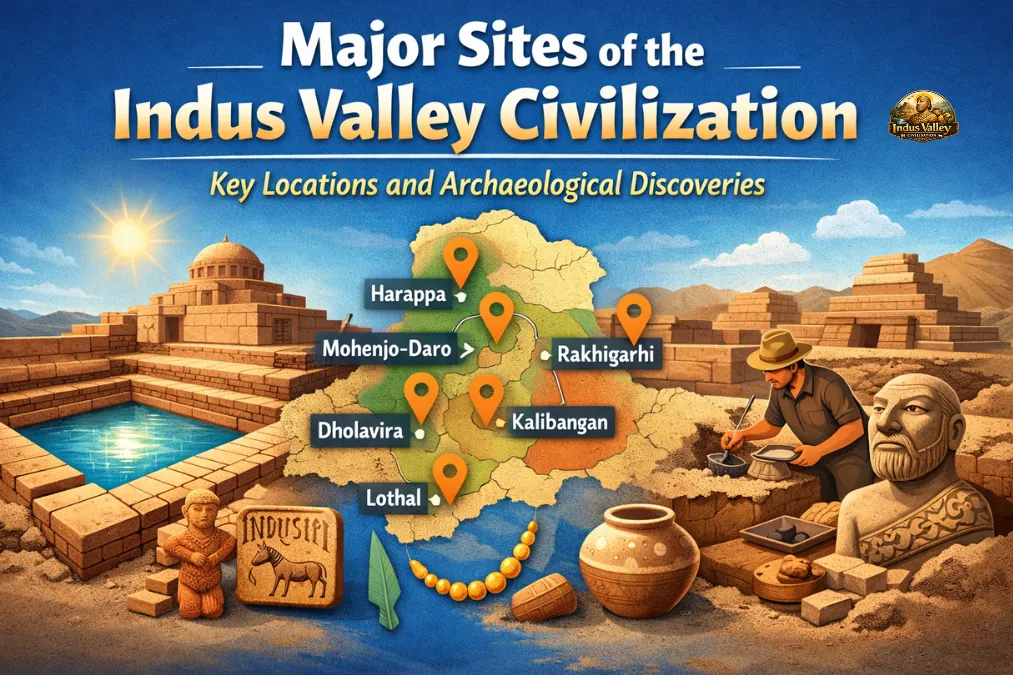
The Major Sites of the Indus Valley Civilization continue to fascinate historians, archaeologists, and researchers across the world. Known as one of the earliest urban cultures in human history, the Indus Valley Civilization (IVC)-also called the Harappan Civilization-flourished between 3300 BCE and 1300 BCE in the northwestern regions of South Asia. This ancient civilization stands alongside Mesopotamia, Egypt, and China as one of the four great early civilizations, and is often considered the largest among them in terms of geographical spread.
Covering an area of approximately 1.25 million square kilometers, the civilization extended across present-day Pakistan, northwestern India, and parts of northeastern Afghanistan. What makes the Major Sites of the Indus Valley Civilization especially remarkable is their advanced urban planning, architectural brilliance, and well-organized social systems-features that were far ahead of their time.
Discovery and Historical Background
The story of the Indus Valley Civilization came to light in 1921, when archaeologists from the Archaeological Survey of India (ASI) discovered the first site at Harappa. This groundbreaking discovery marked the beginning of extensive excavations that revealed a sophisticated urban culture that had remained buried for thousands of years.
Since then, numerous sites have been identified, leading historians to refer to the civilization as the Harappan Civilization, after its first discovered city. These sites collectively provide valuable insights into the economic, social, and cultural life of one of the world’s earliest urban societies.
Unique Features of the Indus Valley Civilization
The Major Sites of the Indus Valley Civilization are known for their striking uniformity and advanced infrastructure. Some of the most notable features include:
- Grid-based city planning with straight roads intersecting at right angles
- Standardized baked bricks used in construction
- Sophisticated drainage systems, including covered drains
- Fortified structures and citadels for administrative and possibly defensive purposes
- Extensive trade networks, both internal and international
- Artistic achievements, including terracotta figurines, seals, and pottery
Despite these advancements, one of the biggest mysteries remains unsolved—the Indus script, which has not yet been deciphered. This has left many aspects of their governance, religion, and eventual decline open to interpretation.
List of Major Sites of the Indus Valley Civilization
The Major Sites of the Indus Valley Civilization are spread across modern-day India, Pakistan, and Afghanistan. Most of these sites are located along the Indus River and the now-dry Ghaggar-Hakra River system.
Here are the key sites:
- Harappa
- Mohenjo-daro
- Dholavira
- Rakhigarhi
- Lothal
- Kalibangan
- Banawali
- Chanhudaro
- Sutkagendor
- Alamgirpur
Detailed Table of Major Sites and Discoveries
To better understand these historical locations, here is a comprehensive table highlighting the Major Sites of the Indus Valley Civilization, their locations, excavation details, and key findings:
| Year | Site Name | Location | Excavator / Authority | Key Discoveries |
|---|---|---|---|---|
| 1921 | Harappa | Punjab, Pakistan | Daya Ram Sahni (ASI) | Red sandstone male torso, Shiva lingam-like structures, granary remains, mother goddess figurines |
| 1922 | Mohenjo-daro | Sindh, Pakistan | R.D. Banerji (ASI) | Advanced drainage system, Great Bath, seals, terracotta figurines |
| 1968 | Dholavira | Kutch, Gujarat, India | Archaeological Survey of India | Water reservoirs, stepwells, large inscriptions, advanced city planning |
| 1963 | Rakhigarhi | Haryana, India | Dr. Amarendra Nath (ASI) | Human skeletons, seals, pottery, urban planning evidence |
| 1955 | Lothal | Gujarat, India | Archaeological Survey of India | Dockyard, bead-making factory, drainage system |
| 1960 | Kalibangan | Rajasthan, India | B.B. Lal (ASI) | Fire altars, ploughed fields, pottery |
| 1974 | Banawali | Haryana, India | R.S. Bisht (ASI) | Fortification walls, pottery, beads |
| 1935 | Chanhudaro | Sindh, Pakistan | Ernest Mackay | Bead-making workshops, absence of citadel |
| 1960 | Sutkagendor | Balochistan, Pakistan | George F. Dales (Makran Survey) | Stone and mud-brick structures, coastal trade evidence |
| 1958 | Alamgirpur | Uttar Pradesh, India | Y.D. Sharma (ASI) | Pottery, beads, evidence of Harappan culture |
Key Highlights of Major Sites
Harappa
Harappa was the first discovered site and remains one of the most significant centers of the civilization. Excavations revealed granaries, seals, and sculptures, indicating a well-organized society with strong economic foundations.
Mohenjo-daro
One of the most iconic cities, Mohenjo-daro is famous for the Great Bath, which suggests the importance of ritual bathing. The city’s drainage system is considered one of the most advanced in the ancient world.
Dholavira
Located in Gujarat, Dholavira stands out for its water conservation system, including reservoirs and stepwells. It also features one of the earliest known signboards or inscriptions, indicating a developed communication system.
Rakhigarhi
Rakhigarhi is among the largest Harappan sites discovered in India. Findings such as human skeletons and pottery provide crucial information about the lifestyle and burial practices of the people.
Lothal
Lothal is known for its dockyard, making it a key center for maritime trade. The presence of a bead-making factory highlights its role in craftsmanship and trade.
Kalibangan
Kalibangan is notable for its fire altars and evidence of ploughed agricultural fields, offering insights into the agricultural practices of the civilization.
Banawali
Banawali shows both pre-Harappan and Harappan phases, with evidence of fortified structures and artistic craftsmanship.
Chanhudaro
Unlike other major cities, Chanhudaro lacked a citadel, suggesting a different administrative structure. It was primarily an industrial center, especially for bead-making.
Sutkagendor
Situated near the coast, Sutkagendor played a significant role in trade with distant regions, including Mesopotamia.
Alamgirpur
Alamgirpur represents the easternmost extension of the civilization and provides evidence of Harappan cultural influence in the Ganga-Yamuna region.
Cultural and Archaeological Significance
The Major Sites of the Indus Valley Civilization reveal a culture that was not only advanced in terms of urban planning but also rich in art and craftsmanship. Artifacts such as:
- Terracotta figurines
- Seals with animal motifs
- Jewelry and beads
- Tools and pottery
demonstrate the artistic excellence and daily life of the people.
Additionally, the uniformity in construction and city planning across distant sites suggests a centralized system or shared cultural practices, even though no clear evidence of a ruling authority has been found.
The Mystery of the Indus Script
One of the most intriguing aspects of the Major Sites of the Indus Valley Civilization is the undeciphered script found on seals and artifacts. Despite numerous attempts, scholars have not yet been able to decode it. This has left many questions unanswered regarding:
- Governance and administration
- Religious beliefs
- Social hierarchy
- Causes of decline
Also Read: Banawali: Exploring the Ancient Harappan Site on the Banks of the Lost Saraswati River
Decline of the Civilization
While the exact reasons for the decline of the Indus Valley Civilization remain unclear, several theories have been proposed, including:
- Climate change and drying of rivers
- Decline in trade networks
- Natural disasters such as floods or earthquakes
- Gradual migration of populations
The lack of definitive evidence makes the decline one of history’s greatest unsolved mysteries.
Conclusion
The Major Sites of the Indus Valley Civilization offer a remarkable glimpse into one of the world’s earliest and most sophisticated urban cultures. From the well-planned streets of Mohenjo-daro to the advanced water systems of Dholavira and the bustling trade hub of Lothal, each site contributes uniquely to our understanding of this ancient civilization.
Despite decades of research, the Indus Valley Civilization continues to captivate scholars and enthusiasts alike. Its achievements in urban planning, trade, and craftsmanship highlight the ingenuity of early human societies, while its mysteries ensure that it remains a subject of ongoing exploration and discovery.
As archaeological techniques advance, future discoveries at these major sites may finally unlock the secrets of this extraordinary civilization, shedding new light on its people, language, and legacy.