
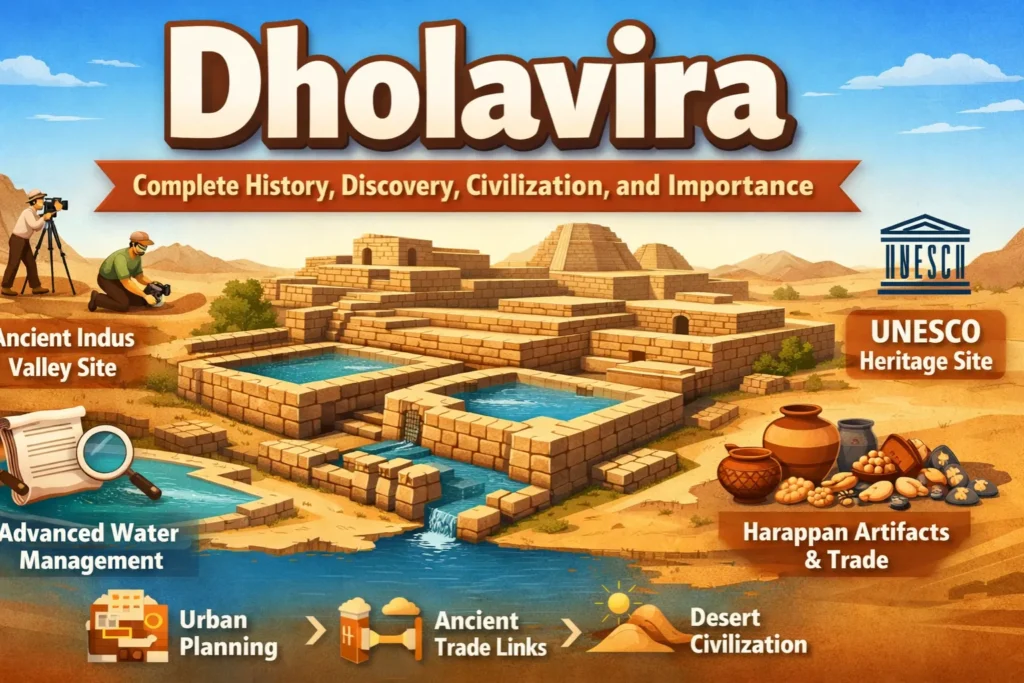
Dholavira is one of the most remarkable archaeological sites of the ancient Indus Valley Civilization, known for its advanced town planning, water management system, and unique architectural design. Located in the dry region of Gujarat, India, Dholavira reveals how an ancient society survived and prospered in harsh desert conditions thousands of years ago.
Introduction to Dholavira
Dholavira was one of the five largest settlements of the Indus Valley Civilization. It flourished between approximately 3000 BCE and 1500 BCE. Unlike other Harappan cities built near rivers, Dholavira developed in an arid region with very little rainfall. This makes its achievements in water conservation and city planning even more impressive.
The site offers deep insight into the social, economic, and technological life of the Harappan people. Today, Dholavira is recognized as one of the most important archaeological discoveries in South Asia.
Location of Dholavira
Dholavira is located on Khadir Bet island in the Rann of Kutch district of Gujarat, India. The site lies between two seasonal streams called Mansar in the north and Manhar in the south. These streams played a vital role in collecting rainwater for the city.
The geographical isolation of the island helped protect the city and allowed its inhabitants to control trade routes linking Gujarat with Sindh, Rajasthan, and coastal regions.
Discovery of Dholavira
Dholavira was discovered in 1967 by archaeologist Jagat Pati Joshi of the Archaeological Survey of India. Systematic excavation began in 1990 under the leadership of R. S. Bisht and continued for more than two decades.
The long excavation period revealed a well-preserved urban settlement with massive stone walls, reservoirs, streets, gateways, and public spaces. These findings placed Dholavira among the most significant Harappan sites ever found.
Historical Background
The history of Dholavira can be divided into seven cultural stages, showing continuous occupation over nearly 1,500 years. These stages reflect growth, decline, rebuilding, and adaptation to changing environmental conditions.
During its peak period, Dholavira was a powerful urban center that maintained strong trade connections with other Harappan cities such as Harappa, Mohenjo-daro, Lothal, and Kalibangan.
City Planning of Dholavira
Unique Three-Part City Structure
One of the most distinctive features of Dholavira is its three-part city layout. The city was divided into:
- The Citadel
- The Middle Town
- The Lower Town
Each section had its own walls, entrances, and specific functions. This type of division is rarely seen in other Indus Valley sites.
Strong Fortification Walls
The city was surrounded by massive stone walls built using finely dressed sandstone blocks. These walls provided protection and symbolized the political authority of the rulers.
The use of stone instead of bricks makes Dholavira unique among Harappan cities, which usually relied on baked bricks.
Roads and Streets
Dholavira featured well-planned streets laid out in straight lines, intersecting at right angles. The roads were wide enough for carts and pedestrian movement. Proper drainage channels ran along the streets, showing careful urban planning.
Advanced Water Management System
Importance of Water Conservation
The greatest achievement of Dholavira lies in its extraordinary water management system. Since the region received very little rainfall, the survival of the city depended on storing every drop of water.
Reservoirs and Tanks
More than sixteen massive reservoirs have been discovered at Dholavira. These reservoirs were carved out of rock and lined with stone blocks to prevent water leakage.
Rainwater from the city and nearby streams was carefully channeled into these tanks. Some reservoirs were as large as modern swimming pools, demonstrating advanced engineering skills.
Stepwells and Channels
The city also had stepwells, underground drains, and check dams. These structures ensured year-round water availability for drinking, bathing, and agriculture.
This system is considered one of the earliest and most sophisticated water harvesting techniques in the ancient world.
Architecture and Construction Techniques
Buildings in Dholavira were constructed mainly using locally available sandstone. The stones were cut into uniform shapes and fitted together without mortar in many places.
Large public buildings, assembly halls, and ceremonial structures indicate organized labor and skilled craftsmanship. The precision in construction reflects advanced knowledge of geometry and engineering.
The Great Signboard of Dholavira
One of the most famous discoveries at Dholavira is a large signboard containing ten Indus script symbols. The letters were made of white gypsum inlayed on a wooden board.
This is the largest known inscription of the Indus script found so far. It suggests that the people of Dholavira used written communication for public display, possibly for administrative or ceremonial purposes.
Although the Indus script has not yet been deciphered, this signboard remains a key clue in understanding Harappan writing.
Social and Administrative System
The structured layout of Dholavira indicates a well-organized administrative system. The separation of residential areas from public and ceremonial zones shows social planning.
The citadel likely housed rulers or administrators, while the lower town was meant for common people, artisans, and traders. This planned hierarchy reflects political stability and governance.
Economic Life of Dholavira
Agriculture
Despite the dry environment, agriculture was practiced using stored rainwater. Crops such as wheat, barley, pulses, and millet were cultivated.
Animal husbandry was also common, including cattle, sheep, and goats.
Trade and Commerce
Dholavira was a major trading center of the Indus Valley Civilization. Archaeological evidence shows trade links with:
- Mesopotamia
- Oman
- Bahrain
- Coastal Gujarat
Items such as beads, shells, semi-precious stones, copper tools, and pottery were traded extensively.
Dockyard-related activities at nearby coastal sites supported maritime trade.
Art and Craftsmanship
The people of Dholavira were skilled artisans. Excavations have revealed:
- Bead-making workshops
- Shell ornaments
- Gold and copper jewelry
- Terracotta figurines
- Stone tools
Beads made from carnelian, agate, jasper, and lapis lazuli were highly valued in ancient markets.
Religious Beliefs and Culture
Unlike later civilizations, no clear evidence of temples or large statues has been found at Dholavira. However, ceremonial grounds and fire altars suggest ritual practices.
The society may have worshipped natural forces such as water, fire, and celestial bodies. The emphasis on water structures hints at its spiritual importance.
Decline of Dholavira
The decline of Dholavira began around 1900 BCE. Several factors contributed to its downfall:
- Prolonged droughts
- Climate change
- Drying of rivers and streams
- Decline in trade networks
As water sources weakened, maintaining the large city became difficult. Gradually, people migrated to smaller settlements.
By 1500 BCE, Dholavira was largely abandoned.
Archaeological Importance of Dholavira
Dholavira holds immense importance for understanding the Indus Valley Civilization. It provides valuable information about:
- Urban planning in desert regions
- Early water conservation systems
- Administrative organization
- Harappan writing
- Long-term settlement sustainability
The site has helped historians rethink how advanced ancient Indian civilizations truly were.
UNESCO World Heritage Site Status
In 2021, Dholavira was declared a UNESCO World Heritage Site. This recognition highlights its universal cultural value and the need for global preservation.
It became India’s first Indus Valley Civilization site to receive this honor, bringing international attention to its historical significance.
Tourism and Preservation
Today, Dholavira is open to visitors and researchers. The Archaeological Survey of India has developed walkways, information boards, and viewing platforms to protect the ruins.
The remote location and peaceful surroundings allow visitors to experience the grandeur of ancient urban life without modern disturbance.
Responsible tourism plays an important role in preserving this priceless heritage.
Comparison with Other Harappan Cities
While Harappa and Mohenjo-daro are famous for brick structures and drainage, Dholavira stands apart due to:
- Extensive stone architecture
- Massive water reservoirs
- Three-part city division
- Desert-based urban survival
These differences show the diversity within the Indus Valley Civilization rather than a single uniform culture.
Lessons from Dholavira
Dholavira teaches important lessons for the modern world, especially in water-scarce regions. Its sustainable approach to rainwater harvesting, storage, and reuse is highly relevant today.
The city demonstrates that careful planning, respect for nature, and community cooperation can support long-term human survival even in extreme environments.
Read also: What Is Mohenjo Daro: Complete History, Discovery, Civilization, and Importance
Conclusion
Dholavira stands as a powerful symbol of human intelligence, resilience, and innovation. Built more than 4,500 years ago in a harsh desert landscape, the city reflects extraordinary achievements in engineering, governance, and environmental management.
From its massive reservoirs to its carefully planned streets, every element of Dholavira tells a story of advanced urban life long before modern technology existed. Its discovery has transformed our understanding of ancient Indian civilization and continues to inspire researchers across the world.
As one of the finest examples of the Indus Valley Civilization, Dholavira remains a timeless reminder that true progress lies in harmony between humans and nature.