
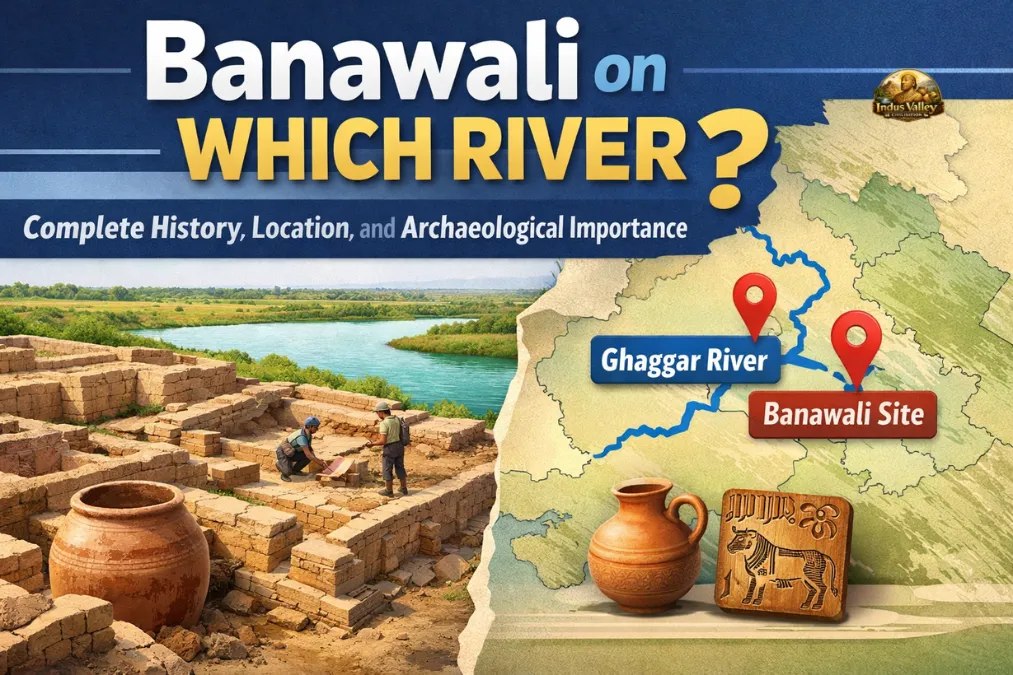
Banawali on which river is a common question among students, history lovers, and people interested in the Indus Valley Civilization. Banawali is one of the most important archaeological sites of ancient India and plays a major role in understanding Harappan culture. This site provides valuable information about early town planning, agriculture, trade, and daily life during the Bronze Age.
Located in present-day Haryana, Banawali helps historians understand how ancient civilizations developed near rivers and natural water sources. In this detailed article, we will clearly explain Banawali on which river it was situated, why that river was important, and how Banawali contributed to the growth of the Harappan Civilization.
Introduction to Banawali Archaeological Site
Banawali is an ancient settlement belonging to the Indus Valley Civilization, also known as the Harappan Civilization. It is located in the Fatehabad district of Haryana, India, near the border of Rajasthan.
The site was discovered in 1974 by archaeologist R. S. Bisht of the Archaeological Survey of India. Excavations revealed that Banawali was occupied during both the Early Harappan and Mature Harappan periods.
Banawali is especially important because it shows the transition from early rural settlements to well-planned urban towns.
Banawali on Which River Was Located
Banawali on Which River: The Saraswati River Connection
The clear answer to banawali on which river is that Banawali was located on the banks of the ancient Saraswati River.
Today, the Saraswati River is considered a dried or paleo river. Many scholars identify its remains with the present-day Ghaggar-Hakra river system. During the Harappan period, this river was a powerful and life-supporting water source.
Banawali was situated near the Ghaggar River, which is widely believed to be the ancient Saraswati mentioned in early Indian texts.
Importance of the Saraswati River for Banawali
The Saraswati River played a crucial role in the development of Banawali. Like other Harappan cities, Banawali depended heavily on river water for survival and growth.
The river provided:
- Drinking water for people
- Water for agriculture
- Fertile alluvial soil for farming
- Transportation routes for trade
- Natural protection from dry desert regions
Because of the river, Banawali could support a large population and stable economy.
Geographical Location of Banawali
Banawali is located about 16 kilometers northeast of Fatehabad town in Haryana. It lies in the northwestern plains of India, a region once rich in rivers and vegetation.
During ancient times, this area was not dry as it appears today. The Saraswati river system created fertile lands that were ideal for early settlements.
The geographical position of Banawali connected it with major Harappan centers like:
- Kalibangan
- Rakhigarhi
- Harappa
- Mohenjo-daro
This made Banawali an important regional center.
Historical Timeline of Banawali
Banawali shows evidence of three main cultural phases:
Early Harappan Phase
This phase dates back to around 3200 BCE. During this time, Banawali was a small settlement with mud-brick houses. Pottery styles were simple, and agriculture had just begun to expand.
Mature Harappan Phase
Around 2600 BCE, Banawali developed into a well-planned town. Brick structures, streets, drainage systems, and fortification walls were constructed.
This phase reflects advanced urban planning similar to Harappa and Mohenjo-daro.
Late Harappan Phase
After 1900 BCE, signs of decline appeared. Urban planning weakened, trade reduced, and people slowly abandoned the site, possibly due to environmental changes and river drying.
Town Planning at Banawali
One of the strongest proofs of advanced Harappan life at Banawali is its town planning.
The city was divided into two main parts:
- The fortified citadel area
- The lower residential town
Streets were laid out in a grid pattern, intersecting at right angles. Houses opened into lanes instead of main roads, showing concern for privacy and cleanliness.
The presence of planned drainage systems indicates a strong civic sense.
Fortification and Security
Banawali had massive mud-brick fortification walls surrounding the settlement. These walls served multiple purposes:
- Protection from floods
- Defense against enemies
- Control of trade and movement
The fortification suggests that Banawali was an important administrative or trade center.
Houses and Buildings
The houses at Banawali were built using mud bricks, unlike baked bricks found in some other Harappan cities.
Features of Banawali houses included:
- Multiple rooms
- Central courtyards
- Storage areas
- Hearths for cooking
Some houses were larger, indicating social differences within society.
Drainage System
Even though Banawali used mud bricks, its drainage system was highly organized.
Covered drains ran along the streets, connected to household outlets. Wastewater flowed out of the city efficiently, proving strong urban management.
This system shows that cleanliness was a priority in Harappan towns.
Agriculture at Banawali
The fertile soil provided by the Saraswati River made agriculture the backbone of Banawali’s economy.
Archaeological evidence suggests cultivation of:
- Wheat
- Barley
- Gram
- Peas
- Mustard
The people also practiced crop rotation and seasonal farming.
Plough marks found at nearby sites support the use of early farming tools.
Animal Husbandry
Animal remains discovered at Banawali indicate domestication of:
- Cattle
- Buffalo
- Sheep
- Goats
- Pigs
Cattle were especially important for farming, milk, and transport.
Animals also played a role in trade and religious rituals.
Trade and Commerce
Banawali was actively involved in internal and long-distance trade.
Artifacts found at the site include:
- Beads made of carnelian and agate
- Shell ornaments
- Copper tools
- Weights and measures
The standardized weights indicate regulated trade systems.
Trade routes connected Banawali with Rajasthan, Gujarat, and even Mesopotamia through other Harappan ports.
Crafts and Industries
Several crafts flourished at Banawali:
Pottery Making
Pottery was well-developed, featuring red ware with black designs. Storage jars, bowls, plates, and cooking pots were commonly used.
Bead Making
Beads made from semi-precious stones show skilled craftsmanship and artistic sense.
Metal Work
Copper tools such as knives, arrowheads, and bangles have been found, proving knowledge of metallurgy.
Religious Beliefs and Practices
Although no large temples have been discovered, Banawali provides clues about Harappan religious life.
Findings include:
- Fire altars
- Terracotta figurines
- Animal motifs
Fire altars suggest ritual worship, possibly connected to early Vedic traditions.
The worship of nature and fertility symbols was common.
Seals and Script
Seals discovered at Banawali contain animal figures and Harappan script.
These seals were used for:
- Trade identification
- Ownership marks
- Administrative control
The script remains undeciphered, but its uniformity across Harappan sites indicates centralized communication.
Decline of Banawali
One of the major reasons behind the decline of Banawali was environmental change.
As the Saraswati River gradually dried or changed its course, water supply became unreliable.
Other contributing factors include:
- Climate change
- Decreasing rainfall
- Loss of agricultural productivity
- Breakdown of trade networks
By around 1700 BCE, Banawali was largely abandoned.
Archaeological Importance of Banawali
Banawali is extremely important for several reasons:
- It confirms the importance of the Saraswati river system
- It shows both rural and urban Harappan phases
- It provides evidence of early fortifications
- It helps understand Harappan town evolution
The site strengthens the theory that many Harappan settlements flourished along the Saraswati rather than the Indus alone.
Banawali and the Saraswati Civilization Theory
The discovery of Banawali supports the idea that the Indus Valley Civilization was actually a vast Saraswati-Indus Civilization.
More than 60 percent of Harappan sites are found along the Ghaggar-Hakra river system.
This highlights why the question banawali on which river is so important in historical studies.
Comparison with Other Harappan Sites
Compared to Harappa and Mohenjo-daro:
- Banawali used more mud bricks
- It had smaller structures
- It still followed advanced urban planning
Compared to Kalibangan:
- Both sites had fire altars
- Both were located on the Saraswati river
- Both show early Harappan traditions
Banawali acts as a bridge between large cities and smaller rural settlements.
Educational and Cultural Significance
Banawali is an important topic in:
- Indian history textbooks
- Archaeology studies
- Competitive examinations
It helps students understand:
- River-based civilizations
- Ancient urban planning
- Environmental impact on civilizations
The site also highlights India’s deep and continuous cultural heritage.
Read also: Banawali: Complete History, Discovery, Civilization, and Archaeological Importance
Current Status of Banawali Site
Today, Banawali is protected by the Archaeological Survey of India.
Although not fully developed as a tourist destination, the site remains open for research and educational visits.
Efforts are ongoing to preserve the remains and promote awareness of its historical value.
Why Banawali Remains Important Today
Banawali teaches us valuable lessons:
- Civilizations depend on natural resources
- Rivers shape human history
- Environmental imbalance can cause decline
- Urban planning existed thousands of years ago
These lessons remain relevant even in the modern world.
Read also: Banawali Haryana: Complete History, Discovery, Civilization, and Archaeological Importance
Conclusion
The answer to banawali on which river is clear and historically supported. Banawali was located on the ancient Saraswati River, now identified with the Ghaggar-Hakra river system.
This river provided fertile land, water, trade routes, and stability that allowed Banawali to grow into a prosperous Harappan town.
Through its town planning, agriculture, trade systems, and cultural remains, Banawali stands as a powerful symbol of India’s ancient civilization.
Understanding Banawali not only helps us learn about the past but also reminds us of the deep relationship between nature and human progress.