

Banawali Haryana is one of the most important archaeological sites of the Indus Valley Civilization and holds a special place in the ancient history of India. Located in the Fatehabad district of Haryana, this site provides valuable evidence about early urban life, town planning, trade systems, and cultural development during the Harappan period. Banawali Haryana helps historians and researchers understand how one of the world’s oldest civilizations evolved and flourished along the ancient river systems of northwestern India.
The discoveries made at Banawali have changed many earlier ideas about the Harappan Civilization and have added new dimensions to Indian archaeology. From planned streets and strong fortifications to advanced pottery and seals, Banawali offers a clear picture of life nearly 4,500 years ago.
Location and Geographical Setting of Banawali Haryana
Banawali Haryana is situated near the Saraswati–Ghaggar river basin, about 120 kilometers northeast of Kalibangan and around 16 kilometers from Fatehabad town. The site lies on the dry bed of the ancient Ghaggar River, which many scholars associate with the legendary Saraswati River mentioned in early Indian texts.
The geographical position of Banawali played a major role in its growth. The fertile plains, access to water, and connectivity with other Harappan settlements made it an ideal location for agriculture, trade, and settlement expansion. This strategic location explains why Banawali became an important center during different phases of the Indus Valley Civilization.
Discovery and Excavation of Banawali Haryana
Banawali Haryana was first reported in 1974 by archaeologist R. S. Bisht of the Archaeological Survey of India. Systematic excavations were carried out between 1974 and 1980, revealing remarkable remains of an ancient urban settlement.
The excavation uncovered multiple cultural layers, showing that Banawali was inhabited over a long period. These layers belong to the pre-Harappan phase, early Harappan phase, and mature Harappan phase. This continuous occupation makes Banawali extremely important for understanding the gradual development of Harappan culture.
Chronology and Cultural Phases
Pre-Harappan Phase
The earliest occupation at Banawali Haryana dates back to around 3000 BCE. During this period, the settlement was still in a developing stage. People lived in mud-brick houses, practiced early agriculture, and produced handmade pottery with simple designs.
The tools and ceramics found from this phase indicate a rural lifestyle that slowly moved toward urban characteristics.
Early Harappan Phase
As time progressed, Banawali entered the early Harappan phase. During this period, significant changes occurred in construction methods, pottery styles, and settlement planning. Burnt bricks began to appear along with better drainage systems and organized housing patterns.
Trade activities also increased, as indicated by seals, beads, and standardized pottery shapes.
Mature Harappan Phase
The mature Harappan phase marks the peak of Banawali Haryana’s development, dating roughly between 2600 BCE and 1900 BCE. The town became fully urbanized with well-planned streets, strong fortification walls, and advanced architecture.
Most of the important discoveries at Banawali belong to this period, reflecting the height of Harappan culture and technological excellence.
Town Planning and Urban Structure
One of the most impressive aspects of Banawali Haryana is its advanced town planning. Unlike many Harappan sites that follow a strict grid pattern, Banawali shows a unique radial layout.
The settlement was divided into two main parts:
The citadel area, built on a raised platform, likely housed administrative or elite structures.
The lower town, where common people lived, consisted of residential buildings, workshops, and storage spaces.
Streets were well-organized and intersected at right angles in several areas. The use of standardized bricks in a fixed ratio demonstrates a high level of engineering knowledge.
Fortification and Defense System
Banawali Haryana was surrounded by massive fortification walls built of mud bricks and burnt bricks. These walls indicate the need for protection against floods, wild animals, or possible conflicts.
The fortification system reflects strong administrative control and organized labor, suggesting that Banawali was an important regional center within the Harappan network.
Residential Architecture
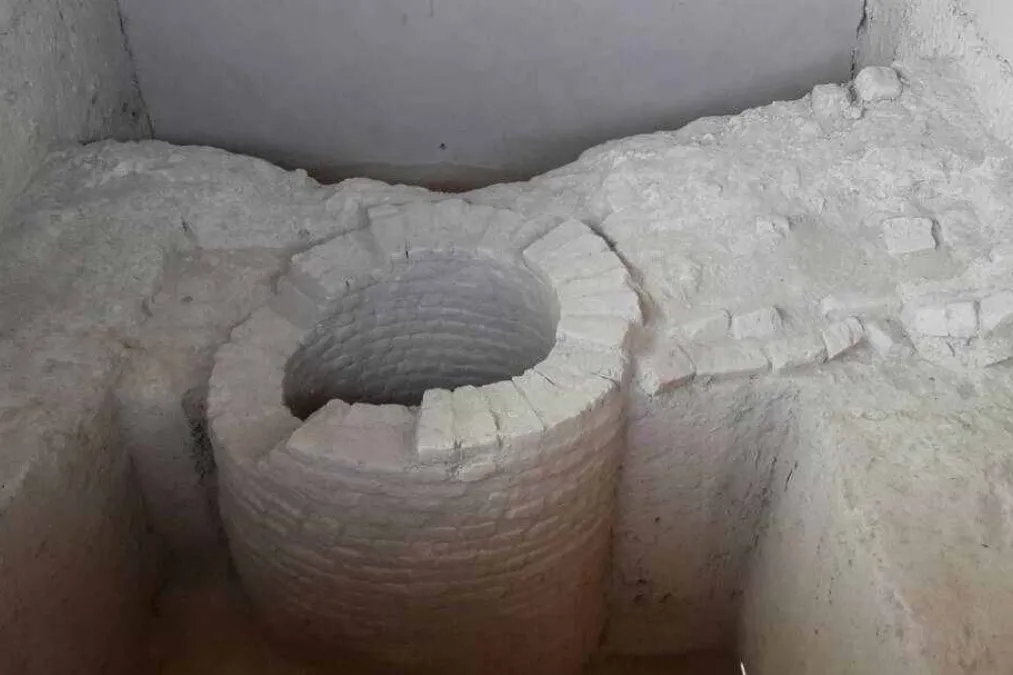
Houses at Banawali Haryana varied in size, indicating social differences within the settlement. Larger houses had multiple rooms, courtyards, and private wells, while smaller houses were simpler in design.
Most houses were built using baked bricks and featured proper ventilation and drainage facilities. Bathrooms connected to covered drains highlight the advanced sanitation system of the Harappans.
Drainage and Water Management
The drainage system of Banawali Haryana is one of its most remarkable features. Covered drains made of bricks ran along the streets and were connected to household outlets.
Soak jars and inspection holes were used to prevent blockage, showing a scientific approach to urban hygiene. This system proves that cleanliness and public health were important concerns even in ancient times.
Pottery and Ceramic Traditions
Large quantities of pottery have been discovered at Banawali Haryana. The pottery includes:
Red ware with black painted designs
Storage jars
Bowls and dishes
Perforated jars
Goblets and cups
The designs often feature geometric patterns, plants, animals, and abstract symbols. The quality and uniformity of pottery reflect skilled craftsmanship and standardized production.
Seals and Script Evidence
Several seals made of steatite have been found at Banawali Haryana. These seals typically display animals such as bulls, elephants, and mythical creatures, along with Harappan script symbols.
Although the Indus script remains undeciphered, these seals likely served administrative, commercial, or identity purposes. Their presence confirms Banawali’s participation in long-distance trade networks.
Beads, Ornaments, and Artifacts
Excavations at Banawali have yielded a wide variety of ornaments and personal items, including:
Beads made of carnelian, agate, jasper, and faience
Shell bangles
Copper tools
Terracotta figurines
These objects reflect aesthetic sense, technological skill, and trade connections with distant regions such as Gujarat, Rajasthan, and coastal areas.
Agricultural Practices and Food Habits
Evidence from Banawali Haryana shows that agriculture was the backbone of the economy. Remains of wheat, barley, mustard, and legumes have been found at the site.
Animal bones suggest domestication of cattle, sheep, goats, and buffalo. The presence of plough marks at nearby sites supports the idea of advanced farming techniques.
Food habits were simple but nutritious, based mainly on grains, milk products, and meat.
Trade and Economic Activities
Banawali Haryana was well connected with other Harappan cities such as Harappa, Mohenjo-daro, Kalibangan, Rakhigarhi, and Lothal.
Trade items included:
Pottery
Beads
Metals
Shell objects
Semi-precious stones
The standardized weights and measures found at the site indicate regulated trade and economic planning.
Religious Beliefs and Cultural Life
Although no large temples have been discovered, several artifacts suggest religious practices. Terracotta figurines of mother goddess figures indicate fertility worship.
Fire altars found at Banawali Haryana point toward ritual activities, possibly related to early Vedic traditions. These findings show the spiritual life of the people and their connection with nature and fire rituals.
Importance of Fire Altars at Banawali Haryana
One of the most debated discoveries at Banawali is the presence of fire altars. These structures are similar to those found at Kalibangan and suggest ceremonial or religious functions.
The fire altars strengthen the theory that the Harappan people practiced rituals involving fire, which later influenced Vedic culture.
Comparison with Other Harappan Sites
Banawali Haryana shares many similarities with other Indus Valley sites but also shows unique features.
Compared to Harappa and Mohenjo-daro, Banawali is smaller but equally well planned.
Unlike the strict grid system of Mohenjo-daro, Banawali follows a radial planning style.
Its proximity to Rakhigarhi makes it crucial for understanding the Harappan presence in Haryana.
Role of Banawali in the Saraswati Civilization Theory
Many scholars consider Banawali Haryana as strong evidence supporting the Saraswati Civilization theory. Its location along the Ghaggar river aligns with descriptions of the Saraswati River in ancient texts.
The density of Harappan sites in Haryana suggests that this region was a major heartland of the civilization rather than its outskirts.
Decline of Banawali Settlement
Like other Harappan cities, Banawali Haryana experienced gradual decline around 1900 BCE. Possible reasons include:
Climate change and reduced rainfall
Drying of the Ghaggar-Saraswati river
Decline in trade networks
Environmental degradation
The decline was not sudden but occurred over several centuries, leading to gradual abandonment.
Archaeological Significance of Banawali Haryana
Banawali Haryana holds immense archaeological value because:
It shows continuous cultural development from pre-Harappan to mature Harappan phases
It provides evidence of advanced town planning in inland regions
It supports the theory of Saraswati-based settlements
It offers insight into early urbanization in north India
The site has helped redefine the geographical spread of the Indus Valley Civilization.
Read also: Banawali: Complete History, Discovery, Civilization, and Archaeological Importance
Preservation and Current Status
Today, Banawali Haryana is protected by the Archaeological Survey of India. However, like many ancient sites, it faces challenges such as erosion, farming activities, and lack of public awareness.
Proper conservation, site museums, and educational programs are essential to preserve this priceless heritage for future generations.
Tourism Potential of Banawali Haryana
Banawali has strong potential as a heritage tourism destination. Its proximity to other important sites such as Rakhigarhi, Agroha, and Kalibangan makes it ideal for archaeological tourism circuits.
With better infrastructure, information centers, and guided tours, Banawali Haryana can become a major attraction for history lovers and researchers.
Read also: Banawali in Which State: Complete History, Location, and Archaeological Importance
Conclusion
Banawali Haryana stands as a silent witness to India’s ancient urban past. Its well-planned streets, strong fortifications, advanced drainage systems, and rich material culture highlight the brilliance of the Indus Valley Civilization.
The discoveries at Banawali have significantly deepened our understanding of early human settlements, trade systems, religious practices, and technological achievements. As research continues, Banawali Haryana will remain one of the most important keys to unlocking the mysteries of one of the world’s greatest ancient civilizations.