
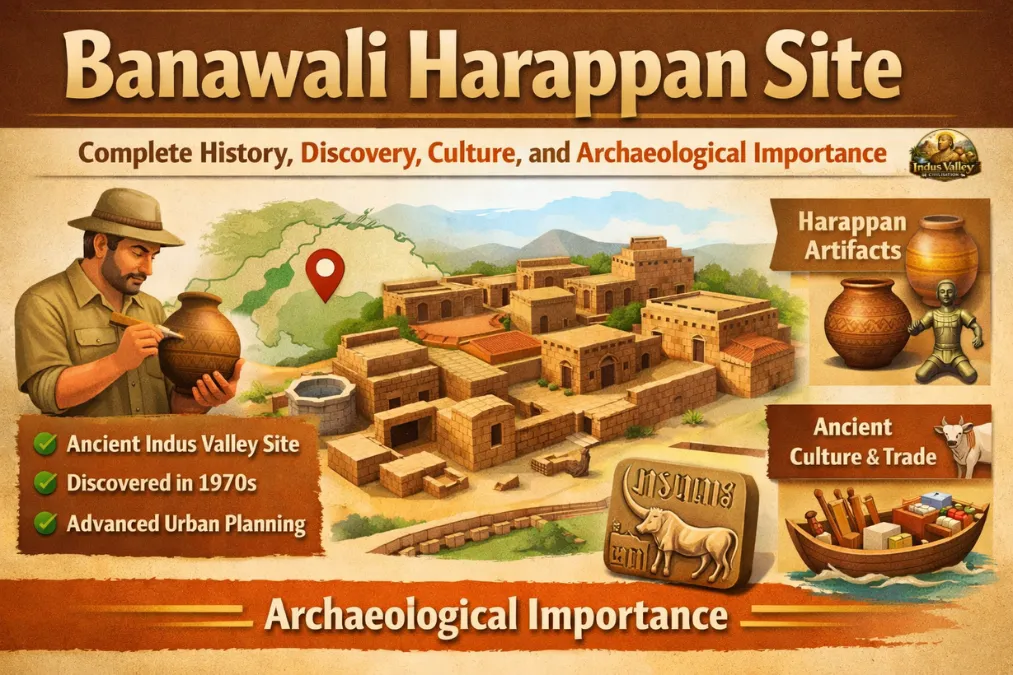
Banawali Harappan site is one of the most important archaeological discoveries of the Indus Valley Civilization, offering deep insight into early urban planning, rural life, and cultural development in ancient India. Located in present-day Haryana, this site has helped historians understand how Harappan civilization spread beyond major cities and adapted to different geographical conditions.
The discovery of Banawali proved that the Harappan people were not limited to river valleys alone. Instead, they developed advanced settlements even in semi-arid regions. Through excavations, scholars have uncovered houses, streets, fortifications, tools, pottery, and religious objects that reveal the daily life, beliefs, and technical skills of the Harappan people.
Location and Geographical Setting of Banawali
The Banawali Harappan site is situated in the Fatehabad district of Haryana, near the ancient course of the Saraswati or Ghaggar River. The site lies close to the Indo-Pakistan border region and forms an important link between major Harappan centers such as Kalibangan, Rakhigarhi, and Harappa.
Banawali’s location played a major role in its development. The presence of fertile land allowed agriculture to flourish, while nearby trade routes helped connect the settlement with other Harappan towns. The landscape shows clear evidence that ancient river systems once supported large populations in this region.
Discovery and Excavation History
The Banawali Harappan site was discovered in 1973 by archaeologist R. S. Bisht of the Archaeological Survey of India. Large-scale excavations were conducted between 1974 and 1980, bringing to light one of the most well-preserved Harappan settlements in northern India.
Excavation revealed two major cultural phases at Banawali. The earliest phase belonged to the pre-Harappan period, while the later phase represented the mature Harappan civilization. This continuous occupation makes Banawali extremely valuable for understanding how early village communities transformed into organized urban societies.
Chronology and Cultural Phases
Archaeological evidence suggests that Banawali was inhabited between approximately 2600 BCE and 1900 BCE. The site clearly shows a transition from early farming communities to a fully developed Harappan town.
The pre-Harappan phase shows simple mud-brick houses, handmade pottery, and basic tools. In the mature Harappan phase, baked bricks, standardized measurements, planned streets, and advanced drainage systems appear. This gradual evolution highlights the technological and social progress of the Harappan people.
Town Planning at the Banawali Harappan Site
One of the most remarkable features of the Banawali Harappan site is its well-organized town planning. Unlike many Harappan cities that followed a grid pattern, Banawali had a somewhat radial layout, showing regional variation in urban design.
The settlement was divided into two main areas: a fortified citadel and a lower town. The citadel stood on a raised platform and housed important administrative or religious buildings. The lower town was where common people lived and worked.
Streets were laid out carefully, often intersecting at right angles. Houses opened into narrow lanes, ensuring privacy and cleanliness. This advanced planning reflects a strong central authority and deep understanding of civic management.
Architecture and Building Materials
Buildings at Banawali were constructed using both mud bricks and baked bricks. The standardized size of bricks indicates uniform building practices across the Harappan civilization.
Most houses had multiple rooms, courtyards, and storage areas. Some larger houses may have belonged to wealthy families or administrators. The presence of fire altars in certain structures suggests ritual activities within residential spaces.
Walls were thick and sturdy, showing that durability and climate protection were important concerns for the inhabitants.
Drainage and Water Management System
The Banawali Harappan site features an advanced drainage system similar to those found at Mohenjo-daro and Harappa. Covered drains made of bricks ran along the streets and were connected to household outlets.
Soak pits and inspection holes ensured proper waste disposal. This system prevented waterlogging and maintained sanitation, proving that public health was a priority in Harappan society.
Wells and water storage facilities were also discovered, indicating efficient water management even in areas with limited rainfall.
Economic Life and Occupations
Agriculture formed the backbone of Banawali’s economy. Excavations have revealed evidence of wheat, barley, and possibly rice cultivation. The fertile plains surrounding the settlement supported large-scale farming.
Animal bones suggest the domestication of cattle, sheep, goats, and buffaloes. These animals were used for farming, transportation, and food.
Craft production was another important occupation. Archaeologists discovered beads made of carnelian, shell, and faience, along with tools used for bead-making. Pottery kilns and metalworking evidence indicate specialized artisans living in the town.
Pottery and Artistic Traditions
Pottery from the Banawali Harappan site is rich in variety and design. The ceramics include red ware painted with black geometric patterns, floral designs, and animal motifs.
Storage jars, bowls, dishes, and cooking pots were commonly used. The uniform style of pottery reflects cultural unity across the Harappan world while also showing local artistic preferences.
Terracotta figurines of humans and animals were also found, possibly used for religious or decorative purposes.
Tools, Weapons, and Technology
Numerous tools made of copper, bronze, stone, and bone have been unearthed at Banawali. These include knives, chisels, arrowheads, fishhooks, and axes.
The discovery of standardized weights and measures demonstrates the use of an organized trade and economic system. The weights were usually made of chert and followed a precise ratio, similar to other Harappan cities.
This technological advancement indicates a strong understanding of mathematics and engineering.
Religious Beliefs and Ritual Practices
Religion at the Banawali Harappan site appears to have been closely connected with nature and daily life. The discovery of fire altars is one of the most significant religious findings at the site.
These fire altars suggest ritual worship possibly related to fertility, purification, or seasonal cycles. Terracotta figurines of mother goddess types indicate belief in female deities associated with growth and prosperity.
Seals with symbolic motifs hint at spiritual concepts that are still not fully understood.
Trade and External Connections
Banawali was well connected with other Harappan settlements through land routes. Artifacts found at the site show similarities with those from Rakhigarhi, Kalibangan, Lothal, and Harappa.
Beads made from semi-precious stones not locally available suggest long-distance trade. Copper likely came from Rajasthan, while shells were brought from coastal regions.
These trade networks helped spread ideas, technology, and culture across the Harappan civilization.
Social Structure and Daily Life
The layout of houses and neighborhoods indicates social organization within the town. Larger homes with multiple rooms suggest the presence of elite families, while smaller houses belonged to common workers.
Despite social differences, the uniformity in city planning and sanitation suggests a society focused on collective welfare rather than extreme inequality.
Daily life included farming, craft production, trade, cooking, and religious rituals. Children likely learned skills from elders, continuing traditions over generations.
Decline of the Banawali Settlement
Like other Harappan cities, Banawali experienced decline around 1900 BCE. Archaeological layers show a gradual abandonment rather than sudden destruction.
Possible reasons include climate change, drying of rivers, declining agriculture, and shifting trade routes. Environmental stress may have forced people to migrate toward more fertile regions.
There is no strong evidence of invasion, supporting the theory of slow socio-environmental transformation.
Importance of Banawali in Harappan Studies
The Banawali Harappan site holds exceptional importance because it provides clear evidence of both pre-Harappan and mature Harappan phases at one location.
It helps archaeologists understand how urbanization developed over time. The site also proves that Harappan civilization extended deep into Haryana, strengthening the idea of the Ghaggar-Saraswati region as a major cultural zone.
Banawali’s unique town layout, fire altars, and rural-urban link make it a key reference point in Indus Valley research.
Read also: Banawali on Which River: Complete History, Location, and Archaeological Importance
Comparison with Other Harappan Sites
Compared to Mohenjo-daro and Harappa, Banawali was smaller in size but equally advanced in planning. Unlike the strict grid pattern of major cities, Banawali shows flexible urban design adapted to local conditions.
When compared with Kalibangan, Banawali shares similarities such as fire altars and river-based settlement planning. With Rakhigarhi, it shares cultural continuity and trade connections.
These comparisons help scholars see the Harappan civilization as a network of interconnected yet regionally diverse settlements.
Present Condition and Preservation
Today, the Banawali Harappan site is protected by the Archaeological Survey of India. Excavated structures are preserved, though much of the site remains buried for future research.
Efforts are ongoing to increase awareness, improve conservation, and promote responsible heritage tourism. Proper preservation is essential to protect this ancient treasure for future generations.
Read also: Banawali Haryana: Complete History, Discovery, Civilization, and Archaeological Importance
Conclusion
The Banawali Harappan site stands as a powerful symbol of India’s ancient heritage and the brilliance of the Indus Valley Civilization. From advanced town planning and drainage systems to agriculture, trade, and religious practices, Banawali reveals how organized and forward-thinking Harappan society truly was.
Its strategic location, long cultural sequence, and unique architectural features make it one of the most valuable archaeological sites in South Asia. As research continues, Banawali will remain central to understanding the origins, growth, and transformation of one of the world’s earliest urban civilizations.