
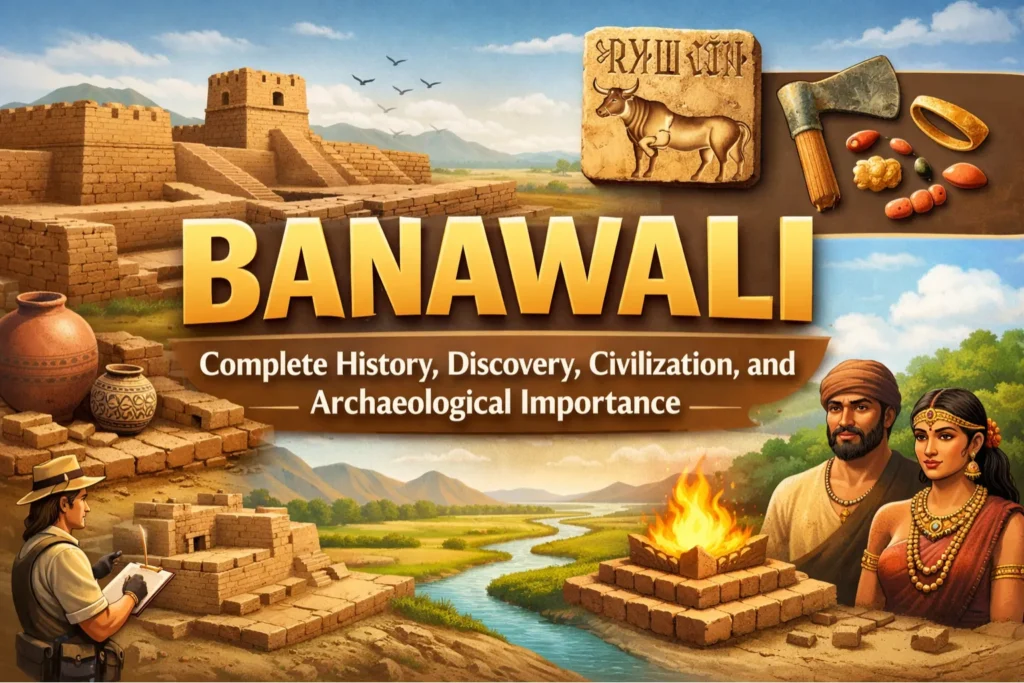
Banawali is one of the most important archaeological sites of the ancient Indus Valley Civilization, offering valuable insight into early urban life in the Indian subcontinent. Located in present-day Haryana, India, Banawali helps historians understand how people lived, planned cities, practiced agriculture, and developed trade systems thousands of years ago. This ancient settlement shows a clear link between rural farming communities and well-planned Harappan cities, making it a key site for studying early human civilization.
Banawali stands out because it shows both pre-Harappan and mature Harappan cultural phases at the same location. This makes it extremely useful for understanding how civilization evolved gradually rather than appearing suddenly.
Location of Banawali
Banawali is situated in the Fatehabad district of Haryana, close to the ancient Saraswati or Ghaggar river system. The site lies about 120 kilometers northeast of Kalibangan and around 200 kilometers from Harappa. Its location near seasonal rivers provided fertile land, water supply, and trade routes, which helped the settlement grow into a major center of the Indus Valley Civilization.
The geographical position of Banawali connects it to several important Harappan sites such as Rakhigarhi, Kalibangan, and Bhirrana, forming a strong network of ancient settlements across northwest India.
Discovery of Banawali
Banawali was discovered in 1974 by archaeologist R. S. Bisht during a survey conducted by the Archaeological Survey of India. Excavations began soon after and continued in multiple phases throughout the late 1970s and 1980s.
During excavation, archaeologists uncovered evidence of continuous occupation from the early pre-Harappan period to the mature Harappan phase. This discovery was significant because it helped establish Haryana as a major region of the Indus Valley Civilization, rather than just a peripheral area.
Historical Background of Banawali
The history of Banawali dates back to around 3200 BCE. The site shows three major cultural stages:
Pre-Harappan Phase
The earliest settlers of Banawali lived in simple mud-brick houses. They practiced early agriculture, domesticated animals, and produced handmade pottery. This phase represents a developing rural society that laid the foundation for later urban growth.
Early Harappan Phase
During this stage, Banawali began showing signs of planned settlement. Bricks became standardized, streets were laid out in straight lines, and trade activities increased. Pottery styles improved, and seals and ornaments began to appear.
Mature Harappan Phase
In the mature phase, Banawali reached its peak. The town developed strong fortification walls, advanced drainage systems, well-built houses, and organized public spaces. This period reflects full integration with the wider Harappan civilization.
Urban Planning at Banawali
One of the most remarkable features of Banawali is its advanced town planning. Unlike some Harappan cities that follow a grid pattern, Banawali shows a slightly radial layout, adapting to the natural shape of the land.
The city was divided into two main parts:
Citadel Area
The citadel was located on elevated ground and protected by thick mud-brick walls. This area likely housed administrative buildings, granaries, and possibly residences of important officials.
Lower Town
The lower town was meant for common people and included residential houses, workshops, and markets. The separation of zones shows strong administrative control and social organization.
Streets were wide and well-laid, intersecting at right angles in many places. Proper drainage channels ran alongside the roads, demonstrating excellent sanitation knowledge.
Houses and Architecture in Banawali
The houses at Banawali were built using standardized burnt bricks and mud bricks. Most homes had multiple rooms arranged around a central courtyard. Some houses even had private wells and bathrooms connected to covered drains.
Doors usually opened into side lanes rather than main streets, showing concern for privacy and cleanliness. The architectural style closely matches that of major Harappan cities, proving that Banawali was not a small village but a developed urban center.
Drainage and Sanitation System
The drainage system at Banawali reflects advanced engineering skills. Covered brick drains ran beneath the streets, with inspection holes for cleaning. Wastewater from houses flowed into main drains, keeping living areas hygienic.
This well-planned sanitation system highlights the importance given to public health, something rarely seen in other ancient civilizations of the same time.
Economic Life of Banawali
Agriculture
Agriculture formed the backbone of Banawali’s economy. Excavations have revealed evidence of wheat, barley, sesame, and mustard cultivation. The fertile alluvial soil near the river system made farming highly productive.
Irrigation likely depended on seasonal floods and water storage techniques.
Animal Husbandry
People domesticated cattle, buffalo, sheep, goats, and dogs. Animal bones found at the site indicate the use of oxen for plowing and transportation.
Trade and Commerce
Banawali was actively involved in regional and long-distance trade. Artifacts found at the site include beads made of carnelian, lapis lazuli, shell, and faience. Many of these raw materials came from distant regions such as Gujarat, Rajasthan, and Afghanistan.
Standardized weights and seals indicate regulated trade practices similar to other Harappan cities.
Artifacts Found at Banawali
Archaeological excavations at Banawali have uncovered a wide range of artifacts that provide insight into daily life.
Pottery
The pottery includes red ware, painted pottery, dish-on-stand, bowls, jars, and storage vessels. Many pieces feature black geometric patterns, animals, and plant motifs.
Seals
Terracotta and steatite seals with animal figures and Harappan script have been found. These seals were likely used for trade identification and administrative purposes.
Ornaments
Beads, bangles, necklaces, and earrings made of shell, copper, gold, and semi-precious stones show advanced craftsmanship.
Tools and Weapons
Copper tools such as knives, axes, chisels, and fishhooks indicate metalworking knowledge. Stone tools continued to be used alongside metal implements.
Religious Beliefs and Practices
Although no large temple has been discovered at Banawali, several findings suggest religious activity. Fire altars discovered at the site point toward ritual practices related to fire worship.
Terracotta figurines of animals and mother goddess-like figures indicate fertility worship. These beliefs appear consistent with religious traditions observed across the Indus Valley Civilization.
Social Structure of Banawali
The organized layout of Banawali suggests a structured society. The presence of a fortified citadel indicates administrative authority, while uniform housing points to social equality with limited wealth differences.
However, variations in house size and artifact richness hint at some level of social hierarchy, though far less extreme than in later civilizations.
Importance of Banawali in Indus Valley Studies
Banawali holds exceptional importance because it shows the gradual transformation from early farming communities to urban civilization.
Its significance includes:
• Clear cultural sequence from pre-Harappan to mature Harappan
• Evidence of early town planning development
• Strong link between rural and urban lifestyles
• Confirmation of the Ghaggar-Saraswati region as a Harappan heartland
Banawali proves that the Indus Valley Civilization was not limited to modern-day Pakistan but extended deep into northwestern India.
Comparison of Banawali with Other Harappan Sites
Compared to Mohenjo-daro and Harappa, Banawali is smaller in size but equally important in historical value.
Unlike Dholavira, which used stone architecture, Banawali relied mainly on bricks. Its town layout differs slightly from the strict grid system, showing regional variation within the civilization.
When compared with Kalibangan, Banawali shares similarities such as fire altars and early cultural layers, but Banawali shows better residential planning and stronger fortification.
Decline of Banawali
The decline of Banawali occurred around 1900 BCE, similar to other Harappan cities. Several factors may have contributed to this decline:
• Drying of the Ghaggar-Saraswati river system
• Climate change and reduced rainfall
• Decline in agricultural productivity
• Breakdown of long-distance trade
Gradually, the settlement was abandoned as people migrated toward more fertile regions.
Present Condition of Banawali
Today, Banawali exists as an archaeological mound. Although not as developed for tourism as some major sites, it remains protected by the Archaeological Survey of India.
Ongoing research continues to reveal new details about the settlement, and Banawali remains an important site for students, historians, and archaeologists studying early Indian civilization.
Banawali’s Contribution to Indian History
Banawali plays a vital role in understanding India’s ancient past. It highlights the scientific planning, social discipline, and environmental awareness of early inhabitants.
The site strengthens the view that ancient Indian civilization was highly advanced long before the rise of later historical kingdoms.
Read also: Rakhigarhi: Complete History, Discovery, Civilization, and Archaeological Importance
Conclusion
Banawali is a remarkable example of human innovation during the Bronze Age. From its early agricultural roots to its fully developed urban culture, the site provides a complete picture of civilization in progress.
Through its planned streets, advanced drainage, thriving trade, and rich cultural life, Banawali stands as a powerful reminder of the brilliance of the Indus Valley Civilization. Its discoveries continue to reshape our understanding of early history and confirm that ancient India was home to one of the world’s earliest and most sophisticated civilizations.