
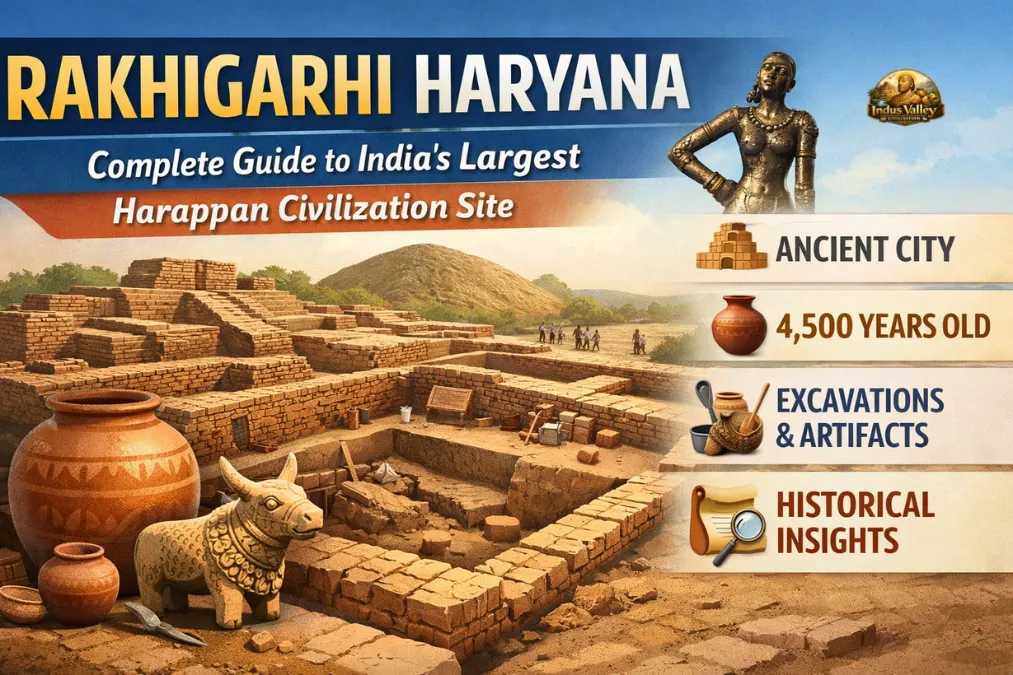
Rakhigarhi Haryana is one of the most important archaeological sites in India and the largest known settlement of the Indus Valley Civilization. Located in the Hisar district of Haryana, this ancient site has changed the way historians understand early urban life in the Indian subcontinent. With its advanced town planning, rich cultural remains, and deep historical roots, Rakhigarhi continues to attract researchers, students, and history lovers from around the world.
This article provides a fully detailed and easy-to-understand explanation of Rakhigarhi Haryana, covering its location, discovery, history, archaeological findings, cultural importance, and its role in shaping India’s ancient past.
Where Is Rakhigarhi Haryana Located
Rakhigarhi Haryana is situated in the Hisar district, about 150 kilometers northwest of Delhi. The site lies near the villages of Rakhigarhi and Rakhi Khas, close to the ancient course of the Drishadvati River, which is believed to be a tributary of the Saraswati River mentioned in early Indian texts.
The location of Rakhigarhi Haryana was ideal for early human settlement due to fertile plains, access to water, and favorable climate conditions. These natural advantages helped the city grow into a major urban center during ancient times.
Historical Background of Rakhigarhi Haryana
Rakhigarhi Haryana dates back nearly 5,000 years to the Mature Harappan Phase of the Indus Valley Civilization, roughly between 2600 BCE and 1900 BCE. This civilization is known for its well-planned cities, advanced drainage systems, standardized bricks, and strong trade networks.
While sites like Harappa and Mohenjo-daro were discovered earlier in present-day Pakistan, Rakhigarhi Haryana emerged as the largest Harappan site within India. Its size and archaeological richness suggest that it was one of the most important centers of the civilization.
Discovery and Excavation of Rakhigarhi Haryana
Rakhigarhi Haryana was first identified in 1963 by the Archaeological Survey of India. However, large-scale excavations began much later, mainly during the 1990s and early 2000s.
Over the years, archaeologists uncovered several mounds spread across nearly 350 hectares, making Rakhigarhi larger than both Harappa and Mohenjo-daro. Continuous excavations have revealed layers of settlement from early Harappan to mature Harappan phases.
Importance of Rakhigarhi Haryana in Indian History
Rakhigarhi Haryana holds exceptional importance because it provides strong evidence that the Indus Valley Civilization had a deep and widespread presence in northwestern India. The site proves that Haryana was not a peripheral area but a core region of Harappan culture.
Findings from Rakhigarhi Haryana have helped scholars understand:
- Urban planning techniques
- Social structure and daily life
- Agricultural practices
- Religious beliefs
- Genetic ancestry of ancient populations
These discoveries have reshaped historical narratives about early Indian civilization.
Urban Planning and City Structure
One of the most impressive features of Rakhigarhi Haryana is its advanced urban planning. The city was carefully designed with a clear layout that reflects strong administrative control.
Grid Pattern Streets
The streets of Rakhigarhi Haryana were laid out in a grid pattern, intersecting at right angles. This level of planning shows remarkable engineering knowledge for such an early period.
Drainage System
The drainage system was highly developed, with covered drains running alongside roads. Wastewater from houses flowed into main drains, keeping the city clean and hygienic.
Standardized Bricks
Buildings were constructed using baked bricks of uniform size, a distinctive feature of the Harappan Civilization. This standardization indicates centralized production and strict quality control.
Residential Areas and Public Structures
Excavations at Rakhigarhi Haryana have uncovered both small houses and large residential complexes. This suggests social diversity, with people from different economic backgrounds living within the city.
Large public structures, storage units, and possible administrative buildings indicate organized governance and collective planning.
Artifacts Found at Rakhigarhi Haryana
Thousands of artifacts have been discovered at the site, offering valuable insight into Harappan life.
Pottery
Different types of pottery were found, including red ware with black designs. Many pots feature geometric patterns, animals, and plant motifs.
Seals
Seals made of steatite were commonly used for trade and administration. These seals often contain animal figures and the undeciphered Harappan script.
Jewelry and Ornaments
Beads made of carnelian, agate, shell, gold, and copper have been uncovered. This shows that people of Rakhigarhi Haryana valued beauty and craftsmanship.
Tools and Weapons
Stone blades, copper tools, fish hooks, and agricultural implements reveal advanced technological skills.
Burial Practices and Human Remains
Burial sites found at Rakhigarhi Haryana have provided crucial information about Harappan beliefs regarding death and the afterlife.
The graves typically include pottery, ornaments, and daily-use items, suggesting belief in life beyond death. The skeletal remains have also helped scientists study health, diet, and physical features of ancient people.
DNA Research and Global Attention
One of the most significant contributions of Rakhigarhi Haryana to world history came through ancient DNA studies. Genetic analysis of human remains revealed that the Harappans were primarily indigenous people with no evidence of large-scale migration from outside regions during that time.
This research has helped clarify debates regarding the origins of South Asian populations and has placed Rakhigarhi Haryana at the center of global academic discussions.
Economic Life and Trade Networks
The people of Rakhigarhi Haryana were actively involved in agriculture, crafts, and long-distance trade.
Agriculture
Evidence suggests the cultivation of wheat, barley, peas, and sesame. Animal domestication included cattle, buffalo, sheep, and goats.
Trade
Rakhigarhi had trade connections with other Harappan cities such as Dholavira, Kalibangan, and Lothal. Artifacts indicate trade with Mesopotamia through land and sea routes.
Weights and measures found at the site show a standardized economic system.
Religious and Cultural Beliefs
Although Harappan religious practices remain partly mysterious, several clues have emerged from Rakhigarhi Haryana.
Terracotta figurines of mother goddess figures suggest fertility worship. Fire altars and ritual spaces indicate ceremonial activities. Animal symbolism on seals may reflect spiritual beliefs connected to nature.
Comparison With Other Harappan Sites
When compared with other sites, Rakhigarhi Haryana stands out in several ways.
- Larger in area than Mohenjo-daro
- More extensive residential zones
- Clear evidence of early and mature Harappan phases
- Strong genetic and cultural continuity
These features make Rakhigarhi a key site for understanding the full development of the Indus Valley Civilization.
Role of Rakhigarhi Haryana in Haryana Tourism
Rakhigarhi Haryana is gradually emerging as a major heritage tourism destination. The Haryana government, along with the Archaeological Survey of India, has initiated development plans to preserve the site and promote responsible tourism.
A proposed museum and interpretation center aim to display artifacts and explain the historical importance of the region to visitors.
Challenges in Preservation
Despite its importance, Rakhigarhi Haryana faces several challenges.
Urban expansion, agricultural activity, and environmental erosion threaten parts of the site. Protecting such a vast archaeological area requires constant monitoring, funding, and public awareness.
Efforts are ongoing to balance development with heritage conservation.
Why Rakhigarhi Haryana Matters Today
Rakhigarhi Haryana is not just an ancient ruin. It represents the roots of urban life in India. The values of cleanliness, organization, trade cooperation, and community planning seen here remain relevant even today.
The site reminds modern society that advanced civilization existed in India thousands of years ago, built on knowledge, discipline, and harmony with nature.
Educational and Academic Importance
Universities and research institutions from India and abroad continue to study Rakhigarhi Haryana. The site serves as a living laboratory for archaeology, anthropology, genetics, and history.
Students gain first-hand exposure to excavation techniques and heritage studies, making it one of the most important academic locations in South Asia.
Read also: Rakhigarhi in Which State: Complete Guide to Location, History, and Importance
Future Research and Excavations
Only a small portion of Rakhigarhi Haryana has been excavated so far. Archaeologists believe that many secrets still lie beneath the soil, including possible administrative centers, marketplaces, and residential expansions.
Future research is expected to provide deeper insights into:
- Harappan governance systems
- Language and script patterns
- Environmental adaptation strategies
- Causes of civilization decline
Read also: Rakhigarhi: Complete History, Discovery, Civilization, and Archaeological Importance
Conclusion
Rakhigarhi Haryana stands as a powerful symbol of India’s ancient heritage and human achievement. As the largest known site of the Indus Valley Civilization, it offers unmatched insight into early urban planning, culture, science, and social life.
From advanced drainage systems to genetic discoveries, every excavation adds a new chapter to human history. Rakhigarhi Haryana not only connects modern India with its ancient past but also strengthens global understanding of early civilizations.
Preserving and studying this remarkable site ensures that the story of one of the world’s oldest urban cultures continues to inspire future generations.