
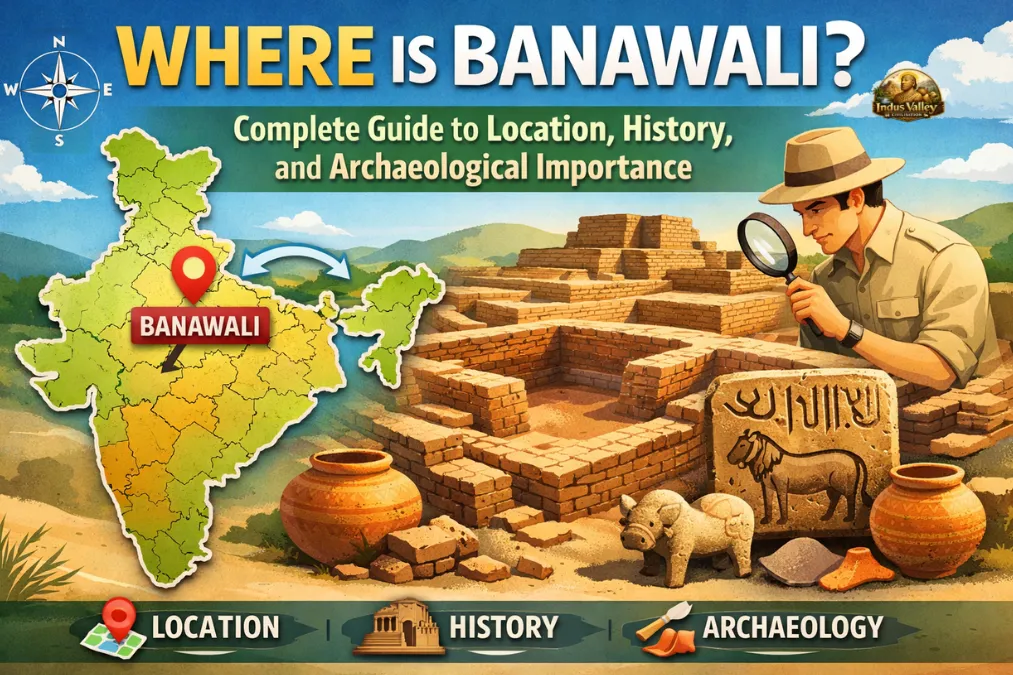
Where is Banawali is a common question asked by students, history lovers, and researchers who want to understand one of the important sites of the Indus Valley Civilization. Banawali is an ancient archaeological site in India that provides valuable information about early urban life, town planning, and cultural development during the Harappan period.
This article explains clearly where Banawali is located, why it is important, how it was discovered, and what makes it special among Indus Valley sites. The information is written in simple English so that everyone can understand it easily.
Where Is Banawali Located in India
Where is Banawali located exactly can be explained in very simple terms. Banawali is situated in the Hisar district of the Indian state of Haryana. It lies near the ancient Saraswati River region, which is believed to have supported many Harappan settlements.
The site is located about 120 kilometers northeast of Kalibangan and around 16 kilometers from the town of Fatehabad. Banawali stands on the banks of the dried-up Saraswati or Ghaggar river system, which played a major role in the growth of early civilizations in northwestern India.
Because of its geographical position, Banawali connects the Indus Valley sites of Rajasthan, Haryana, and Punjab, making it a key settlement in ancient trade and communication networks.
Why People Ask “Where Is Banawali”
Many people ask where is Banawali because it is not as famous as Harappa or Mohenjo-daro, yet it holds equal historical value. Banawali helps historians understand how the Harappan civilization spread far beyond the Indus River into present-day Haryana.
Students preparing for competitive exams, archaeology enthusiasts, and history researchers often search for Banawali because it shows early urban planning before full Harappan development.
The site is also important because it reveals both pre-Harappan and mature Harappan phases at the same location.
Discovery of Banawali
Banawali was discovered in 1973 by archaeologist R. S. Bisht of the Archaeological Survey of India. Excavations were carried out between 1974 and 1980.
During these excavations, archaeologists uncovered a well-planned town with streets, houses, drainage systems, and fortification walls. These findings proved that Banawali was not a small village but a well-developed urban center.
The discovery helped scholars understand that Harappan culture extended deep into the Indian subcontinent.
Historical Period of Banawali
Banawali belongs to the Bronze Age and dates back to around 2600 BCE to 1900 BCE. Evidence from the site shows three major cultural phases.
The earliest phase is known as the pre-Harappan phase, followed by the early Harappan phase, and finally the mature Harappan phase. This continuous occupation makes Banawali extremely valuable for studying the evolution of Harappan society.
Unlike many sites that show only one phase, Banawali provides a complete picture of cultural development over centuries.
Where Is Banawali in Relation to Other Harappan Sites
Understanding where is Banawali becomes easier when compared with other Indus Valley sites. Banawali lies between Kalibangan in Rajasthan and Rakhigarhi in Haryana.
Rakhigarhi, the largest Harappan site in India, is located about 150 kilometers southeast of Banawali. This closeness suggests strong trade, cultural exchange, and political connections between these settlements.
Together, Banawali and Rakhigarhi show that Haryana was one of the main centers of the Harappan civilization.
Town Planning at Banawali
Banawali displays advanced town planning similar to other major Harappan cities. The settlement was divided into two main parts: the citadel and the lower town.
The citadel was built on a raised platform and probably housed administrative or religious buildings. The lower town was meant for common people and included residential houses and workshops.
The streets were laid out in a grid pattern, intersecting at right angles. This type of planning shows strong administrative control and advanced engineering knowledge.
Fortification and City Structure
One of the most impressive features of Banawali is its massive fortification wall. The entire settlement was surrounded by mud-brick walls for protection.
The presence of bastions and gateways indicates concern for security and organized urban life. Such structures confirm that Banawali was a planned city rather than a naturally grown settlement.
This fortification also suggests that the city may have faced threats from floods, wild animals, or rival groups.
Houses and Residential Buildings
The houses at Banawali were built mainly with mud bricks and baked bricks. Most houses had multiple rooms, courtyards, and storage spaces.
Some houses included private wells and bathing areas, showing a strong emphasis on hygiene. Drainage channels were connected to main drains running along the streets.
These features prove that people of Banawali lived a comfortable and organized urban life.
Drainage and Sanitation System
The drainage system at Banawali reflects high civic sense. Covered drains ran alongside the streets and were connected to soak pits.
Wastewater from houses flowed into these drains, preventing waterlogging and disease. This system was similar to those found at Harappa and Mohenjo-daro.
Such advanced sanitation highlights the scientific thinking of the Harappan people.
Important Archaeological Findings
Excavations at Banawali have revealed a large number of artifacts that help historians understand daily life.
These include pottery, seals, terracotta figurines, beads, bangles, tools, and weights. The pottery shows both handmade and wheel-made techniques.
Seals discovered at Banawali contain animal motifs and symbols of the Harappan script, which remains undeciphered even today.
Evidence of Trade and Economy
Trade played a major role in Banawali’s economy. Archaeologists found standardized weights and measures, indicating regulated trade practices.
Beads made of carnelian, shell, and semi-precious stones suggest trade connections with distant regions such as Gujarat and coastal areas.
The site’s location near ancient river routes helped Banawali function as a trade hub between inland and river-based settlements.
Agriculture and Food Habits
Agriculture formed the backbone of Banawali’s economy. Excavations have revealed remains of wheat, barley, and pulses.
Animal bones indicate domestication of cattle, sheep, goats, and buffaloes. Fishing and hunting also supplemented food resources.
The fertile floodplains of the Saraswati-Ghaggar system made farming productive and sustainable.
Religious Beliefs and Practices
Although no large temple has been found, Banawali provides clues about religious life. Fire altars discovered at the site suggest ritual practices.
Terracotta figurines of animals and mother goddess-like figures point toward fertility worship.
These beliefs were similar to other Harappan centers, showing a shared spiritual culture.
Importance of Banawali in Indian History
Banawali holds a special place in Indian history because it shows that advanced civilization existed in Haryana over 4,500 years ago.
It proves that the Indus Valley Civilization was not limited to present-day Pakistan but extended deeply into India.
Banawali also helps bridge the gap between early village cultures and mature urban societies.
Where Is Banawali Today and Its Present Condition
Where is Banawali today can be answered easily for travelers and researchers. The site is located near Banawali village in Fatehabad district, Haryana.
Today, the ruins are protected by the Archaeological Survey of India. However, most structures remain exposed foundations rather than standing buildings.
Informational boards and fenced areas mark the excavation zones, but the site still needs better tourism development.
How to Reach Banawali
Banawali can be reached by road from Hisar and Fatehabad. Hisar is well connected by rail and road to major cities such as Delhi, Jaipur, and Chandigarh.
From Fatehabad, local transport and taxis can take visitors to the site. The nearest airport is in Delhi.
The best time to visit is between October and March when the weather is pleasant.
Educational and Research Value
Banawali is extremely important for archaeological education. Many universities and institutions use the site for field studies.
It helps students understand excavation methods, stratigraphy, and ancient urban planning.
Research at Banawali continues to provide new insights into Harappan society and environmental conditions.
Comparison with Other Indus Valley Sites
When comparing where is Banawali with other sites, it stands out because of its continuous cultural sequence.
Unlike Dholavira, which is famous for water management, or Mohenjo-daro for its Great Bath, Banawali is known for its early urban layout and fortification.
Each Harappan site contributes uniquely, and Banawali plays a vital role in understanding regional diversity.
Read also: Banawali Harappan Site: Complete History, Discovery, Culture, and Archaeological Importance
Why Banawali Is Still Not Very Famous
Despite its importance, Banawali is not widely known due to limited promotion and infrastructure.
Most tourists visit better-developed sites like Harappa museums or Dholavira in Gujarat.
However, historians consider Banawali one of the key sites for understanding the eastern extent of the Indus Valley Civilization.
Preservation Challenges
Banawali faces several preservation challenges including weather damage, agricultural activity nearby, and lack of visitor awareness.
Protecting such sites is essential to preserve India’s ancient heritage for future generations.
Improved conservation efforts and educational tourism can help safeguard this historical treasure.
Read also: Banawali on Which River: Complete History, Location, and Archaeological Importance
Conclusion
Where is Banawali is not just a question of geography but a gateway to understanding India’s ancient past. Located in Haryana’s Fatehabad district, Banawali stands as a powerful reminder of the advanced Harappan civilization that flourished thousands of years ago.
With its planned streets, fortified walls, drainage systems, and rich artifacts, Banawali proves that early Indians possessed remarkable knowledge of urban life.
Although lesser known, Banawali is one of the most important archaeological sites in South Asia. Learning about where is Banawali helps us appreciate the depth, diversity, and brilliance of India’s ancient civilization.