
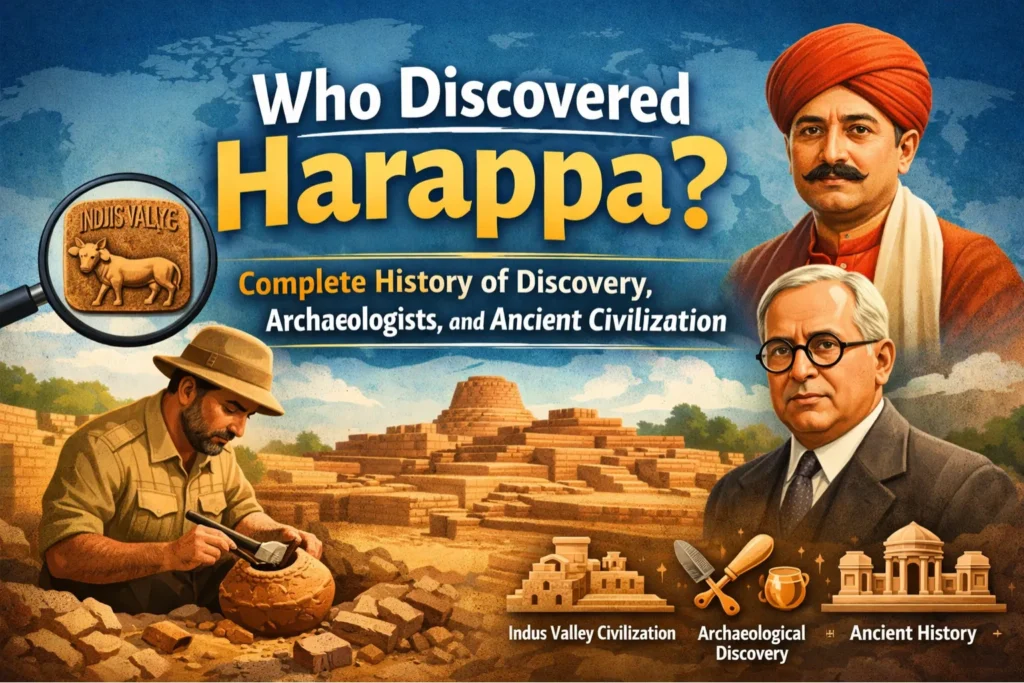
Who discovered Harappa is one of the most important questions in the study of ancient Indian history, because the discovery of this site changed our understanding of early civilizations in South Asia. Harappa is one of the earliest known urban centers of the world and played a major role in revealing the greatness of the Indus Valley Civilization.
The discovery of Harappa brought to light a highly developed society that existed more than 4,500 years ago. Before its excavation, historians believed that Indian civilization began much later. Harappa proved that advanced city life existed in the Indian subcontinent during the Bronze Age.
Introduction to Harappa Civilization
Harappa was a major city of the Indus Valley Civilization, also known as the Harappan Civilization. This civilization flourished between approximately 2600 BCE and 1900 BCE. It covered large areas of present-day Pakistan and northwestern India.
The cities of Harappa, Mohenjo-daro, Dholavira, Rakhigarhi, Lothal, and Kalibangan were part of this civilization. Among them, Harappa holds special importance because it was the first site to be scientifically identified and studied.
Who Discovered Harappa and When
The answer to who discovered Harappa lies in the year 1921, when Indian archaeologist Daya Ram Sahni carried out systematic excavations at the site under the guidance of Sir John Marshall, the Director-General of the Archaeological Survey of India.
Although the ruins were known earlier, the true historical importance of Harappa was recognized only during these excavations. Daya Ram Sahni is officially credited with the discovery of Harappa as an ancient civilization site.
Early Mentions Before the Official Discovery
Long before archaeologists realized its importance, Harappa was already visible as a mound of ancient ruins. Local villagers had known about the site for centuries and used its baked bricks for construction.
In 1826, British army deserter Charles Masson visited the area and mentioned ancient ruins in his travel records. However, he did not conduct scientific studies.
Later, in 1856, British engineers John and William Brunton noticed the ruins while working on the Lahore–Multan railway line. Many Harappan bricks were taken from the site and used in railway construction, causing serious damage before its value was understood.
Scientific Discovery of Harappa
The true discovery of Harappa occurred when the Archaeological Survey of India began planned excavations in the early 20th century.
In 1921, Daya Ram Sahni excavated the site and confirmed that the ruins belonged to a very ancient urban culture. This discovery was revolutionary because the artifacts were far older than the Maurya or Gupta periods previously known in Indian history.
Sir John Marshall announced that India had once been home to a Bronze Age civilization comparable to those of Mesopotamia and Egypt.
Role of Daya Ram Sahni in Discovering Harappa
Daya Ram Sahni played the central role in answering who discovered Harappa. He carefully excavated the mound and uncovered:
Well-planned streets
Baked brick structures
Seals with unknown script
Pottery and tools
Drainage systems
His findings showed advanced engineering skills and urban planning. Sahni’s work proved that Harappa was not a small settlement but a major city.
Contribution of Sir John Marshall
Although Daya Ram Sahni conducted the excavation, Sir John Marshall deserves credit for recognizing the global importance of the discovery.
He compared the findings with Mesopotamian artifacts and confirmed their Bronze Age origin. In 1924, Marshall officially announced the discovery of the Indus Valley Civilization to the world.
This announcement reshaped Indian archaeology and world history.
Meaning and Location of Harappa
Harappa is located in present-day Punjab province of Pakistan, near the Ravi River. The ancient city covered an area of more than 150 hectares, making it one of the largest urban centers of its time.
The city was strategically located near fertile plains, which supported agriculture, trade, and transportation.
Why the Discovery of Harappa Was Important
The discovery of Harappa proved several important facts:
Indian civilization is one of the oldest in the world
Urban planning existed around 2600 BCE
People had advanced engineering knowledge
Trade networks extended to Mesopotamia
Standardized weights and measures were used
Before Harappa’s discovery, historians believed that Indian history began around 1500 BCE. Harappa pushed the timeline back by at least a thousand years.
Urban Planning Revealed at Harappa
Excavations revealed a remarkable level of planning. The city was divided into two main areas:
The Citadel
The Lower Town
The streets were laid out in a grid pattern, intersecting at right angles. Houses had private wells, bathrooms, and covered drains connected to a main sewage system.
Such planning was unmatched in the ancient world.
Architecture and Buildings
Harappan buildings were constructed using standardized baked bricks. The uniform size of bricks across different cities indicates strong administrative control.
Important structures included:
Granaries
Workshops
Assembly halls
Residential houses
The massive granary at Harappa suggests organized food storage and distribution.
Harappan Script and Seals
One of the most mysterious discoveries at Harappa was the seals engraved with symbols and animal figures.
These seals were used for trade, identity, and administration. Despite many attempts, the Harappan script remains undeciphered.
The seals provide strong evidence of trade with distant regions including Mesopotamia, where Harappa was known as Meluhha.
Economic Life of Harappa
The people of Harappa practiced agriculture as their main occupation. They cultivated wheat, barley, peas, and cotton.
Harappa is among the earliest civilizations to use cotton for textiles.
Trade was both internal and international. Goods such as beads, pottery, metal tools, and ornaments were widely exchanged.
Social Life and Culture
The Harappan society appears to have been peaceful and well-organized. There is little evidence of weapons or warfare.
People lived in well-built houses, wore ornaments made of gold, silver, and semi-precious stones, and practiced skilled craftsmanship.
The uniformity across cities suggests equality and strong civic discipline.
Religious Beliefs at Harappa
Although no temples have been clearly identified, several religious symbols were found.
These include:
Proto-Shiva figure
Sacred animals
Mother goddess figurines
Peepal tree motifs
These discoveries suggest early forms of religious practices that later influenced Indian culture.
Decline of Harappa Civilization
By around 1900 BCE, Harappa began to decline. Archaeological evidence shows reduced construction quality and population movement.
Possible reasons include:
Climate change
Drying of rivers
Floods
Earthquakes
Decline in trade
The civilization gradually dispersed into smaller rural communities.
Later Excavations at Harappa
After Daya Ram Sahni, many archaeologists continued work at Harappa, including:
Mortimer Wheeler
George Dales
Richard Meadow
These excavations expanded our understanding of Harappan society, economy, and decline.
Who Discovered Harappa and Why It Still Matters
Understanding who discovered Harappa helps us appreciate the efforts of early archaeologists who brought lost civilizations back into human memory.
Daya Ram Sahni’s discovery remains one of the greatest achievements in Indian archaeology. Without his work, the Indus Valley Civilization might have remained buried forever.
Global Significance of Harappa
Today, Harappa is recognized as one of the four earliest civilizations of the world, alongside:
Mesopotamian Civilization
Egyptian Civilization
Chinese Civilization
Its discovery placed South Asia on the global archaeological map.
Read also: What Is Harappa: Complete Guide to the Ancient Indus Valley Civilization
Harappa in Modern Education
Harappa is now an essential topic in history education across India and Pakistan. It is studied for its:
Urban planning
Scientific drainage
Economic organization
Cultural continuity
The site continues to attract researchers and historians from around the world.
Preservation Challenges
Despite its importance, Harappa faces several threats such as erosion, pollution, and human activity.
Efforts by UNESCO and local authorities aim to preserve the site for future generations.
Protecting Harappa means protecting the roots of human civilization.
Read also: Where Is Harappa Located? Map Location, Modern Country, and Historical Importance
Conclusion
Who discovered Harappa is more than a simple historical question. It represents a turning point in world history.
The discovery by Daya Ram Sahni in 1921 revealed a highly advanced civilization that existed thousands of years before modern cities. Supported by Sir John Marshall, this discovery transformed our understanding of ancient India.
Harappa stands as a powerful reminder that human innovation, organization, and creativity flourished long before written history. Its discovery continues to inspire historians, archaeologists, and learners across the world.