
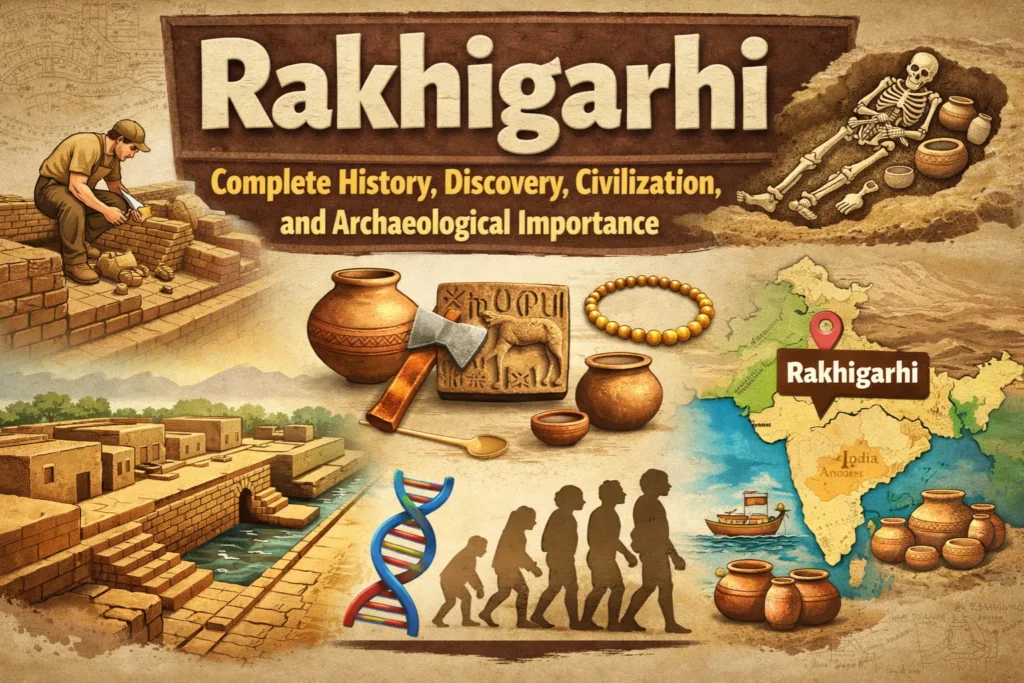
Rakhigarhi is one of the most important archaeological sites of the ancient Indus Valley Civilization and is considered the largest Harappan city discovered so far. Located in the Indian state of Haryana, Rakhigarhi has changed the way historians understand early urban life in South Asia. The site reveals advanced town planning, social organization, trade systems, and cultural traditions that existed more than 4,500 years ago.
Over the years, Rakhigarhi has attracted global attention because of its size, age, and scientific discoveries, including DNA studies that provide valuable information about ancient populations. Today, it stands as a key link in understanding the origins of Indian civilization.
Where Is Rakhigarhi Located
Rakhigarhi is located in Hisar district of Haryana, India. The site lies about 150 kilometers northwest of Delhi and near the Ghaggar River basin, which many scholars associate with the ancient Saraswati River mentioned in early texts.
The geographical location of Rakhigarhi was ideal for ancient settlement. Fertile plains, seasonal rivers, and access to trade routes helped the city grow into a major urban center of the Indus Valley Civilization.
Discovery of Rakhigarhi
Rakhigarhi was first identified in 1963 by archaeologist Suraj Bhan during a survey conducted by the Archaeological Survey of India. At that time, only limited excavation was carried out, and the true scale of the site was not fully understood.
Major excavations began in the 1990s and continued in later years under various archaeological teams. As digging progressed, researchers realized that Rakhigarhi was larger than Mohenjo-daro and Harappa, covering more than 350 hectares. This discovery placed Rakhigarhi at the center of Indus Valley research.
Historical Timeline of Rakhigarhi
Early Settlement Phase
Archaeological evidence shows that Rakhigarhi was inhabited as early as 7000 BCE. This early phase predates the mature Harappan period and indicates the gradual development of farming communities into urban societies.
Mature Harappan Period
Between 2600 BCE and 1900 BCE, Rakhigarhi reached its peak. During this time, the city expanded significantly and displayed all key features of the Indus Valley Civilization, including standardized bricks, drainage systems, and planned streets.
Decline Phase
After 1900 BCE, the city slowly declined. Environmental changes, river drying, and shifts in trade routes are believed to be major reasons for the abandonment of Rakhigarhi.
Rakhigarhi as the Largest Harappan Site
What makes Rakhigarhi unique is its enormous size. Archaeologists have identified at least seven major mounds, labeled RGR 1 to RGR 7. Each mound served a different purpose, such as residential areas, industrial zones, burial grounds, and administrative centers.
The scale of Rakhigarhi suggests that it was not just a city but possibly a regional capital that controlled surrounding settlements.
Town Planning and Architecture
Well-Planned Streets
Like other Harappan cities, Rakhigarhi followed a grid pattern. Roads were laid out in straight lines intersecting at right angles, showing advanced urban planning.
Standardized Bricks
Buildings were constructed using baked mud bricks of uniform size. This standardization reflects centralized planning and skilled craftsmanship.
Advanced Drainage System
One of the most impressive features of Rakhigarhi is its drainage system. Covered drains ran along streets and were connected to household outlets. This highlights the importance given to hygiene and sanitation.
Residential Houses
Homes varied in size, suggesting social diversity. Most houses had courtyards, kitchens, bathing areas, and storage rooms.
Daily Life in Rakhigarhi
Life in Rakhigarhi was organized, peaceful, and community-based. Archaeological remains provide insights into how people lived thousands of years ago.
People practiced agriculture, growing crops such as wheat, barley, rice, and legumes. Animal remains show domestication of cattle, buffalo, sheep, and goats.
Pottery, toys, beads, and tools indicate a rich daily life filled with art, craftsmanship, and trade activities.
Economy and Trade
Rakhigarhi played a major role in regional and long-distance trade.
Local Trade
The city exchanged goods with nearby settlements. Farmers, craftsmen, and traders worked together to support the urban economy.
Long-Distance Trade
Artifacts found at Rakhigarhi suggest trade links with regions as far as Afghanistan, Mesopotamia, and coastal Gujarat. Items such as semi-precious stones, shells, and metals were imported and exported.
Standardized weights and seals discovered at the site confirm organized commercial systems.
Artifacts Found at Rakhigarhi
Excavations at Rakhigarhi have uncovered a wide range of artifacts that reflect the technological and cultural excellence of the Harappans.
Common discoveries include pottery with geometric designs, copper tools, terracotta figurines, bangles, beads made of carnelian and lapis lazuli, and stone weights.
Seals featuring animals and symbols provide important clues about administration and communication.
Burial Practices and Human Remains
One of the most important discoveries at Rakhigarhi is its burial site. Archaeologists found well-planned cemeteries with rectangular graves.
Bodies were buried with pottery, ornaments, and food items, suggesting belief in an afterlife. Some graves also show symbolic burials without skeletons.
These burial practices closely resemble those of other Harappan cities, confirming cultural unity across the civilization.
DNA Research and Its Significance
A major breakthrough in Indian archaeology came from DNA analysis of human remains found at Rakhigarhi.
The study revealed that the people of the Indus Valley Civilization were primarily descended from ancient South Asian hunter-gatherers. The findings challenged earlier theories of large-scale migration during the Harappan period.
This research placed Rakhigarhi at the center of global discussions on human ancestry and civilization development.
Religious and Cultural Beliefs
Although no large temples have been found at Rakhigarhi, several artifacts hint at spiritual practices.
Terracotta figurines, fire altars, and symbolic objects suggest worship related to nature, fertility, and ritual purity. These early belief systems likely influenced later cultural traditions of the Indian subcontinent.
Comparison Between Rakhigarhi and Other Harappan Cities
Rakhigarhi shares many similarities with Mohenjo-daro and Harappa, such as city planning, drainage, and brick technology.
However, its larger area and early settlement layers make it unique. While Mohenjo-daro represents the southern region and Harappa the northern, Rakhigarhi connects both zones, showing cultural continuity across the civilization.
Importance of Rakhigarhi in Indian History
Rakhigarhi holds immense importance because it proves that one of the world’s earliest urban civilizations developed indigenously in the Indian subcontinent.
The site provides evidence of advanced science, engineering, trade, and social organization long before many other civilizations emerged.
It strengthens India’s role in global ancient history and helps redefine early human development.
Preservation and Conservation Efforts
Despite its historical value, Rakhigarhi faces threats from farming, construction, and natural erosion.
The Archaeological Survey of India and the Haryana government have taken steps to protect the site. Plans include creating a heritage museum, controlled excavations, and promoting cultural tourism.
Proper preservation is essential to protect Rakhigarhi for future generations.
Rakhigarhi Museum and Tourism Potential
A modern museum has been planned near the site to display artifacts, models, and research findings.
Once fully developed, Rakhigarhi has the potential to become one of India’s most important heritage tourism destinations, similar to Mohenjo-daro and Dholavira.
Educational tours, research centers, and guided visits can help spread awareness about India’s ancient past.
Why Rakhigarhi Matters Today
Rakhigarhi is not just an archaeological site; it is a reminder of human innovation, cooperation, and resilience.
The city shows that advanced urban life existed thousands of years ago without modern technology. Its discoveries continue to influence studies in archaeology, genetics, history, and anthropology.
Understanding Rakhigarhi helps modern society appreciate sustainable living, planned cities, and respect for natural resources.
Read also: Lothal: Complete History, Discovery, Dockyard, Civilization, and Importance
Conclusion
Rakhigarhi stands as a powerful symbol of the Indus Valley Civilization’s greatness. From its massive size and scientific planning to its role in rewriting ancient history, the site continues to reveal new secrets with every excavation.
As research advances, Rakhigarhi is expected to provide even deeper insights into the origins of civilization in South Asia. Preserving and studying this ancient city is not only important for India but for the entire world, as it represents one of humanity’s earliest steps toward organized urban life.