
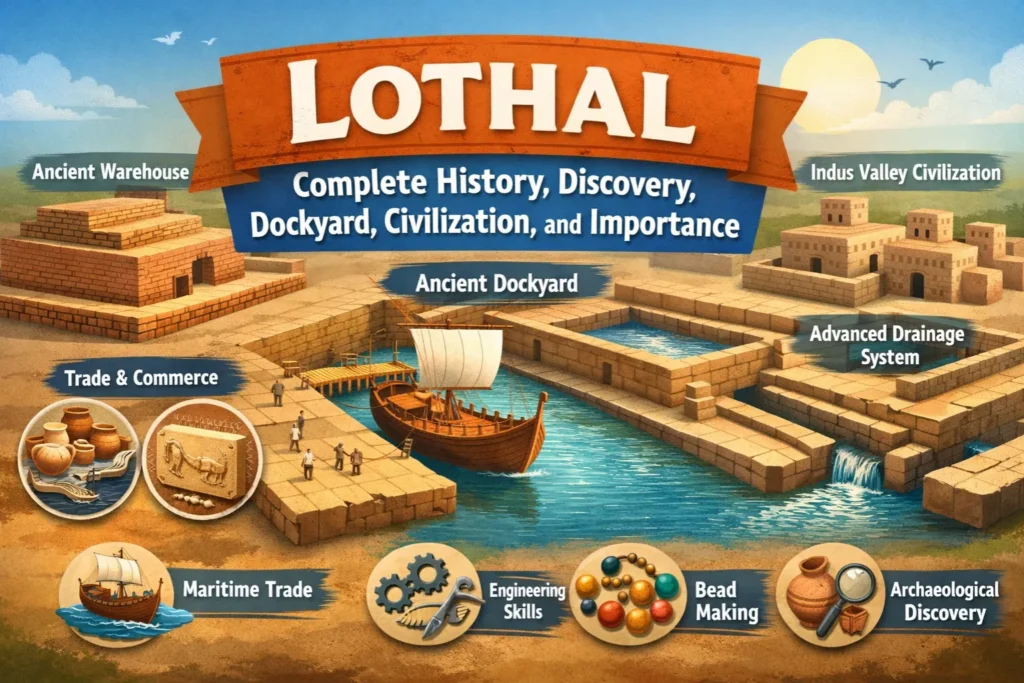
Lothal is one of the most important archaeological sites of the ancient Indus Valley Civilization and holds a special place in Indian history. Located in present-day Gujarat, Lothal gives us valuable information about early urban planning, maritime trade, engineering skills, and daily life of people who lived more than 4,000 years ago. This ancient city proves that the Indus Valley people were not only skilled builders but also excellent traders who maintained contacts with distant lands.
The ruins of Lothal reveal a well-planned town with advanced drainage systems, organized streets, warehouses, and the world’s earliest known dockyard. Because of these remarkable discoveries, Lothal is considered one of the greatest achievements of the Harappan Civilization.
Where Is Lothal Located
Lothal is situated in the Bhal region of Gujarat, about 85 kilometers southwest of Ahmedabad. The site lies near the Sabarmati River and was once connected to the Arabian Sea through ancient river channels. This geographical position played a major role in making Lothal a flourishing port city.
During ancient times, the region had access to tidal waters, which allowed ships to move in and out easily. This natural advantage helped Lothal become an important center of trade and commerce in the Indus Valley Civilization.
Discovery of Lothal
Lothal was discovered in 1954 by the Archaeological Survey of India under the leadership of archaeologist S. R. Rao. Excavations were carried out between 1955 and 1960, revealing a well-organized city buried under layers of soil.
The discovery of Lothal was groundbreaking because it confirmed that the Harappan people had advanced knowledge of navigation and sea trade. The dockyard structure found at the site changed the way historians understood ancient Indian maritime history.
Meaning of the Name Lothal
The name Lothal comes from two Gujarati words: “Loth” meaning dead and “Thal” meaning mound. Together, the name means “Mound of the Dead.” This name was given by local villagers long before archaeologists understood its historical importance.
Despite its name, Lothal was once a lively and prosperous city filled with workshops, markets, houses, and bustling trade activity.
Lothal in the Indus Valley Civilization
Lothal was part of the mature phase of the Indus Valley Civilization, dating from around 2400 BCE to 1900 BCE. Along with major cities like Harappa and Mohenjo-daro, Lothal played a crucial role in economic and cultural development.
What makes Lothal unique is its coastal location and strong connection to maritime trade. While cities like Harappa were land-based trade centers, Lothal served as a gateway between inland cities and overseas markets.
Town Planning of Lothal
The town planning of Lothal reflects exceptional engineering skills. The city was divided into two main parts: the citadel and the lower town.
The citadel was built on a raised platform and contained important administrative buildings, warehouses, and possibly the residence of rulers. The lower town housed common people, craftsmen, and traders.
Streets in Lothal followed a grid pattern, intersecting at right angles. Houses were built using baked bricks of uniform size, showing strict construction standards across the city.
Advanced Drainage System
One of the most impressive features of Lothal is its advanced drainage system. Covered drains ran along the streets and were connected to individual houses. These drains had inspection holes for cleaning, which shows careful urban planning.
Wastewater flowed out of the city without contaminating living areas. This system was far ahead of its time and proves that cleanliness and hygiene were major concerns for the Harappan people.
The Famous Dockyard of Lothal
World’s Oldest Known Dockyard
The dockyard of Lothal is considered the world’s earliest known dock built for maritime trade. It is a massive structure made of baked bricks, measuring approximately 214 meters long and 36 meters wide.
The dockyard was connected to an ancient river channel, allowing ships to enter during high tide. A sophisticated system of sluice gates regulated water levels and prevented silting.
Purpose of the Dockyard
The dockyard was used for loading and unloading goods, repairing ships, and managing overseas trade. Its strategic design protected ships from strong tidal currents while maintaining enough water depth for navigation.
This discovery proves that Lothal was a major port city and one of the earliest examples of organized maritime infrastructure in the world.
Warehouse and Trade Storage
Near the dockyard, archaeologists discovered a large warehouse built on a high brick platform. The warehouse had multiple square platforms where goods were stored safely above ground level.
This structure indicates systematic trade management and centralized control of commercial activities. Goods arriving from foreign lands were likely stored here before distribution to other Indus cities.
Trade and Commerce in Lothal
Trade was the backbone of Lothal’s economy. The city had both inland and overseas trade connections.
Domestic Trade
Lothal traded extensively with other Indus Valley cities such as Mohenjo-daro, Harappa, Dholavira, and Kalibangan. Goods were transported through river routes and land caravans.
International Trade
Archaeological evidence suggests trade links with Mesopotamia, Bahrain, Oman, and regions of present-day Iran. Seals, beads, and pottery found in foreign lands support this claim.
Exports from Lothal included beads, jewelry, cotton textiles, ivory items, and metal tools. Imports included copper, semi-precious stones, and luxury items.
Bead-Making Industry of Lothal
Lothal was one of the most important bead-manufacturing centers of the ancient world. Thousands of beads made from carnelian, agate, jasper, and lapis lazuli have been found at the site.
The craftsmen used advanced techniques such as drilling with precision tools. The uniform size and high quality of beads show mass production under skilled supervision.
Beads from Lothal were highly valued and exported to distant regions, making the city famous among ancient traders.
Weights and Measures System
The people of Lothal followed a standardized system of weights and measures. Cubical stone weights were used for trade transactions, ensuring fairness and accuracy.
These weights follow the same ratio found across the Indus Valley Civilization, proving strong administrative control and economic unity.
Pottery and Artifacts
Pottery found at Lothal includes painted jars, bowls, dishes, and storage vessels. Many pieces display geometric patterns, animal figures, and natural motifs.
Other important artifacts discovered include seals, terracotta figurines, tools, copper objects, and ornaments. These findings provide insight into the artistic skills and cultural beliefs of the people.
Seals of Lothal
Seals were an essential part of trade and administration. Lothal seals were usually square and made of steatite.
They often featured animals such as bulls, unicorns, elephants, and goats, along with inscriptions written in the Indus script. These seals were used to mark ownership and authenticate goods.
Religious Beliefs and Practices
Although no large temples have been found, evidence suggests that the people of Lothal followed nature-based worship.
Fire altars discovered at the site indicate ritual practices involving fire. Figurines of animals and mother goddess-like figures suggest fertility worship.
Religion in Lothal appears to have been simple and closely connected to natural elements.
Daily Life in Lothal
Life in Lothal was well-organized and peaceful. People lived in brick houses with courtyards, bathrooms, and wells.
The presence of workshops shows that many residents were craftsmen, traders, sailors, and laborers. Fishing, farming, bead-making, pottery, and trade were common occupations.
Food habits included wheat, barley, rice, fish, and dairy products. The discovery of tools and cooking vessels supports this lifestyle.
Scientific Knowledge and Engineering Skills
The city of Lothal reflects remarkable scientific understanding. Engineers carefully calculated brick dimensions, slope gradients, water flow, and tidal movements.
The dockyard alone demonstrates advanced knowledge of hydraulics and marine engineering, unmatched in the ancient world.
Decline of Lothal
Around 1900 BCE, Lothal began to decline. Several factors contributed to its downfall.
Frequent floods damaged the dockyard and residential areas. Changes in river courses reduced access to the sea, affecting trade. Earthquakes may also have played a role.
As trade declined, the city gradually lost its importance, and people eventually abandoned it.
Archaeological Importance of Lothal
Lothal is one of the most valuable archaeological sites in India. It provides clear evidence of:
• Early maritime trade
• Advanced urban planning
• Standardized economic systems
• Skilled craftsmanship
• Scientific engineering
The site has helped historians understand the economic strength and global connections of the Indus Valley Civilization.
Lothal Museum
The Lothal Archaeological Museum houses many artifacts found during excavation. Visitors can see beads, seals, tools, pottery, ornaments, and models of the dockyard.
The museum plays an important role in preserving and presenting the rich heritage of Lothal to the public.
Lothal in Modern Education
Lothal is an important topic in Indian history textbooks. It is studied to understand early urban development, trade systems, and technological advancement.
The site also inspires research in archaeology, marine history, and ancient engineering.
Lothal Today
Today, Lothal is a protected archaeological site maintained by the Archaeological Survey of India. Efforts are ongoing to conserve the ruins and promote heritage tourism.
The Government of India has also proposed the National Maritime Heritage Complex near Lothal to highlight India’s ancient naval traditions.
Why Lothal Is Historically Important
Lothal stands as strong evidence that ancient India had advanced port management, international trade networks, and scientific planning long before many other civilizations.
It proves that the Indus Valley Civilization was not isolated but deeply connected with the ancient world.
Read also: Kalibangan: Complete History, Discovery, Civilization Features, and Archaeological Importance
Conclusion
Lothal is not just an ancient ruin but a powerful symbol of human innovation, intelligence, and cooperation. Its dockyard, warehouses, drainage system, and trade network reflect a civilization far ahead of its time.
By studying Lothal, we gain a deeper understanding of how early humans organized cities, managed trade, respected planning, and lived in harmony with nature. Even after thousands of years, Lothal continues to teach valuable lessons about sustainable development, engineering excellence, and cultural unity.
The legacy of Lothal remains one of the brightest chapters in the history of the Indus Valley Civilization and the ancient world.