
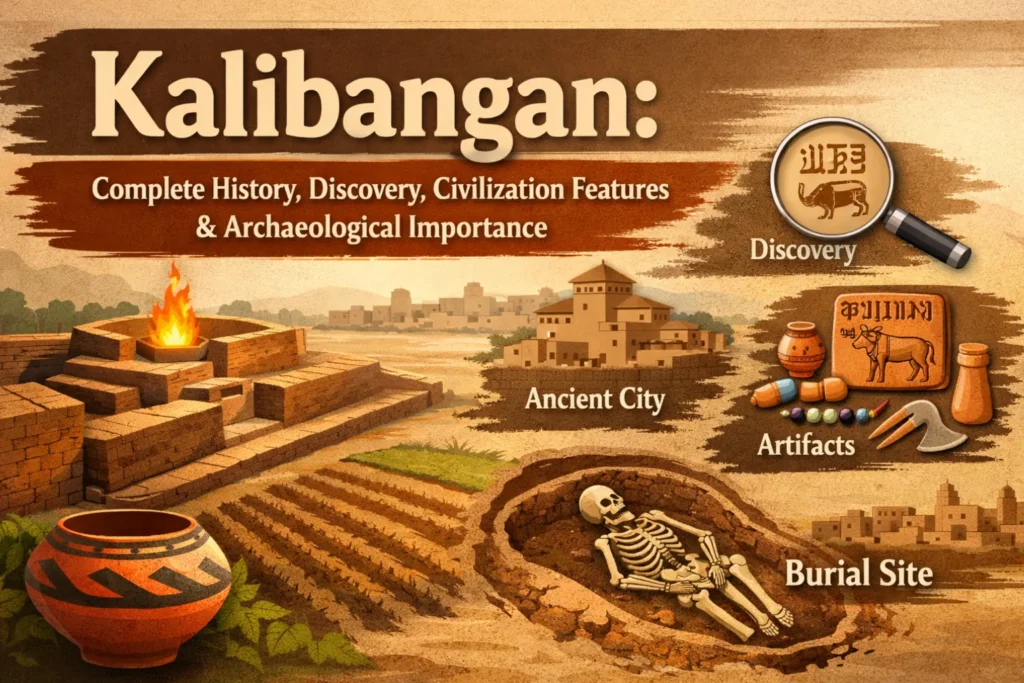
Kalibangan is one of the most important archaeological sites of the ancient Indus Valley Civilization and holds a special place in the history of early India. Located in present-day Rajasthan, this ancient city provides valuable information about town planning, religious practices, agriculture, and daily life during one of the world’s earliest urban civilizations.
Kalibangan is unique because it clearly shows both pre-Harappan and Harappan phases of development at the same site. Through its ruins, fire altars, streets, houses, pottery, and seals, historians have gained deep insight into how people lived nearly 4,500 years ago.
Where Is Kalibangan Located
Kalibangan is situated in the Hanumangarh district of Rajasthan, India. The site lies on the left bank of the Ghaggar River, which many scholars identify with the ancient Saraswati River mentioned in early Indian texts.
The dry riverbed near Kalibangan suggests that the city once depended heavily on river water for agriculture and daily use. When the river gradually dried up, it likely played a major role in the decline of the settlement.
Meaning of the Name Kalibangan
The name Kalibangan comes from two Hindi words: “Kali” meaning black and “Bangan” meaning bangles. Large numbers of black bangles were found at the site, which led local people to call it Kalibangan, or the place of black bangles.
Discovery of Kalibangan
Kalibangan was discovered in 1953 by the Archaeological Survey of India. The major excavation work was carried out between 1960 and 1969 under the leadership of archaeologist B. B. Lal and later by B. K. Thapar.
This excavation proved extremely important because it confirmed that the Indus Valley Civilization extended far beyond Punjab and Sindh and had a strong presence in Rajasthan as well.
Historical Timeline of Kalibangan
Kalibangan shows two major cultural phases that help historians understand its long history.
Pre-Harappan Phase
The earliest settlement at Kalibangan dates back to around 3500 BCE. During this period, people lived in mud-brick houses, used handmade pottery, and practiced early agriculture. This phase shows the gradual development of urban life before the mature Harappan period.
Harappan Phase
The mature Harappan phase at Kalibangan began around 2600 BCE. During this time, the city adopted standardized bricks, advanced town planning, drainage systems, and trade networks similar to Harappa and Mohenjo-daro.
The presence of both phases at one site makes Kalibangan extremely valuable for archaeological study.
Town Planning in Kalibangan
The town planning of Kalibangan reflects a high level of engineering skill and administrative control.
The city was divided into two main parts:
Citadel Area
The citadel stood on a raised platform and was probably used for religious and administrative activities. It contained important structures such as fire altars and ceremonial spaces.
Lower Town
The lower town was meant for common people. It had well-planned streets, residential houses, wells, and drainage channels.
The streets intersected at right angles, forming a grid pattern, which shows advanced urban planning similar to other Indus cities.
Architecture and Buildings
Buildings in Kalibangan were mainly constructed using mud bricks instead of baked bricks, which were more common in cities like Mohenjo-daro.
Houses were built along the streets and usually had multiple rooms, courtyards, kitchens, and storage areas. Many homes had private wells, indicating awareness of hygiene and water management.
Drainage System
Although simpler than the drainage systems of Harappa, Kalibangan still had a planned drainage network. Wastewater from houses flowed into street drains made of mud bricks.
This shows that cleanliness and sanitation were important aspects of daily life in the city.
Fire Altars of Kalibangan
One of the most unique discoveries at Kalibangan is the presence of fire altars.
Several fire altars were found in rows within the citadel area. These structures strongly suggest ritual practices involving fire worship. This is one of the earliest archaeological proofs of fire rituals in the Indian subcontinent.
Some scholars believe these rituals may be linked to later Vedic traditions, though this remains a topic of debate.
Agricultural Evidence at Kalibangan
Kalibangan provides the earliest known evidence of ploughed agricultural fields in the world.
Archaeologists discovered furrow marks arranged in a crisscross pattern, indicating advanced farming methods. This system allowed farmers to grow two crops simultaneously, such as barley and mustard.
This discovery highlights the scientific knowledge and agricultural planning of the Indus Valley people.
Crops Grown by the People
The people of Kalibangan cultivated a variety of crops, including:
- Wheat
- Barley
- Mustard
- Gram
The fertile soil of the Ghaggar river basin supported farming, but dependency on seasonal river water made the settlement vulnerable to climate changes.
Pottery and Artifacts
Large quantities of pottery were found at Kalibangan, including both pre-Harappan and Harappan styles.
Common pottery designs included geometric patterns, animal figures, and linear motifs painted in black and red colors. These designs show artistic skills and cultural symbolism.
Other artifacts discovered include:
- Terracotta toys
- Beads made of carnelian and shell
- Copper tools
- Bangles
- Seals with animal motifs
Seals and Script
Several seals were found at Kalibangan, though fewer compared to major cities like Harappa.
These seals contained animal figures such as bulls and symbolic signs of the Indus script. The script remains undeciphered, but it is believed to represent administrative or trade-related communication.
Trade and Economic Life
Kalibangan was connected to other Indus Valley cities through trade networks.
Archaeological findings suggest trade links with:
- Harappa
- Mohenjo-daro
- Lothal
- Gujarat coastal regions
Items such as beads, metals, shells, and pottery were exchanged, indicating a strong economic system.
Social Life of Kalibangan People
The social structure of Kalibangan appears to be well-organized.
The separation between the citadel and the lower town suggests some form of social or administrative hierarchy. However, there is no evidence of palaces, temples, or royal tombs, indicating a relatively equal society.
Daily life revolved around farming, craftwork, trade, and religious activities.
Religious Beliefs and Practices
Religion played an important role in Kalibangan society.
The discovery of fire altars, animal figurines, and symbolic seals suggests ritual worship. Unlike other Indus sites, no Great Bath or large temple has been found here.
This shows that religious practices varied across different regions of the Indus Valley Civilization.
Burial Practices
Burial sites at Kalibangan provide important clues about beliefs related to death.
Three types of burials have been identified:
- Extended burials with skeletons
- Pot burials containing remains
- Symbolic burials without human remains
These different methods suggest complex beliefs about life after death.
Decline of Kalibangan
Kalibangan began to decline around 1900 BCE.
The major reasons behind its abandonment include:
- Drying of the Ghaggar River
- Climate change and reduced rainfall
- Agricultural failure
- Breakdown of trade networks
As water sources disappeared, people gradually migrated to other regions.
Importance of Kalibangan in Indian History
Kalibangan holds great importance for understanding ancient Indian civilization.
It proves that the Indus Valley Civilization extended into Rajasthan and was not limited to Punjab and Sindh alone. The site also provides early evidence of agriculture, fire worship, and urban planning.
Its pre-Harappan layers help historians trace the gradual evolution of urban culture in India.
Kalibangan Compared to Other Indus Sites
Kalibangan differs from other Indus Valley cities in several ways.
Unlike Mohenjo-daro, it lacks baked brick structures. Unlike Harappa, it shows strong ritual evidence through fire altars. Unlike Dholavira, it does not have massive stone architecture.
These differences show that the Indus Civilization was not uniform but adapted to local geography and resources.
Archaeological Preservation Today
Today, Kalibangan is protected by the Archaeological Survey of India. The ruins are open to visitors, and ongoing research continues to uncover new details about the site.
Museums nearby display important findings such as pottery, seals, tools, and ornaments recovered during excavations.
Why Kalibangan Is Still Relevant Today
Kalibangan remains highly relevant in modern times because it helps us understand sustainable living, water management, and early scientific agriculture.
Its rise and fall remind us of the importance of natural resources and environmental balance. The city’s decline due to river drying offers valuable lessons for present-day societies facing climate change.
Read also: Dholavira: Complete History, Discovery, Civilization, and Importance
Conclusion
Kalibangan stands as a remarkable symbol of human achievement in ancient India. From its advanced town planning and agricultural innovation to its unique fire altars and cultural traditions, the site offers a detailed picture of life during the Indus Valley Civilization.
As one of the few sites showing both early and mature Harappan phases, Kalibangan plays a crucial role in understanding how one of the world’s oldest civilizations developed, flourished, and eventually disappeared.
Even after thousands of years, Kalibangan continues to speak through its ruins, reminding us of the intelligence, adaptability, and creativity of our ancient ancestors.