
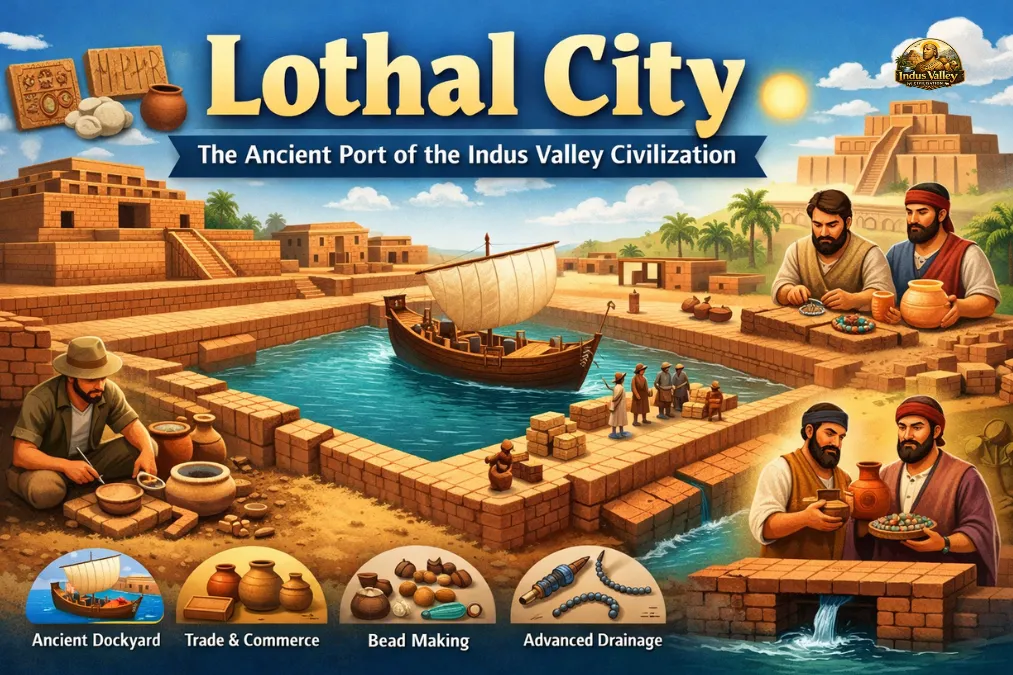
Lothal city is one of the most remarkable archaeological sites of the ancient Indus Valley Civilization and plays a crucial role in understanding early urban development in the Indian subcontinent. Located in the present-day state of Gujarat, Lothal city was once a thriving port and commercial hub that connected ancient India with distant civilizations through maritime trade.
The remains of Lothal city show that it was a carefully planned settlement with advanced infrastructure, organized streets, drainage systems, industrial workshops, and one of the earliest known dockyards in the world. Archaeologists believe that the city flourished around 2400 BCE and served as a major center of trade, craftsmanship, and cultural exchange. Today, Lothal city is considered one of the most important archaeological discoveries in India because it reveals the technological achievements and urban planning skills of the Indus Valley people.
Historical Background of Lothal City
Lothal city was part of the Indus Valley Civilization, also known as the Harappan Civilization, which existed between approximately 2600 BCE and 1900 BCE. This civilization is recognized as one of the earliest urban cultures in the world and was spread across large areas of present-day India and Pakistan.
The archaeological site of Lothal city was discovered in 1954 by the Archaeological Survey of India. Excavations conducted between 1955 and 1960 under the leadership of archaeologist S. R. Rao revealed the remains of a sophisticated port town with impressive urban planning and advanced trade systems.
The name Lothal is believed to mean “Mound of the Dead” in Gujarati. The site was strategically located near the Sabarmati River and the Gulf of Khambhat, which made it ideal for maritime trade and transportation.
Important Historical Facts About Lothal City
| Feature | Details |
|---|---|
| Civilization | Indus Valley Civilization |
| Estimated Time Period | Around 2400 BCE |
| Discovery Year | 1954 |
| Excavation Period | 1955–1960 |
| Lead Archaeologist | S. R. Rao |
| Present Location | Gujarat, India |
| Historical Importance | Ancient port and trade center |
These discoveries confirmed that Lothal city was not only an important settlement but also a major hub of international trade in ancient times.
Geographic Location and Strategic Importance of Lothal City
Lothal city is located in the Bhal region of Gujarat, approximately 80 kilometers southwest of Ahmedabad. Its location near rivers and the Arabian Sea played a key role in the development of trade and commerce.
The nearby waterways allowed ships to travel between Lothal city and distant regions such as Mesopotamia and the Persian Gulf. This made the city an essential part of ancient maritime trade networks.
The surrounding fertile land also supported agriculture, which provided food for the city’s residents. Farmers cultivated crops such as wheat, barley, and rice, while fishermen and traders contributed to the local economy.
Urban Planning and Architecture of Lothal City
One of the most impressive aspects of Lothal city is its well-organized urban planning. The city layout reflects a high level of engineering knowledge and civic management.
The city was divided into two main parts: the upper town and the lower town. The upper town was built on a raised platform and likely served administrative and elite functions. Important structures such as warehouses and official buildings were located in this area.
The lower town consisted mainly of residential neighborhoods. Houses were constructed using baked bricks and were arranged along straight streets that intersected at right angles, forming a grid-like pattern.
Another notable feature of Lothal city was its advanced drainage system. Almost every house had a bathroom connected to underground drains, which carried wastewater away from residential areas.
Key Urban Features of Lothal City
| Urban Feature | Description |
|---|---|
| City Layout | Divided into upper town and lower town |
| Street Planning | Grid pattern with straight intersecting roads |
| Building Material | Baked bricks |
| Drainage System | Covered drains connected to houses |
| Public Infrastructure | Warehouses and dockyard |
| Water Supply | Wells and drainage channels |
This level of planning demonstrates the sophisticated understanding of urban management among the people of Lothal city.
The Famous Dockyard of Lothal City
One of the most remarkable discoveries at Lothal city is its dockyard, which is widely considered one of the earliest known dockyards in the world. This structure highlights the city’s importance as a major maritime trading center.
The dockyard was a large rectangular basin connected to a nearby river channel. It allowed ships to dock safely and facilitated the loading and unloading of goods. Engineers designed the dockyard in a way that protected it from tidal fluctuations and flooding.
The dockyard had a sophisticated water control system that helped regulate water levels during high tides and heavy rainfall. This indicates that the people of Lothal city possessed advanced knowledge of hydraulic engineering.
Dockyard Specifications of Lothal City
| Feature | Details |
|---|---|
| Type | Rectangular dock basin |
| Purpose | Maritime trade and ship docking |
| Water Connection | Linked to nearby river channel |
| Engineering Feature | Water regulation system |
| Historical Importance | One of the earliest dockyards in the world |
The existence of this dockyard suggests that Lothal city maintained strong maritime connections with distant civilizations.
Trade and Economy of Lothal City
Trade played a central role in the prosperity of Lothal city. The port allowed merchants to exchange goods with other regions, making the city an important commercial hub in ancient times.
Archaeologists have discovered many artifacts that indicate active trade activities. These include beads, shells, ivory objects, pottery, and metal tools. The people of Lothal city were particularly famous for their bead-making industry.
Beads made from carnelian, agate, and jasper were highly valued and were exported to foreign markets. Evidence suggests that traders from Lothal city conducted trade with Mesopotamia, where similar artifacts have been discovered.
Major Trade Goods from Lothal City
| Product | Material | Use |
|---|---|---|
| Beads | Carnelian, agate, jasper | Jewelry and trade |
| Pottery | Clay | Storage and domestic use |
| Ivory Products | Ivory | Decorative items |
| Copper Tools | Copper | Tools and weapons |
| Cotton Textiles | Cotton | Clothing and export goods |
The presence of standardized weights and measuring scales found at the site also shows that the trade system in Lothal city was highly organized.
Industries and Craftsmanship in Lothal City
Lothal city was not only a trading center but also a place where many skilled craftsmen worked. Several industries operated within the city, producing goods that were used locally and exported to other regions.
The bead-making industry was one of the most advanced crafts in the city. Archaeologists discovered workshops where artisans shaped, polished, and drilled beads with great precision.
Pottery production was another important industry. Potters created a variety of ceramic vessels used for cooking, storage, and trade. Many pottery items were decorated with geometric patterns and artistic designs.
Metalworking was also practiced in Lothal city. Craftsmen used copper and bronze to produce tools, ornaments, and household objects.
Major Industries in Lothal City
| Industry | Products Produced |
|---|---|
| Bead Making | Decorative beads and jewelry |
| Pottery | Storage jars, bowls, and utensils |
| Metalworking | Tools, ornaments, weapons |
| Ivory Craft | Decorative items |
| Textile Production | Cotton fabrics |
These industries helped support the economic strength and trade reputation of Lothal city.
Daily Life of People in Lothal City
The archaeological remains of Lothal city provide valuable insights into the everyday life of its residents. The population included traders, craftsmen, farmers, and administrators who contributed to the development of the city.
Most houses were built with baked bricks and included several rooms surrounding a central courtyard. Many homes also had private wells, bathrooms, and drainage systems, indicating a comfortable standard of living.
Food was mainly based on agricultural products. The people consumed grains such as wheat, barley, and rice, along with vegetables and fish. Archaeological evidence also shows the use of cooking utensils and storage jars.
Religion and cultural practices were also part of life in Lothal city. Terracotta figurines, seals, and ritual objects discovered at the site suggest that the residents followed spiritual traditions and participated in ceremonial activities.
Archaeological Discoveries at Lothal City
Excavations at Lothal city have uncovered numerous artifacts that reveal the advanced culture and technological knowledge of the Indus Valley Civilization.
Among the most important discoveries are seals made of steatite, which often feature animal figures and mysterious symbols belonging to the undeciphered Indus script. These seals were likely used for trade identification and administrative purposes.
Archaeologists also discovered a large warehouse located near the dockyard. The warehouse had multiple platforms where goods were stored before being shipped to other regions.
Important Archaeological Discoveries at Lothal City
| Discovery | Significance |
|---|---|
| Dockyard | Evidence of maritime trade |
| Warehouse | Storage and trade management |
| Seals with Indus Script | Administrative and trade records |
| Bead Workshops | Advanced craftsmanship |
| Standard Weights | Organized commercial system |
These discoveries help historians better understand the social, economic, and technological development of Lothal city.
Decline of Lothal City
Despite its prosperity, Lothal city eventually declined and was abandoned. Historians believe that natural disasters and environmental changes may have contributed to its downfall.
One possible reason is repeated flooding. The region where Lothal city was located was prone to floods, which could have damaged the dockyard, homes, and infrastructure.
Another possible factor was the shifting of river channels. If waterways connecting the city to the sea changed course, it would have affected maritime trade and transportation.
Over time, these challenges may have led to the gradual abandonment of Lothal city.
Also read: Lothal India: Exploring the Ancient Harappan Port City and Its Remarkable History
Lothal City as a Modern Archaeological Site
Today, Lothal city is one of the most important archaeological attractions in India. The site attracts historians, archaeologists, students, and tourists who are interested in ancient civilizations.
The Archaeological Survey of India has preserved the ruins and established a museum near the site. The museum displays artifacts discovered during excavations, including beads, pottery, seals, tools, and ornaments.
Visitors can explore the remains of the dockyard, drainage systems, warehouses, and residential structures that once formed the thriving settlement of Lothal city.
Cultural and Historical Importance of Lothal City
Lothal city represents the remarkable achievements of the Indus Valley Civilization in urban planning, trade, and engineering. The city’s dockyard, drainage systems, and industrial workshops demonstrate the advanced knowledge possessed by its inhabitants.
The discoveries made at Lothal city continue to help researchers understand the economic and cultural connections between ancient civilizations. The site proves that early societies were capable of developing complex trade networks and well-organized urban centers.
Also read: Lothal Dockyard: The World’s Oldest Known Maritime Engineering Marvel
Conclusion
Lothal city remains one of the most fascinating archaeological sites in the world. As an important port of the Indus Valley Civilization, it played a crucial role in connecting ancient India with distant regions through maritime trade.
The well-planned streets, advanced drainage systems, industrial workshops, and impressive dockyard highlight the technological brilliance of the people who lived in Lothal city. Even today, the ruins of this ancient settlement continue to inspire historians and researchers.
By studying Lothal city, we gain a deeper understanding of early human civilization and the remarkable achievements of the Indus Valley people. The site stands as a powerful reminder of India’s rich cultural heritage and its long history of innovation, trade, and urban development.