
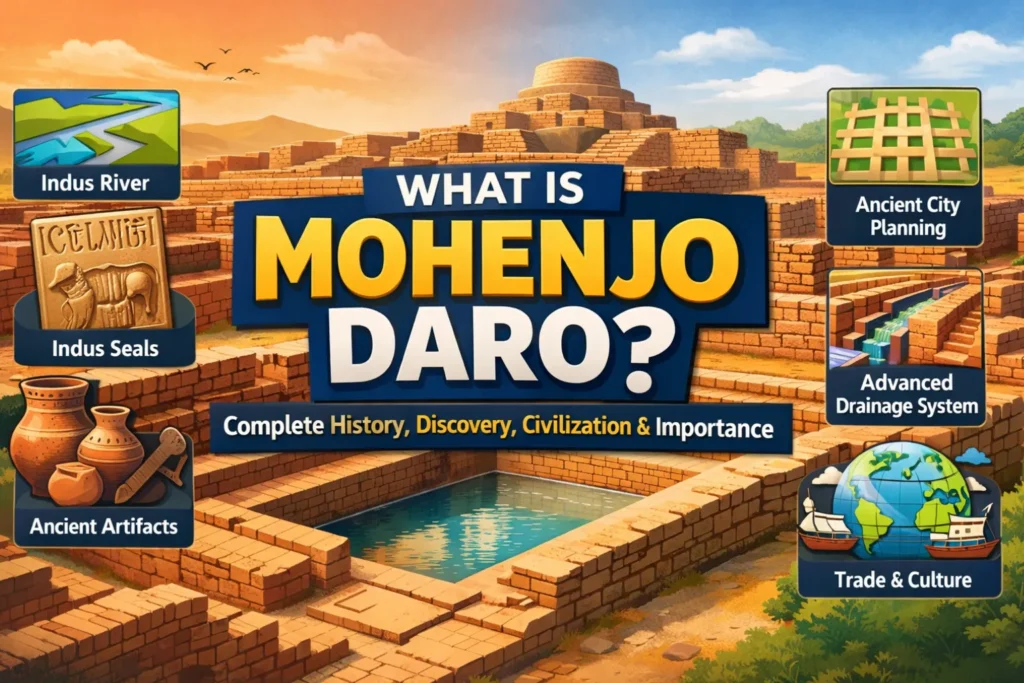
What is mohenjo daro is one of the most common questions asked when learning about the ancient Indus Valley Civilization. Mohenjo Daro was one of the world’s earliest and most advanced urban cities, built more than 4,500 years ago in the region that is now Pakistan. It represents a remarkable achievement in early human planning, architecture, sanitation, and social organization.
This ancient city provides deep insight into how early civilizations lived, governed, and developed complex systems without modern technology. Even today, Mohenjo Daro continues to amaze historians, archaeologists, and students across the world.
What Is Mohenjo Daro
Mohenjo Daro was a major city of the Indus Valley Civilization, also known as the Harappan Civilization. The name “Mohenjo Daro” means “Mound of the Dead,” which was given long after the city had disappeared.
The city was built around 2500 BCE and flourished for several centuries. It was one of the largest settlements of its time, covering nearly 300 hectares and supporting tens of thousands of people.
Unlike many ancient cities, Mohenjo Daro shows no evidence of kings, palaces, or large temples. This suggests that the society may have been organized in a more equal and systematic way rather than ruled by powerful monarchs.
Location of Mohenjo Daro
Mohenjo Daro is located in the Sindh province of present-day Pakistan. It lies on the western bank of the Indus River, which played a crucial role in the city’s growth and prosperity.
The fertile plains around the river supported agriculture, trade, and transportation. The Indus River also connected Mohenjo Daro with other cities of the civilization, such as Harappa, Dholavira, and Lothal.
Discovery of Mohenjo Daro
Mohenjo Daro was discovered in 1922 by Indian archaeologist R. D. Banerji during excavations conducted by the Archaeological Survey of India. At that time, no one expected to uncover a civilization older than ancient Egypt and Mesopotamia.
The discovery completely changed the understanding of early human history in South Asia. It proved that an advanced urban civilization had existed thousands of years earlier than previously believed.
Historical Background
The Indus Valley Civilization developed around 3300 BCE and reached its peak between 2600 BCE and 1900 BCE. Mohenjo Daro emerged as one of its most important urban centers.
The civilization spread across modern-day Pakistan and northwest India, covering an area larger than both Mesopotamia and Egypt combined. Mohenjo Daro functioned as a key administrative, commercial, and cultural hub within this vast region.
City Planning and Urban Design
One of the most impressive features of Mohenjo Daro is its advanced city planning. The city was carefully laid out in a grid pattern with straight streets intersecting at right angles.
The city was divided into two main parts:
The Citadel
The citadel was built on a raised platform and contained important public structures. It likely served religious, administrative, or ceremonial purposes.
The Lower City
The lower city was where most people lived. Houses varied in size, suggesting different social or economic levels, but all followed a similar architectural design.
This uniformity shows that the city followed strong planning rules and building standards.
Advanced Drainage System
The drainage system of Mohenjo Daro is considered one of the most advanced of the ancient world.
Every house had access to:
- Covered brick drains
- Bathrooms connected to street drains
- Inspection holes for cleaning
Wastewater flowed through underground drains made of baked bricks, which were far superior to the open drainage systems of other ancient civilizations.
This shows that public hygiene and sanitation were major priorities.
Houses and Buildings
Homes in Mohenjo Daro were built using standardized baked bricks. Most houses had:
- Flat roofs
- Central courtyards
- Wells for water
- Separate bathing areas
Some larger houses had multiple rooms and staircases, suggesting that they may have been two stories high.
The presence of private wells indicates a strong understanding of water management.
The Great Bath
The Great Bath is the most famous structure found at Mohenjo Daro.
It is a large rectangular tank made of finely fitted bricks and sealed with natural tar to make it waterproof. Steps on both sides allowed people to enter the water.
Historians believe the Great Bath was used for religious or ritual bathing, possibly symbolizing purification ceremonies.
It is one of the earliest known public water tanks in human history.
Granaries and Storage Systems
Large brick structures believed to be granaries were discovered near the citadel. These buildings had ventilation systems and raised platforms to protect grain from moisture and pests.
This suggests organized food storage and possibly centralized distribution, which would have been essential for managing a large urban population.
Economy and Trade
The economy of Mohenjo Daro was based on agriculture, craftsmanship, and trade.
Main agricultural products included:
- Wheat
- Barley
- Cotton
- Dates
Mohenjo Daro was also a major trading center. Archaeological evidence shows trade links with:
- Mesopotamia
- Persia
- Afghanistan
Seals found in the city have been discovered in distant regions, proving long-distance trade networks.
Art and Craftsmanship
The people of Mohenjo Daro were highly skilled artisans. Excavations have revealed:
- Beads made of carnelian and lapis lazuli
- Pottery with geometric designs
- Shell ornaments
- Metal tools made of copper and bronze
These objects show artistic sense, technological knowledge, and commercial activity.
Seals and Script
Thousands of seals have been found at Mohenjo Daro. These seals usually feature animals such as bulls, elephants, and unicorn-like figures, along with symbols.
The Indus script remains undeciphered, making it one of the greatest mysteries of ancient history.
Although scholars have not yet been able to read the script, it likely served administrative or commercial purposes.
Social Life and Society
The society of Mohenjo Daro appears to have been peaceful and well-organized.
There is little evidence of:
- Weapons of war
- Large armies
- Fortified defenses
This suggests that the civilization focused more on trade, planning, and community living rather than military conquest.
The standardized lifestyle indicates equality and shared civic responsibility.
Religion and Beliefs
The exact religion of Mohenjo Daro is unknown, but archaeological evidence provides clues.
Figures and seals suggest:
- Worship of nature
- Reverence for animals
- Possible proto-Shiva figure in meditation posture
- Importance of ritual bathing
These beliefs may have influenced later religious traditions in the Indian subcontinent.
Technology and Scientific Knowledge
Mohenjo Daro demonstrated advanced knowledge in:
- Brick-making with precise ratios
- Measurement systems
- Geometry and town planning
- Hydraulic engineering
The uniform brick size used throughout the city shows centralized control and scientific precision.
Decline of Mohenjo Daro
Around 1900 BCE, Mohenjo Daro began to decline. The exact reasons are still debated.
Possible causes include:
- Climate change and reduced rainfall
- Shifting course of the Indus River
- Repeated flooding
- Decline in trade
- Environmental degradation
There is no strong evidence of invasion or war, which makes the collapse even more mysterious.
Importance of Mohenjo Daro in History
Mohenjo Daro holds immense historical significance because it proves that urban civilization developed independently in South Asia.
It highlights:
- Early democratic-style city planning
- Public welfare systems
- Advanced sanitation
- Peaceful urban living
Its achievements rival those of Egypt and Mesopotamia.
Mohenjo Daro as a UNESCO World Heritage Site
In 1980, Mohenjo Daro was declared a UNESCO World Heritage Site due to its outstanding universal value.
However, the site faces serious threats from:
- Water damage
- Salinity
- Climate conditions
- Lack of conservation resources
International efforts continue to preserve this priceless heritage for future generations.
What Is Mohenjo Daro’s Legacy Today
The legacy of Mohenjo Daro continues to influence modern urban planning concepts such as:
- Grid-based city layouts
- Public sanitation systems
- Standardized construction
- Community-based infrastructure
It stands as a powerful reminder that advanced human societies existed long before modern technology.
Read also: What Is Harappa: Complete Guide to the Ancient Indus Valley Civilization
Conclusion
Understanding what is mohenjo daro helps us appreciate the intelligence, creativity, and organization of ancient humans. This remarkable city was far ahead of its time in architecture, hygiene, governance, and social structure.
Mohenjo Daro was not just a settlement but a symbol of human progress and innovation. Even after thousands of years, its ruins continue to teach valuable lessons about sustainable living, urban planning, and collective responsibility.
As one of the greatest archaeological discoveries in world history, Mohenjo Daro remains a timeless treasure of human civilization.