
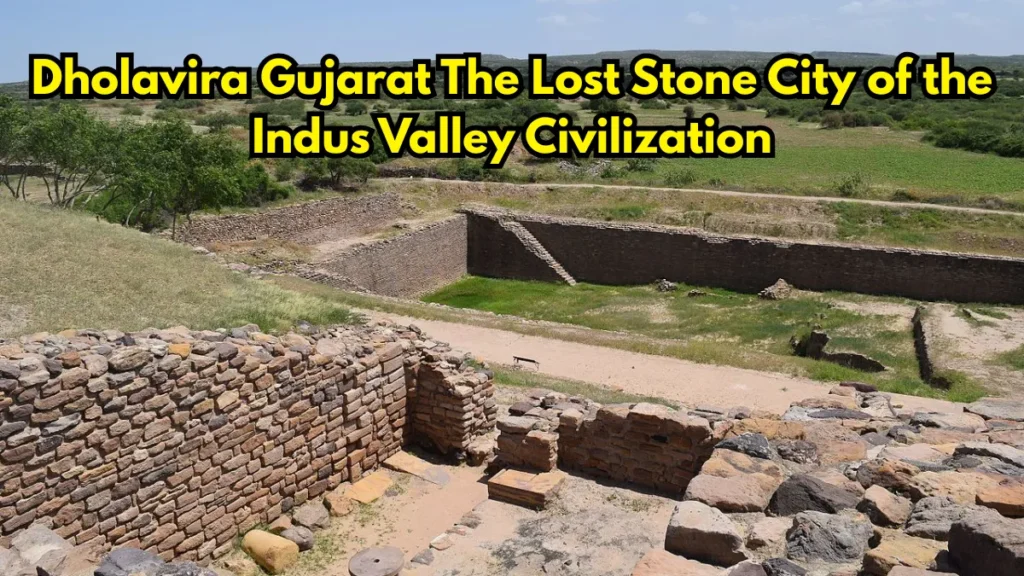
Dholavira Gujarat is one of the most important archaeological sites in India and a remarkable example of the advanced Indus Valley Civilization. Located in the arid region of Kutch, this ancient city tells the story of a highly developed urban culture that existed more than 4,500 years ago. From sophisticated water systems to well-planned streets and massive stone structures, Dholavira stands as a symbol of human intelligence, planning, and survival in harsh desert conditions.
This historic site attracts historians, archaeologists, students, and travelers from all over the world who wish to understand India’s ancient past in greater depth.
Introduction to Dholavira Gujarat
Dholavira Gujarat is situated on Khadir Bet, an island in the Great Rann of Kutch in western India. It lies between the seasonal streams Mansar and Manhar, which once provided water to the settlement. The city was one of the five largest urban centers of the Indus Valley Civilization, alongside Harappa, Mohenjo-daro, Ganeriwala, and Rakhigarhi.
What makes Dholavira unique is its excellent state of preservation and its exceptional town planning. The site provides clear evidence of how early humans mastered architecture, engineering, water conservation, and social organization.
Discovery and Excavation History
The site of Dholavira Gujarat was discovered in 1967 by archaeologist Jagat Pati Joshi of the Archaeological Survey of India. Large-scale excavations began in 1990 under the leadership of R. S. Bisht and continued for more than a decade.
Through systematic excavation, researchers uncovered detailed information about the city’s layout, lifestyle, trade practices, and technological skills. The findings changed the global understanding of the Indus Valley Civilization and proved that it was far more advanced than previously believed.
Historical Timeline of Dholavira
The history of Dholavira Gujarat is divided into seven cultural stages that show its rise, decline, and transformation.
The city was established around 3000 BCE during the Early Harappan phase. It reached its peak between 2500 BCE and 1900 BCE during the Mature Harappan period. After that, climatic changes, declining trade, and water shortages slowly led to its decline.
Despite these challenges, Dholavira remained inhabited longer than many other Harappan cities, showing the resilience of its people.
Urban Planning and City Layout
One of the strongest features of Dholavira Gujarat is its brilliant urban planning. The city was divided into three main parts.
The Citadel
The citadel was the most protected and elevated area of the city. It likely housed administrators, rulers, and important officials. Massive stone walls surrounded this section, reflecting political authority and security.
The Middle Town
The middle town served as a transitional area between the citadel and the lower town. It contained residential buildings, workshops, and public spaces.
The Lower Town
The lower town was the largest section, where common people lived. It included houses, streets, drainage systems, and marketplaces arranged in a grid pattern.
This three-tier city planning shows a strong administrative system and clear social organization.
Advanced Water Management System
The water management system of Dholavira Gujarat is considered one of the greatest engineering achievements of the ancient world.
The city was built in a region with very little rainfall, yet its inhabitants created an efficient system to store every drop of water.
Large reservoirs, step tanks, channels, and dams were carved directly into stone. Rainwater and seasonal stream water were carefully collected and stored for use throughout the year.
Some reservoirs were as large as modern swimming pools, proving that water conservation was central to life in Dholavira.
Architecture and Building Techniques
Unlike many Harappan cities that used baked bricks, Dholavira Gujarat mainly used stone for construction. Limestone and sandstone blocks were cut precisely and fitted without mortar.
The buildings included:
Large gateways
Massive fortification walls
Multi-room houses
Public halls and platforms
The architectural style shows strength, durability, and advanced craftsmanship.
The Famous Dholavira Signboard
One of the most important discoveries at Dholavira Gujarat is the large sandstone signboard found near the northern gate of the citadel.
The sign contains ten large symbols of the Indus script, each nearly 30 centimeters high. This is the longest and clearest inscription ever found from the Harappan civilization.
Although the script remains undeciphered, the signboard suggests the existence of formal writing, public communication, and possibly administrative announcements.
Economic Life and Trade
Dholavira Gujarat was a major center of trade and commerce. Archaeological evidence shows that the city was connected with both inland and overseas trade networks.
Artifacts found at the site include:
Beads made of carnelian and agate
Copper tools and ornaments
Shell bangles
Pottery with geometric designs
Trade links existed with Mesopotamia, Oman, Bahrain, and other Harappan cities. The city’s location near the Arabian Sea helped facilitate maritime trade.
Social Life and Culture
The people of Dholavira Gujarat followed an organized and disciplined lifestyle. Their society emphasized cleanliness, planning, and community living.
Houses were designed with proper ventilation and drainage. Streets were wide and straight. Public spaces indicate gatherings, ceremonies, and administrative activities.
The absence of palaces or grand temples suggests a society based more on collective governance rather than kingship.
Religious Beliefs and Practices
While no clear temples have been found, evidence suggests that the people of Dholavira practiced nature-based worship.
Fire altars, symbolic objects, and ritual platforms indicate spiritual practices linked to natural forces such as water, fire, and the sun.
The civilization appears to have focused more on harmony with nature than on monumental religious structures.
Art, Craft, and Technology
Craftsmanship played a major role in Dholavira Gujarat. Skilled artisans produced finely polished beads, seals, tools, and decorative items.
Bead-making workshops reveal complex drilling techniques using stone tools. Pottery styles show artistic expression and standardization.
Metalworking, especially in copper and bronze, reflects strong technological knowledge.
Environmental Adaptation and Sustainability
One of the most inspiring aspects of Dholavira Gujarat is its sustainable living model.
The inhabitants adapted perfectly to their environment by:
Harvesting rainwater
Using local stone materials
Building climate-friendly houses
Managing resources efficiently
These methods allowed the city to survive for centuries despite extreme desert conditions.
Decline of Dholavira
The decline of Dholavira Gujarat was gradual rather than sudden.
Major reasons include:
Reduced monsoon rainfall
Drying of nearby rivers
Decline in trade routes
Environmental stress
As water resources became scarce, people slowly migrated to more fertile regions. By around 1500 BCE, the city was completely abandoned.
UNESCO World Heritage Site Status
In 2021, Dholavira Gujarat was officially declared a UNESCO World Heritage Site.
This recognition highlighted its global importance as a unique example of early urban civilization and sustainable water management.
The UNESCO status has increased international attention and strengthened conservation efforts.
Visiting Dholavira Gujarat Today
Today, Dholavira is open to tourists and history lovers. The site is maintained by the Archaeological Survey of India and includes walkways, information boards, and viewing platforms.
Best Time to Visit
The best time to visit Dholavira Gujarat is between October and March, when the weather is pleasant.
How to Reach
By road: Well connected from Bhuj
By rail: Nearest railway station is Bhuj
By air: Bhuj Airport is the closest airport
The journey through the white desert of Kutch adds to the overall experience.
Nearby Attractions
Visitors to Dholavira Gujarat can also explore nearby attractions such as:
The Great Rann of Kutch
Kutch Desert Wildlife Sanctuary
Kala Dungar
Traditional villages of Kutch
These destinations provide cultural richness and natural beauty alongside historical exploration.
Importance of Dholavira in Indian History
Dholavira Gujarat holds a special place in Indian history because it proves that advanced urban life existed in the Indian subcontinent thousands of years ago.
The site showcases:
Early city planning
Scientific water management
Organized governance
International trade networks
It challenges the idea that ancient civilizations lacked technical knowledge.
Educational and Research Value
For students and researchers, Dholavira Gujarat serves as a living classroom.
It helps in understanding:
Urban evolution
Climate adaptation
Ancient engineering
Social organization
The site continues to offer new insights through ongoing research and studies.
Preservation and Conservation Efforts
Preserving Dholavira is essential for future generations. Conservation teams work to protect structures from erosion, tourism pressure, and climate damage.
Sustainable tourism practices are encouraged to maintain the site’s authenticity and historical value.
Also read: Dholavira: Complete History, Discovery, Civilization, and Importance
Conclusion
Dholavira Gujarat is not just an archaeological site but a powerful reminder of human creativity, resilience, and intelligence. From its water reservoirs and stone architecture to its advanced planning and trade systems, the city represents one of the greatest achievements of the ancient world.
As one of the finest legacies of the Indus Valley Civilization, Dholavira continues to educate, inspire, and connect modern society with a forgotten yet extraordinary chapter of human history.